Jurassic Park
Steven Spielberg / ILM / Dennis Muren / Stan Winston Studio · 1993
The breakthrough film: Gallimimus stampede and T-Rex pursuit sequences that ended the stop-motion era
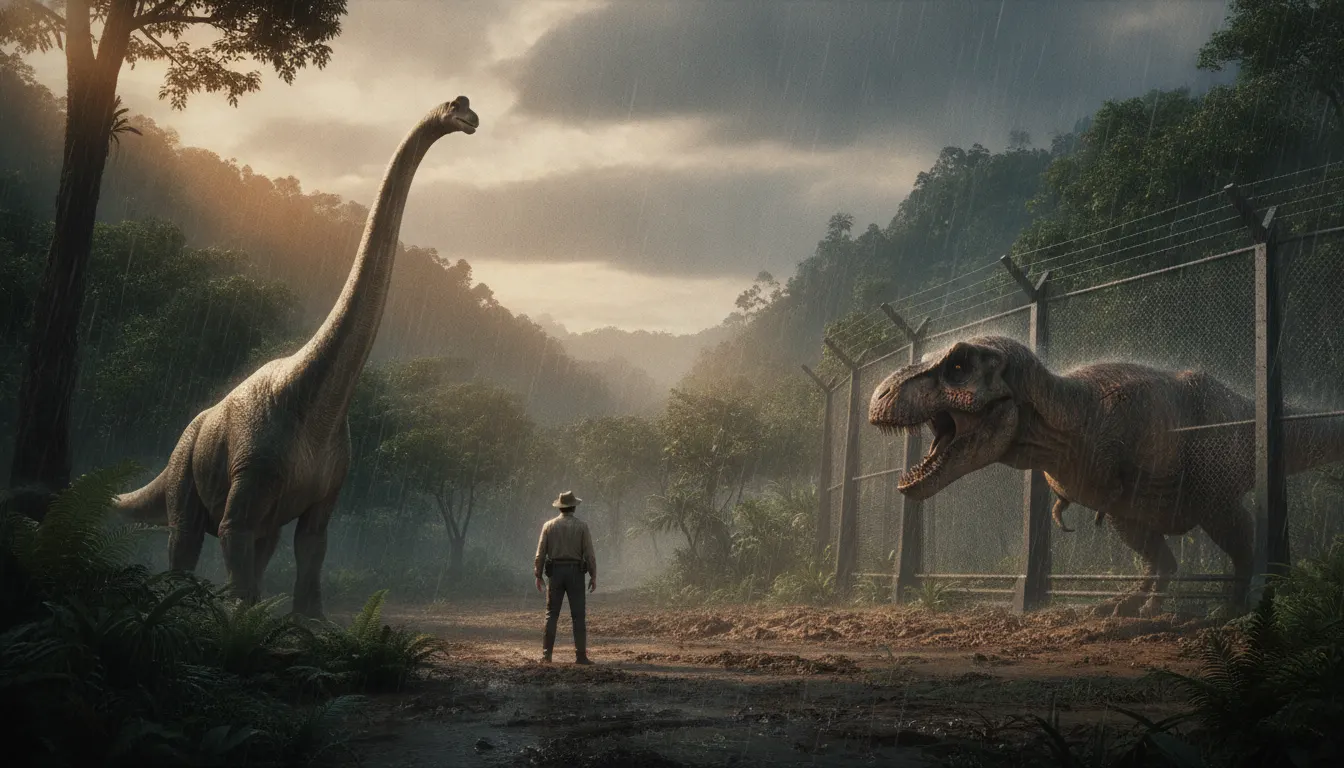
Spielberg Jurassic Park 1993 CGI dinosaur breakthrough. Brachiosaurus reveal, T-rex paddock rain, ILM photoreal-creature VFX milestone, John Williams orchestral.
The moves a human crew would use to get here. Cue applies them for you, and knowing their names is how you ask for a change.
CG elements rendered with exact focal length, f-stop, and depth of field values from production DP Dean Cundey's physical camera data
Stan Winston practical animatronics and ILM digital elements composited with identical lighting and grain to make edit points undetectable
Steve Williams and Mark Dippé's custom motion tools at ILM generating biologically plausible muscle and skin deformation, the first of their kind at feature film resolution
Jack Horner-advised color schemes based on 1993 theories of reptilian coloration, producing the neutral brown-grey T-Rex and grey-green Raptor palette that defined popular dinosaur imagination
CG frames processed with matched film grain passes to blend with photochemically developed 35mm plate photography, resisting the 'too clean' digital tell
Water interaction on dinosaur skin surfaces rendered in the T-Rex approach sequences, adding environmental complexity that verified photoreal surface material response
Steven Spielberg's Jurassic Park (1993, VFX supervisor Dennis Muren at Industrial Light & Magic, additional practical effects by Stan Winston Studio) represents the single most consequential moment in the history of computer-generated imagery in motion pictures. ILM's CG dinosaur sequences -- originally planned as minimal inserts supporting Stan Winston's practical animatronics -- grew to encompass scenes that convinced Spielberg and producer Kathleen Kennedy that CGI could replace practical effects entirely for certain shots.
The specific breakthrough came with the Gallimimus stampede sequence and the T-Rex pursuit scene. Dennis Muren's team developed a CG dinosaur pipeline built on Alias PowerAnimator software, combined with custom procedural motion tools written by Steve Williams and Mark Dippé. Prior to 1993, CGI was used for rigid or liquid surfaces; Jurassic Park was the first production to render photo-convincing photoreal organic muscle and skin movement at feature-film resolution.
ILM's approach was grounded in the premise that CGI elements must be treated with identical photographic logic to practical elements. DP Dean Cundey's real-camera data -- lens focal lengths, f-stops, depth of field at specific distances -- was given to the CG team to match exactly. Motion blur, film grain, and practical location lighting were composited into CG frames rather than added as afterthoughts, creating the optical continuity that made audiences unable to identify the edit point between practical Winston animatronics and CG.
The dinosaur color schemes were developed with paleontological consultant Jack Horner, reflecting 1993's then-current theories about reptilian coloration. T-Rex skin uses a neutral brown-grey with subsurface warmth in the dewlap; Velociraptors have the grey-green of a monitor lizard. These choices have become the canonical 'what dinosaurs looked like' reference for a generation, making the Jurassic Park color palette inseparable from popular palaeontological imagination.
Jurassic Park's success ended the stop-motion era of creature effects and launched the modern VFX industry. ILM's dinosaur tools were adapted into the Cinesite and MPC pipelines; the film's benchmark set the expectation for photoreal creature work for 30 years. The franchise continued through The Lost World (1997), Jurassic Park III (2001), and the Jurassic World series (2015-2022).
Phil Tippett, who had planned to lead the film's stop-motion creature work (having built ILM's stop-motion department on Star Wars), became central to a pivotal production decision in 1992: when ILM showed Spielberg the CGI dinosaur tests, Tippett reportedly said 'I think I'm extinct.' Rather than being replaced, Tippett was retained as 'dinosaur supervisor,' bridging the two approaches and ensuring that the CGI team understood animal motion and weight from a creature animator's perspective. The final film used Tippett's practical animatronic and Winston's physical puppetry for close-up interaction shots, with ILM's CG reserved for wide shots and impossible angles -- a hybrid approach that made the integration seamless.
John Williams' score and Gary Rydstrom's Academy Award-winning sound design are inseparable from how the CGI aesthetic is perceived. The T-Rex's roar (a composite of elephant, tiger, and baby alligator sounds) and the brachiosaurus's calls were designed to give the silent CG models sonic mass and physical presence. Viewers' perception of the dinosaurs as real is partly optical and partly acoustic -- the sound design fills the physical presence that digital imagery cannot fully simulate.
Steven Spielberg / ILM / Dennis Muren / Stan Winston Studio · 1993
The breakthrough film: Gallimimus stampede and T-Rex pursuit sequences that ended the stop-motion era
Steven Spielberg / ILM · 1997
Sequel expanding the CGI dinosaur roster and advancing herd behavior simulation beyond the original
Joe Johnston / ILM / Stan Winston Studio · 2001
Third entry introducing the Spinosaurus and demonstrating ILM's evolution of the original pipeline
Colin Trevorrow / ILM · 2015
Franchise reboot deliberately invoking the 1993 visual nostalgia while using modern rendering infrastructure
J.A. Bayona / ILM · 2018
Gothic horror inflection of the franchise aesthetic demonstrating the palette's adaptability to darker registers
BBC Studios / MPC / David Attenborough · 2022
Nature documentary using modern photoreal dinosaur rendering that explicitly updates the Jurassic Park visual legacy
A Look is not a filter. It is a set of stored decisions the pipeline reads before it makes a single frame, so two videos in the same Look actually match.