The Grinch
Illumination Entertainment / Scott Mosier / Yarrow Cheney · 2018
Primary reference: Seuss IP translated into Illumination 3D with Benedict Cumberbatch voice performance
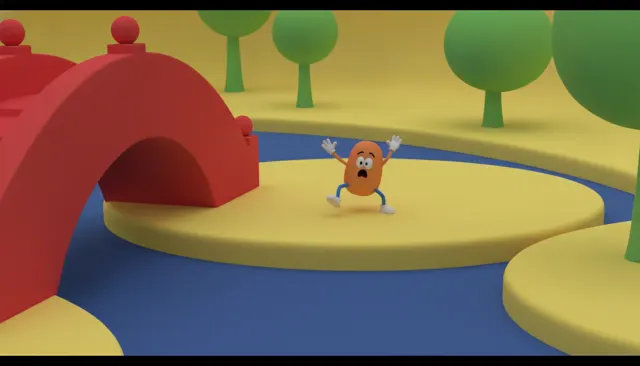
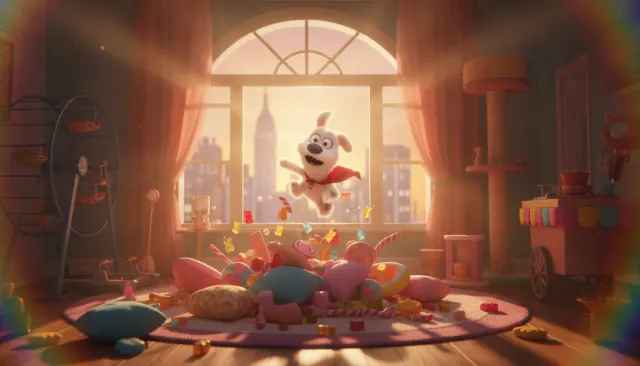
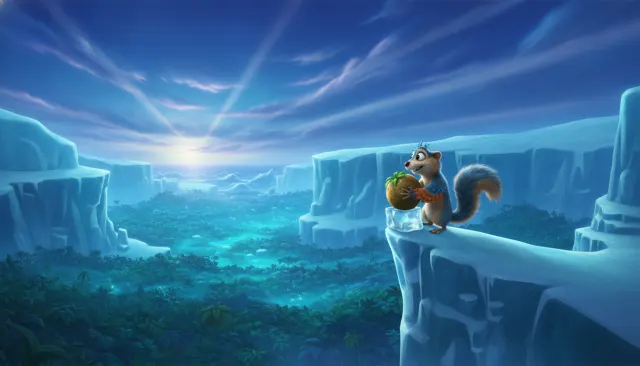
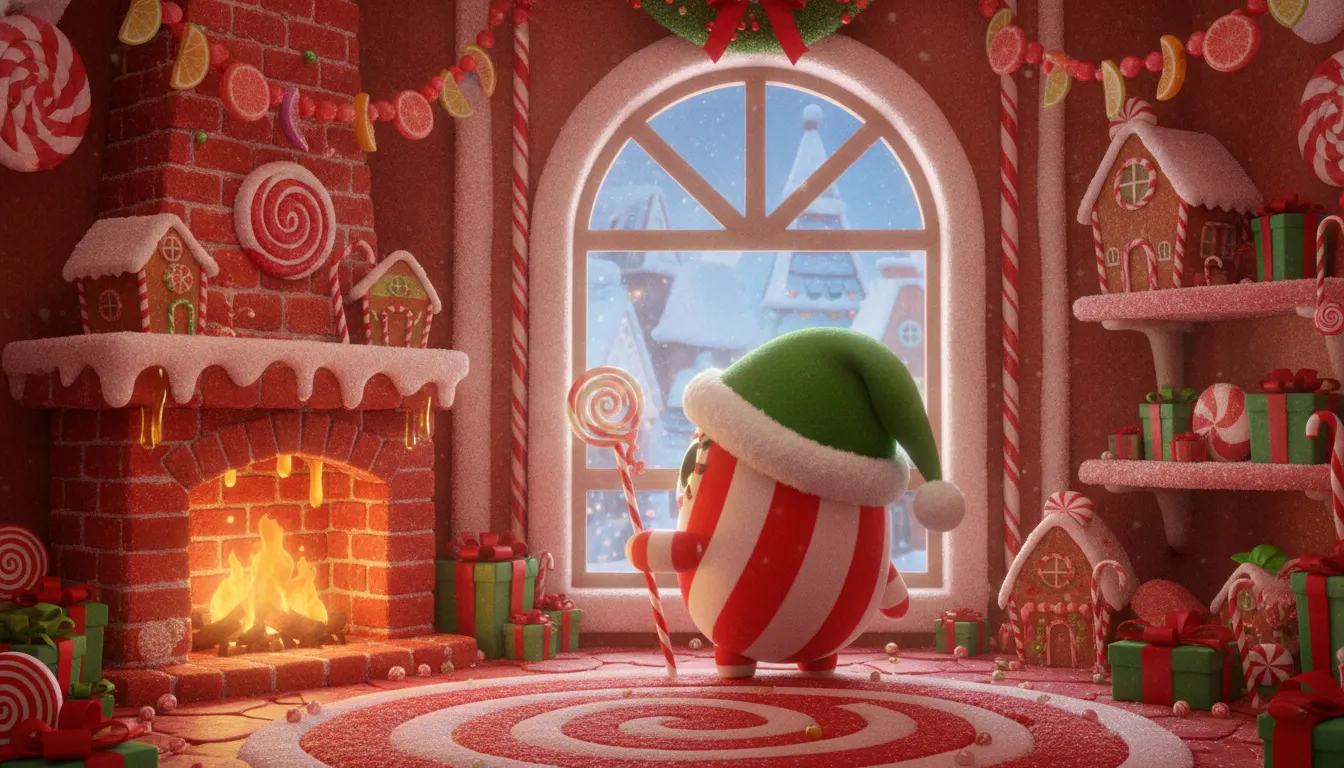
Illumination Grinch CG. Whoville confectionary palette, candy-cane stripes, snow-deep environment, syrupy holiday lighting.
The moves a human crew would use to get here. Cue applies them for you, and knowing their names is how you ask for a change.
Buildings, rooftops, and chimneys at impossible angles and spiral forms referencing Dr. Seuss's graphic eccentricity in 3D volumetric form
Exaggerated brow movement and facial performance in the tradition of theatrical mask work, carrying emotional narrative without dialogue
Deep forest green against candy red with warm gold resolution lighting as a color-coded emotional arc structure
Whoville in warm amber-gold tones versus the Grinch's cave in cool grey-blue, using color temperature as exclusion/belonging metaphor
Illumination's signature smooth, compressed character proportions with specular highlights suggesting toy-like material quality
Fur shading and simulation adding physical warmth to the Grinch character, softening his graphic grotesqueness into sympathetic vulnerability
Illumination Entertainment's The Grinch (2018, directors Scott Mosier and Yarrow Cheney) represents a specific sub-aesthetic within the broader Illumination house style: the studio's Despicable Me franchise sensibility applied to a pre-existing IP with strong graphic design heritage. Dr. Seuss's original 1957 book and the 1966 Chuck Jones television special both had a deliberately crude, jagged line quality; Illumination's 3D reinterpretation preserved the graphic eccentricity while layering in the studio's characteristic rounded softness.
The Grinch himself uses an elongated, somewhat simian body type with a pear-shaped torso and expressive hands -- closer to the Chuck Jones silhouette than a naturalistic humanoid. Fur simulation gives the character tactile warmth that the original 2D version couldn't achieve. Facial expressions are broad and theatrical, using exaggerated brow movement in the tradition of theatrical mask performance. The decision to cast Benedict Cumberbatch required calibrating the character to carry his vocal performance's patrician brittleness.
Whoville's architecture in Illumination's version is pastel-saturated and gravity-defying -- buildings lean at impossible angles, rooftops curl like holiday ribbons, and chimneys twist in spirals. The production design team under Eric Guillon referenced candy shop architecture and Victorian ornament for the Who aesthetic, while making each house distinctly characterful. Snow in Whoville is rendered with Illumination's signature 'good enough physics' approach: convincingly fluffy without ILM-grade procedural simulation.
The film's palette is built on the classic Christmas complementary: deep forest greens against candy reds, with warm gold light as the emotional anchor for the film's resolution. The Grinch's cave on Mount Crumpit uses deliberate color contrast -- cool grey-blue isolation against the warm town below -- as visual metaphor for his exclusion.
The Grinch shares Illumination's preference for round, compressed character forms and high-gloss surface rendering, but differs from Minions and Despicable Me in its more textured, weathered aesthetic -- the Grinch's fur, Whoville's worn stonework, and Max the dog's scruffy coat all push against the studio's usual high-key cleanliness.
Max's character design is a masterclass in Illumination's approach to animal characters: small enough to be visually subordinate to the Grinch but expressive enough to carry emotional counterpoint. His scruffy, slightly pitiful appearance uses the same fur system as the Grinch but with different parameter settings -- sparse rather than dense, grey-tan rather than green -- and his large eyes and exaggerated expressions reference the silent film performance tradition of Buster Keaton. Max carries more emotional truth in most scenes than the Grinch himself.
The Grinch grossed $511 million worldwide against a $75 million budget, confirming Illumination's strategy of applying its house style to IP with proven cultural recognition. Universal/Illumination's model -- small team, efficient production, licensed pre-existing IP -- produces the highest profit-to-cost ratio of any major animation studio. The visual style is a component of this efficiency: Illumination's rounded, high-gloss rendering pipeline was designed for speed and repeatability as much as beauty.
Illumination Entertainment / Scott Mosier / Yarrow Cheney · 2018
Primary reference: Seuss IP translated into Illumination 3D with Benedict Cumberbatch voice performance
Illumination Entertainment / Pierre Coffin / Chris Renaud · 2010
Studio's franchise origin establishing the rounded-forms gloss-surface house style that Grinch adapts
Illumination Entertainment / Chris Renaud · 2012
Earlier Seuss IP adaptation by Illumination showing the studio's approach to Seussian graphic eccentricity
Universal Pictures / Bo Welch · 2003
Live-action Seuss adaptation demonstrating the IP's visual translation challenges that Illumination's 3D approach resolved
Chuck Jones / Warner Bros. / Dr. Seuss · 1966
Originating animated version whose graphic character design and color vocabulary Illumination's 3D deliberately references
Illumination Entertainment / Nintendo · 2023
Most recent major Illumination release demonstrating how the house style adapts to pre-existing IP visual vocabularies
A Look is not a filter. It is a set of stored decisions the pipeline reads before it makes a single frame, so two videos in the same Look actually match.