Despicable Me
Illumination Entertainment / Pierre Coffin / Chris Renaud · 2010
Franchise origin introducing the Minion design and establishing Illumination's primary-palette house style
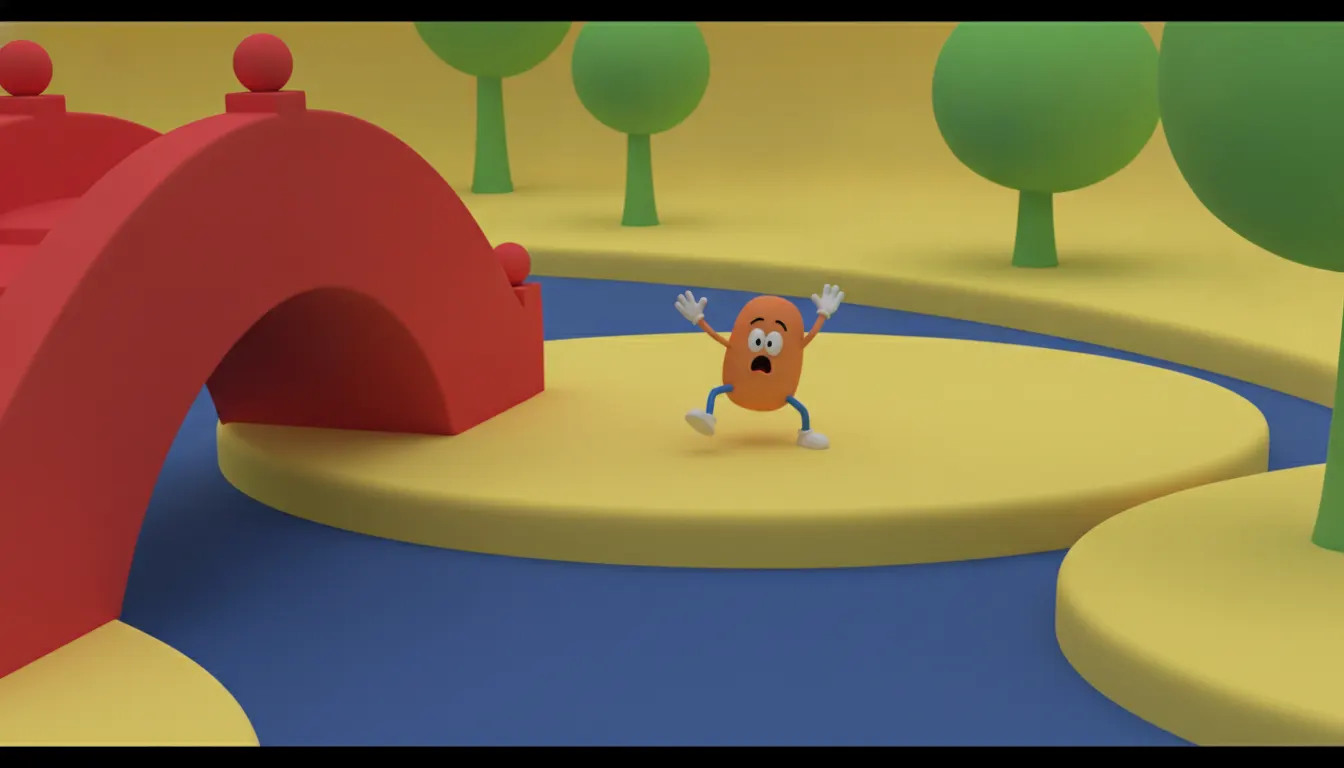
Illumination Entertainment flat-shaded CG. Despicable Me and Minions. Saturated primary colors, simple shapes, slapstick timing.
The moves a human crew would use to get here. Cue applies them for you, and knowing their names is how you ask for a change.
Pill-shaped body, circular goggles, and rectangular mouth readable as a complete identity from silhouette alone before surface detail is processed
Pantone 109 C-approximate yellow engineered for maximum visibility across screen, print, and physical product simultaneously
Character surfaces rendered with low subsurface scattering to maintain flat graphic-design clarity across all lighting conditions
Warm yellow body against grey overalls providing sufficient contrast without requiring outline strokes
Goggle count, hair style, and minor accessories as the only differentiation variables, enabling a cast of dozens while maintaining the core identity
Character forms verified for balloon, plush, and embroidery reproduction before finalization, ensuring commercial lifecycle is built into the design
Illumination Entertainment's Minion characters -- introduced in Despicable Me (2010, directed by Pierre Coffin and Chris Renaud) and given their own franchise origin film in Minions (2015, directed by Kyle Balda and Pierre Coffin) -- became one of the most globally recognized character designs of the 2010s, appearing on over $1 billion in licensed merchandise. The Minion aesthetic prioritizes simplified, primary-color shapes that print, embroider, and inflate into balloon form without losing identity.
Minions use a deliberately limited design vocabulary: a pill-shaped body, one or two circular goggles, a wide rectangular mouth, and grey overalls as the only variable surface. This extreme simplicity is a strategic design decision -- the form reads at low resolution, at small sizes on a phone notification icon, and as a Halloween costume. Pierre Coffin designed the characters to be 'shape-first': the silhouette communicates identity before any surface detail is processed.
The Minion yellow is a specific high-chroma warm yellow (roughly matching Pantone 109 C) that carries maximum visibility across display, print, and physical product simultaneously. The yellow-against-grey overalls combination provides natural contrast without requiring outlines. Supporting characters and environments in the Despicable Me universe use a similarly primary-driven palette: Gru's purple-grey, Vector's orange, Vector's father's rich brown-gold.
Despite being 3D CGI, Minion character surfaces are rendered with minimal subsurface scattering -- they read as flat-lit, slightly rubberized forms rather than organic skin. This is intentional: it maintains the flat graphic-design clarity of the character across all lighting conditions. Environments have more traditional physically-based rendering, which creates a slight graphic-vs-environment contrast that keeps Minions visually dominant in any scene.
The Minion aesthetic's reach into internet meme culture ("Minion memes" peaked on Facebook circa 2012-2016) is inseparable from the visual design: the simplified face with its single expression range and the primary palette reproduced cleanly in screenshot thumbnails. The Minions Rise of Gru (2022) grossed over $939 million globally, confirming the endurance of the visual identity.
Pierre Coffin invented Minionese -- the nonsense language Minions speak, composed of Italian, Spanish, French, English, and invented sounds -- specifically because a fully English-speaking Minion would compete with Gru for audience attention. The decision to keep Minions linguistically opaque was directly tied to their visual design philosophy: like the visual simplicity, the audio simplicity kept them as a comic texture supporting the main narrative rather than replacing it. The aesthetic and the voice design reinforce each other.
The Minion design's simplicity was also an economic decision. Illumination's co-production model between Universal Pictures and Illumination Paris involves smaller teams than Pixar or DreamWorks. The Minion's limited articulation, flat primary textures, and repeatable body geometry made them efficient to animate in large numbers -- the factory floor scenes in Despicable Me featuring dozens of simultaneous Minions would have been budget-prohibitive with more complex character designs.
Illumination Entertainment / Pierre Coffin / Chris Renaud · 2010
Franchise origin introducing the Minion design and establishing Illumination's primary-palette house style
Illumination Entertainment / Pierre Coffin / Chris Renaud · 2013
Expansion of Minion cast and merchandise ecosystem, establishing the design's global licensing scale
Illumination Entertainment / Kyle Balda / Pierre Coffin · 2015
Standalone origin film placing Minion design in 1960s-1970s period settings and expanding the color palette range
Illumination Entertainment / Pierre Coffin / Kyle Balda · 2017
Third mainline entry maintaining core Minion design while introducing sibling Dru as a design variant
Illumination Entertainment / Kyle Balda · 2022
$939M global gross confirming the endurance of the visual identity 12 years after the original
Illumination Entertainment / Chris Renaud · 2024
Most recent franchise entry demonstrating the design's commercial longevity and unchanged core visual system
A Look is not a filter. It is a set of stored decisions the pipeline reads before it makes a single frame, so two videos in the same Look actually match.