The Secret Life of Pets
Illumination Entertainment / Chris Renaud / Yarrow Cheney · 2016
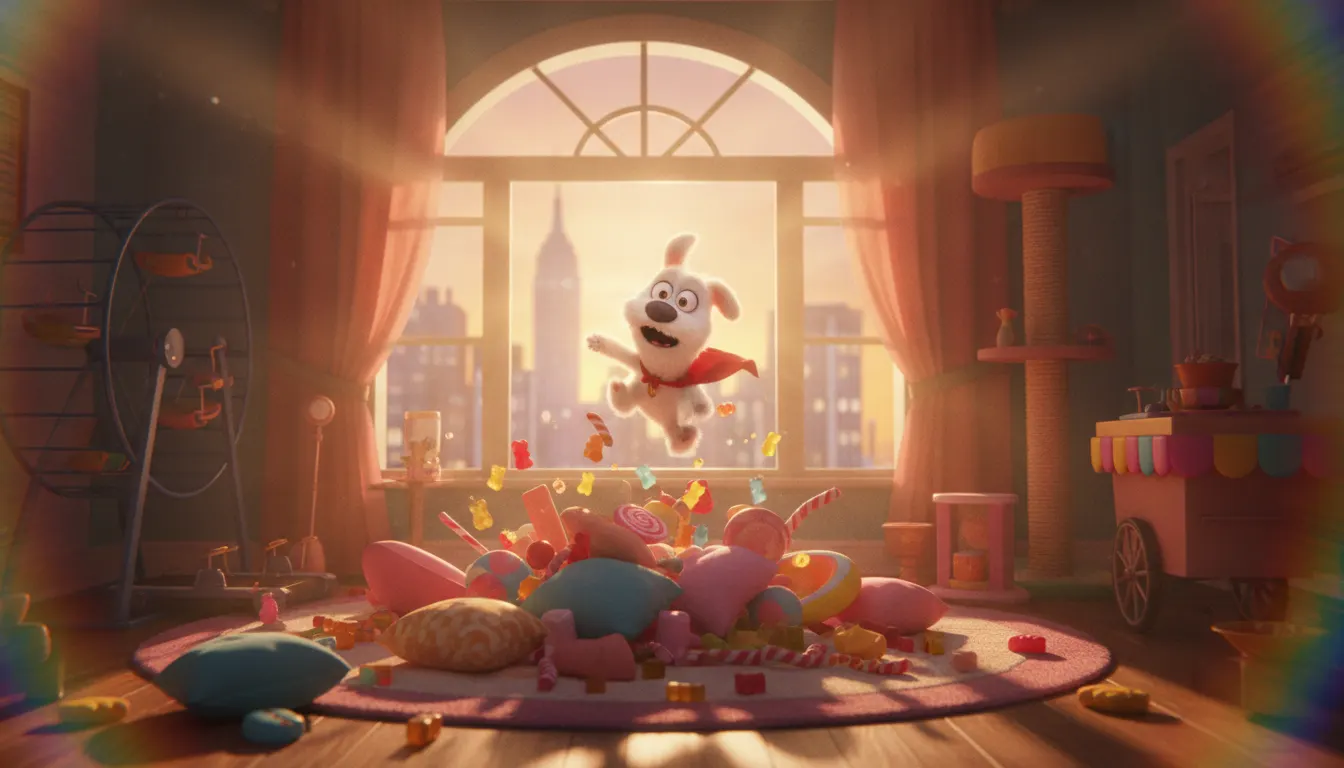
Primary reference establishing the warm Upper West Side domestic animal aesthetic, $875M global gross
Illumination Secret Life of Pets CG. NYC apartment stylization, animal-eye-level POV, broad slapstick, candy palette.
The moves a human crew would use to get here. Cue applies them for you, and knowing their names is how you ask for a change.
Soft amber and cream ambient fill in apartment interiors encoding safety and familiarity as a visual grammar against cooler exterior danger spaces
Real Upper West Side block typologies, Central Park dog runs, and MTA subway cars modeled as references, grounding fantasy in recognizable reality
Species-readable body types with minimal anthropomorphic distortion -- enlarged eyes and rounded proportions without losing the essential read of real breeds
Grooming tools developed for character-scale fur simulation, giving dog and cat characters tactile warmth beyond flat-shaded fur cards
Consistent warm indoors / cool outdoors color temperature encoding the safety-vs.-adventure spatial logic of the narrative
Domestic environments detailed precisely enough that urban apartment dwellers recognize their own layout conventions, making the animal fantasy feel earned
The Secret Life of Pets (2016, directors Chris Renaud and Yarrow Cheney, Illumination Entertainment) offered a specific variation on the Illumination house style: a contemporary New York City setting rendered with warm interior domesticity, animal character designs that balance anatomical plausibility with expressive anthropomorphism, and a comedy-of-recognition premise that required environments to feel genuinely familiar to urban apartment dwellers.
Unlike the fantasy villages of Despicable Me or the Seussian landscapes of Dr. Seuss adaptations, The Secret Life of Pets is set in a highly recognizable Upper West Side Manhattan. Production designer Eric Guillon's team modeled actual New York City block typologies: pre-war brownstone exteriors, Central Park landscapes, Brooklyn bridges, sewers. The environments use warm, slightly heightened lighting that makes domestic interiors feel safe and inviting -- the visual register of a children's book about home.
The film's animal designs walk a specific line: readable species identity (Max is instantly a Jack Russell terrier, Chloe is recognizably a tabby cat) with sufficient anthropomorphism to carry narrative expression. Eye scale is slightly enlarged for readability, and body proportions are somewhat compressed and rounded in the Illumination manner. The real challenge was dog fur -- Illumination's grooming team developed new tools for individual-strand fur simulation at character scale.
The visual premise -- what do pets do when their owners leave for work -- requires environments that viewers recognize as their own domestic spaces. Art direction was deliberately photographically researched: real Upper West Side apartment layouts, real dog run configurations in Central Park, real New York subway car designs. This photographic grounding gives the fantasy elements (animals talking, holding parties) contrast against the real.
Interiors are consistently warm-lit (soft amber, cream walls, warm hardwood) while the outside world uses cooler light. This temperature grammar encodes the safety-vs.-danger spatial logic of the narrative, making visual storytelling work without dialogue for young audiences.
The Secret Life of Pets 2 (2019, director Chris Renaud) expanded the geographic palette to include a farm setting and a circus, testing the domestic aesthetic against new environments while maintaining the core animal-character design system.
New York City functions as a co-protagonist in The Secret Life of Pets: Central Park's Bethesda Terrace, the High Line, the Brooklyn Bridge, and the East River sewers are all rendered with enough geographic fidelity that Manhattan residents identify their specific neighborhoods on screen. This real-city specificity creates a visual contract with the audience -- these animals exist in YOUR city, potentially in YOUR building. The film's fantasy premise (animals living secret lives while owners work) depends on the world being recognizable enough to make the premise feel adjacent to documentary.
The film's casting of specific dog and cat breeds -- Jack Russell terrier, tabby cat, Pomeranian, Dachshund, Bulldog -- uses breed stereotype as shorthand for character type without requiring explicit setup. Gidget the Pomeranian's fluffy white appearance communicates her naivety before she speaks; Mel the Pug's wrinkled face and snorting suggest anxious energy; Duke the mongrel's size signals his outsider status. The visual shorthand of breed recognition compresses character establishment that a purely invented design would require scenes to achieve.
Illumination Entertainment / Chris Renaud / Yarrow Cheney · 2016
Primary reference establishing the warm Upper West Side domestic animal aesthetic, $875M global gross
Illumination Entertainment / Chris Renaud · 2019
Sequel extending the visual system to farm and circus settings while maintaining the core animal character design
Illumination Entertainment / Pierre Coffin / Chris Renaud · 2010
Studio's house style origin with shared art director Eric Guillon establishing the rounded-form foundation
Pixar / Andrew Stanton · 2003
Precedent animal-character film with warm color temperature and recognizable real-world environment grounding
Disney Animation / Chris Williams / Byron Howard · 2008
Dog-lead animation with similar domestic-pet premise, earlier approach to the same genre conventions
Ambient Entertainment · 2019
European animated film working in the same domestic-pets-anthropomorphized genre for direct aesthetic comparison
A Look is not a filter. It is a set of stored decisions the pipeline reads before it makes a single frame, so two videos in the same Look actually match.