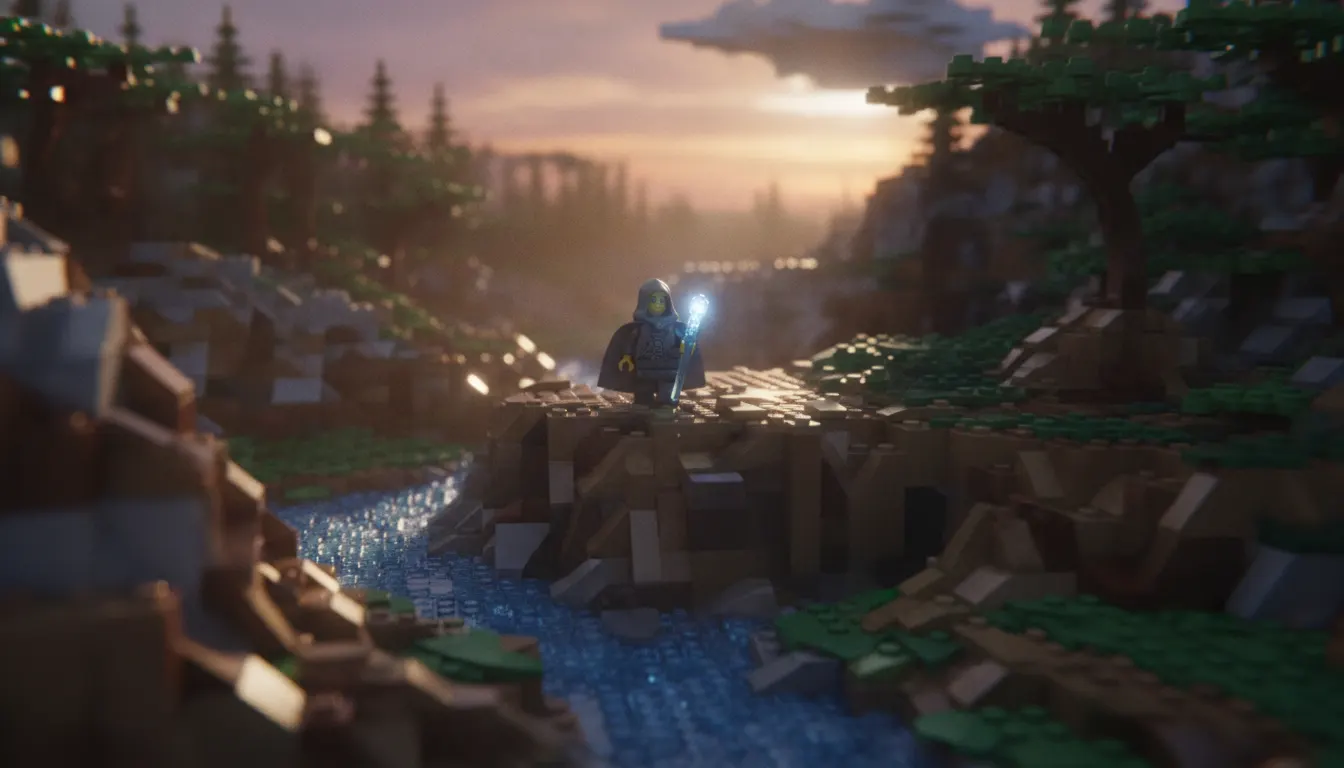
The LEGO Movie
Warner Bros. / Animal Logic / Phil Lord / Christopher Miller · 2014
Defining artistic peak: CGI rendered to look like practical stop-motion brick film, grossing $469M worldwide
Lego Movie stylized 3D-as-stop-motion. Brick-built world with snap-fit characters, slight stop-motion judder, plastic specular highlight.
The moves a human crew would use to get here. Cue applies them for you, and knowing their names is how you ask for a change.
Render-accurate subsurface scattering calibrated to polylactic ABS plastic rather than organic materials, giving bricks their specific semi-translucent warmth
Fingerprints, scuff marks, and age wear added to every brick surface to simulate well-played-with physical toys rather than freshly unboxed product
Depth of field calibrated to 100mm macro photography at close range, giving the animation the focus characteristics of actual brick film stop-motion photography
Fire, water, smoke, and all environmental effects built from actual LEGO piece types, maintaining total-world consistency of the brick universe logic
Five-point minifigure articulation limitations used as comedy tools rather than worked around, turning the constraints into the film's comedic visual language
Faces, text labels, and graphic elements rendered as flat printed sticker surfaces on 3D geometry, referencing the actual LEGO product manufacturing process
The LEGO aesthetic in 3D animation -- established first through video games (LEGO Star Wars, Traveller's Tales, 2005) and reaching its commercial and artistic peak with The LEGO Movie (2014, directors Phil Lord and Christopher Miller, Animal Logic) -- is one of the most distinctive and technically demanding stylized 3D looks in popular culture. The central challenge: render a CGI world that looks like it was filmed in stop-motion using actual LEGO bricks, even though it was created entirely with computers.
The LEGO Movie's production (Animal Logic, Sydney) spent extensive development time making the CGI look like physical plastic bricks under practical studio lighting. This required adding microscopic fingerprints, scuff marks, and age wear to every brick surface; rendering subsurface scatter in ABS plastic rather than organic materials; and using depth-of-field and lens blur calibrated to macro photography rigs rather than wide-angle cinema lenses. The result should feel like watching a very high-production-value brick film.
LEGO characters (minifigures) have only five points of articulation: head rotation, shoulder joints, and hip pivot. Animal Logic built an animation rig that honored these constraints while still achieving expressive performance. Characters cannot bend their knees, have fixed-claw hands, and can only look left-right rather than nod. Within these constraints, the animation team achieved remarkable expressiveness through timing, squash-and-stretch within parts, and comedic motion design that used the limitations as gags.
Every element of the LEGO Movie world, including water, fire, smoke, and laser beams, is built from actual LEGO pieces or printed sticker surfaces. Ocean waves are built from blue ripple-brick elements; explosions use trans-orange and trans-yellow flame pieces; clouds are white cloud bricks on grey stalk connectors. This total-environment consistency creates the film's unified worldview and provided the premise for its pop-culture satire.
Traveller's Tales' LEGO game series (2005-present) established a slightly different but related aesthetic: lower-fidelity but consistent brick logic with comedic pantomime animation that doesn't require voice acting. This game-specific sub-aesthetic, covering Star Wars, Harry Potter, Indiana Jones, Batman, and Marvel IPs, is the most widely experienced LEGO stylized 3D aesthetic globally.
Animal Logic (Sydney, Australia) faced a fundamental aesthetic paradox in producing The LEGO Movie: how do you make CGI look like stop-motion without the limitations of stop-motion? Real brick films have camera shake, focus breathing, and the specific quality of light bouncing off physical ABS plastic under tungsten studio lights. Animal Logic's solution was to build a custom lens simulation system that added physical camera artifacts -- micro-vibrations between frames, breathing focus, lens vignetting -- that were then composited as a final pass over the rendered frames. These artifacts are imperceptible on conscious examination but register subliminally as the 'weight' of physical photography.
The Everything is Awesome aesthetic -- warm, optimistic, and built on the premise that creativity solves problems -- is LEGO's brand philosophy rendered in visual form. This makes the LEGO stylized 3D aesthetic unusual among licensed visual identities: it can absorb any IP (Batman, Harry Potter, Star Wars, Minecraft) and make it feel LEGO rather than being absorbed by the source IP. The visual system is strong enough to be the dominant identity in any collaboration, which is why LEGO's IP partnerships have been commercially durable where most licensed game aesthetics are not.
Warner Bros. / Animal Logic / Phil Lord / Christopher Miller · 2014
Defining artistic peak: CGI rendered to look like practical stop-motion brick film, grossing $469M worldwide
Warner Bros. / Animal Logic / Chris McKay · 2017
Spin-off pushing the aesthetic into superhero genre satire with even denser brick-world environmental design
Warner Bros. / Animal Logic / Charlie Bean · 2017
Third theatrical LEGO film adding live-action wraparound framing device that explicitly referenced the physical toy origin
Traveller's Tales / LucasArts · 2005
Game-series origin establishing the pantomime-no-voice-acting approach that became the game aesthetic template for 20+ titles
Traveller's Tales / Warner Bros. Games · 2022
Most technically advanced LEGO game demonstrating the evolution of the game-specific aesthetic with voice acting and modern lighting
Fox / Endemol Shine · 2019
Physical LEGO construction competition whose challenge reveals and builds provide real-world brick aesthetic reference
A Look is not a filter. It is a set of stored decisions the pipeline reads before it makes a single frame, so two videos in the same Look actually match.