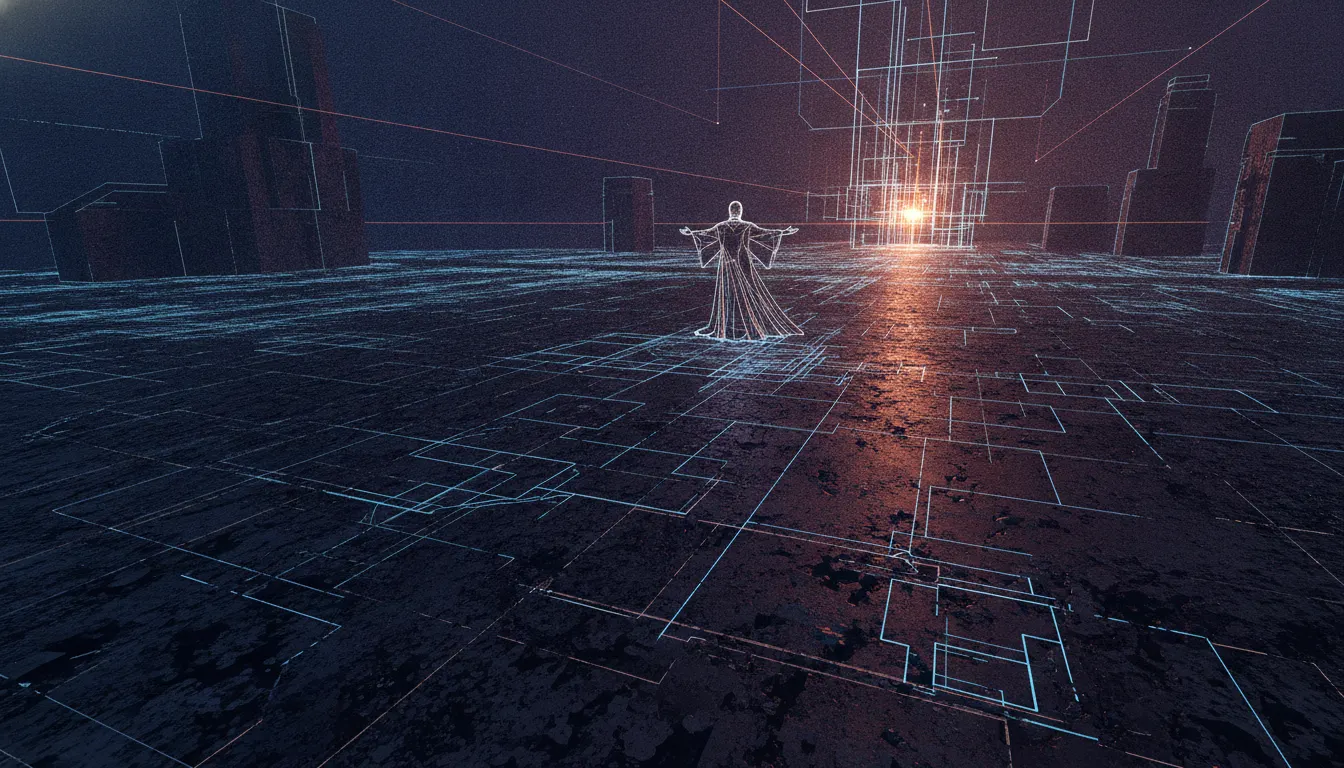
Tron , dir. Steven Lisberger
1982
vector world design by Moebius, Syd Mead, Peter Lloyd
Laser-etched vector aesthetic. Crisp single-pixel line plotted on raw substrate, hairline negative-space cutouts, computer-precision geometry.
The moves a human crew would use to get here. Cue applies them for you, and knowing their names is how you ask for a change.
200 paths, two-color (black/white) output
fill simulation: add diagonal line patterns inside solid shapes at 45 degrees, 3-5px spacing
duplicate white vector layer, apply Gaussian blur 2-4px, blend in Screen mode for Tron-style emission
fine perspective-receding grid at 5-10% opacity to suggest digital space
1px for detail lines, 2-3px for primary outlines, 4-5px for silhouette to mimic engraving depth
grain or acrylic texture composite at 20-30% multiply to add material warmth to monochrome vector
The laser-etched vector aesthetic presents imagery as if burned or cut into a uniform material - typically rendered in monochrome with clean, precise outlines, no fill gradients, and a sense that the image was produced by a controlled mechanical tool rather than a human hand or photographic lens. It combines the precision of vector drawing with the material warmth of physical engraving.
Laser cutting and engraving as an industrial process dates to 1965, when Kumar Patel at Bell Labs invented the CO2 laser, and the first practical CNC (computer-numerical-control) laser cutters entered industrial manufacturing in the early 1970s. Desktop laser engravers became affordable in the 2010s through companies like Glowforge (2015) and the open-source K40 Chinese CO2 laser community, bringing the aesthetic into maker and craft communities. The characteristic look of a laser-etched piece - fine parallel-line halftone hatching, crisp contour paths, and the brown-black char of engraved wood or acrylic - became a recognizable handcraft-meets-technology signature.
The cinematic crystallization of the vector aesthetic was Tron (1982, dir. Steven Lisberger, Walt Disney Pictures). The film's digital world - designed by Moebius (Jean Giraud), Syd Mead, and concept artist Peter Lloyd - rendered characters and environments as glowing outline geometry against black, echoing the vector graphics of arcade games like Battlezone (Atari, 1980) and Asteroids (Atari, 1979), which drew directly onto the screen as glowing vector beams using XY deflection circuits rather than raster scan. Tron Legacy (2010) revisited and updated the look with modern rendering but preserved the core monochrome-outline-on-black identity.
The vector-line aesthetic also derives from technical illustration traditions: engineering blueprints, patent drawings, and medical diagrams use clean single-weight contour lines to prioritize precise shape over photographic detail. The Bauhaus-era typography and grid system lent this precision to graphic design.
In contemporary motion graphics and thumbnail design the look is achieved through Illustrator or Inkscape live trace, Photoshop Find Edges filter with threshold, or dedicated vectorization tools like Vector Magic. The color palette is typically high contrast: white or yellow lines on black, or black char lines on cream/wood-grain warm background.
1982
vector world design by Moebius, Syd Mead, Peter Lloyd
1980
1979
2010
updated monochrome neon vector world
1955
linear title sequence design for _Man with the Golden Arm_ , precision-outline precursor
clean vector-style line art in print (1975-1988)
A Look is not a filter. It is a set of stored decisions the pipeline reads before it makes a single frame, so two videos in the same Look actually match.