Joan G. Stark (jgs) ASCII art collection (1990s-2000s)
hundreds of definitive works archived at chris.com
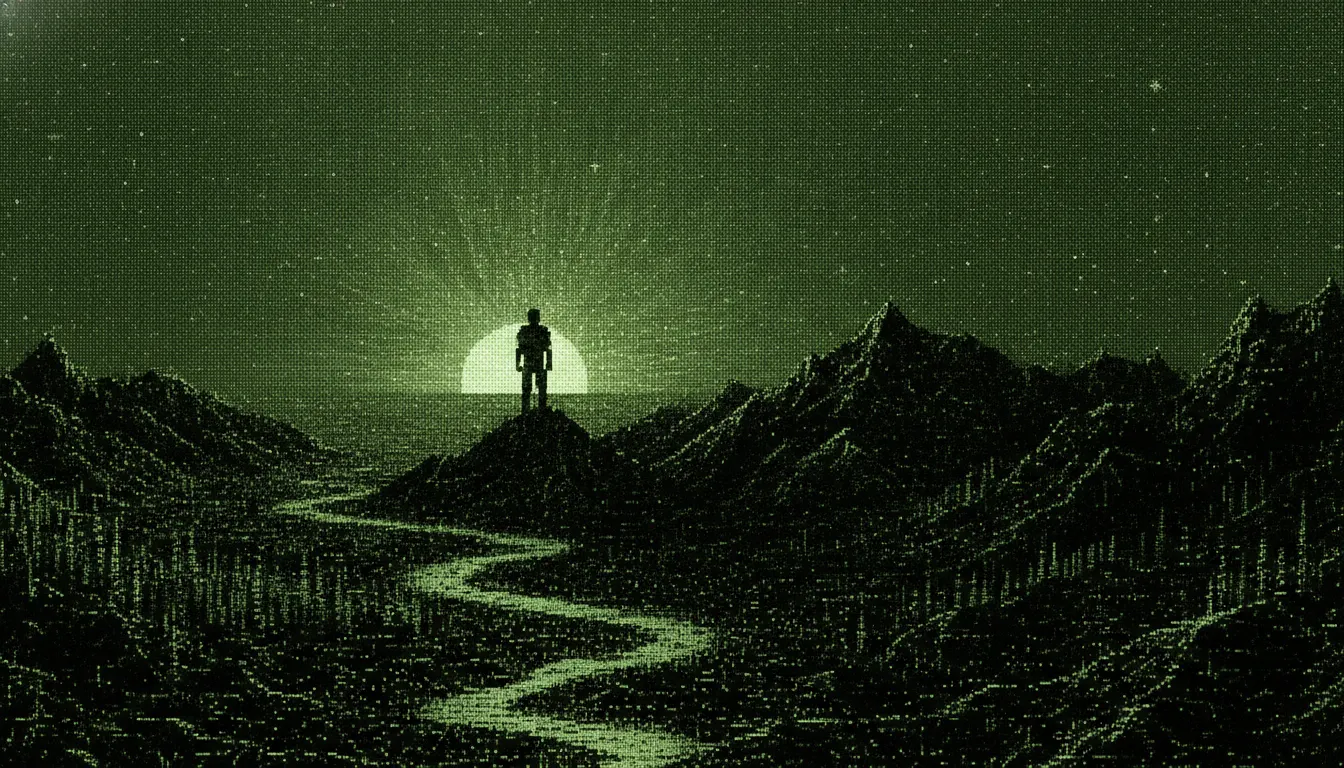
Image rendered as ASCII characters on green-phosphor terminal. Density-mapped glyphs, fixed-width, hacker aesthetic.
The moves a human crew would use to get here. Cue applies them for you, and knowing their names is how you ask for a change.
characters ranked from whitespace (light) to W/M/@ (dark) to represent luminance
column grid constraint - horizontal layout with fixed character-cell proportions
on-black (#00FF00 or #39FF14 on #000000) for terminal nostalgia; white-on-black for clean contemporary look
scale typographic letterforms for title cards
line effect simulating cursor blink or typewriter-reveal character-by-character
style info-box framing for structured data display within ASCII borders
ASCII art predates personal computers. The earliest practitioners worked on RTTY (Radio Teletype) machines in the 1960s, creating images from the 95 printable characters of the ASCII standard by positioning them on fan-fold paper. The form migrated to mainframe line printers and early DEC terminals, then found mass distribution through early internet newsgroups (alt.ascii-art, established 1992) and Japanese oekaki BBS communities where the form overlapped with emoticons (kaomoji) and Shift-JIS art as early as the late 1980s.
Joan G. Stark (online handle: jgs) became the defining figure of classic ASCII art in the 1990s, producing hundreds of recognizable images - animals, holiday scenes, decorative borders - that became ubiquitous in email signatures and early web pages. Her work established a visual vocabulary of density mapping: dense characters (W, M, @, #) for dark regions, sparse or whitespace-heavy characters (., `, ', ) for light regions, and medium characters (o, +, *, =) for midtones. This density-to-brightness mapping remains the core technique whether done by hand or by aa-lib and jp2a conversion software.
Monochrome ASCII art is constrained to a single foreground color (typically green-on-black for terminal nostalgia, white-on-black for contemporary use) with no anti-aliasing. The character cell grid - usually 80 columns wide, variable height - imposes a resolution that creates distinctive pixelated curves. Figlet and Toilet generate large-format letterforms from ASCII characters; tools like ascii-image-converter, aalib, and jp2a automate image-to-ASCII conversion but hand-correction remains common for quality work. Contemporary uses include Neofetch/Fastfetch system-info displays, code art, and the opening sequences of hacker-culture films.
ASCII art is not exclusively Western. Japanese Shift-JIS art (sometimes called 'AA' or kiwi art in Japanese net communities) uses the wider Unicode block of double-byte characters - including block elements, mathematical symbols, and Japanese kana - to achieve finer resolution and different composition possibilities than 7-bit ASCII. The 2channel (2ch) BBS community from 1999 onward developed distinctive Shift-JIS emoticon-art forms like 'Yaranaika' (2006) that achieved international meme status. Korean Hangul character art and Chinese GB2312-based art communities developed parallel traditions.
The form signals technical authenticity, open-source culture, command-line fluency, and retro-computing nostalgia. It appears prominently in hacker folklore (The Jargon File), Unix culture, and the aesthetic of films like 'The Matrix' (1999) and 'Hackers' (1995). The film 'War Games' (1983) established the terminal aesthetic for popular cinema audiences. Revival communities on Twitter/X and Mastodon continue the practice; Aaron Swartz Memorial ASCII art traditions persist in activist tech spaces. Code poetry movements including the International Obfuscated C Code Contest (IOCCC, 1984-present) have produced ASCII art-shaped source code as a sub-genre of both art and programming culture.
hundreds of definitive works archived at chris.com
community foundational texts and landmark images
1999
opening credits and code-rain sequences defining ASCII-adjacent aesthetic for cinema
1995
terminal interface aesthetics establishing visual shorthand for hacker identity
1960s-70s teleprinter originals
procedural ASCII video conversion demonstrations from the late 1990s
modern ASCII distro logos, widely shared in Linux communities
live text-mode visuals for chiptune sets
A Look is not a filter. It is a set of stored decisions the pipeline reads before it makes a single frame, so two videos in the same Look actually match.