The Legend of Korra: Book One
Michael DiMartino & Bryan Konietzko · 2012
Republic City introduction; Art Deco world-building and Pro-bending sports arc
Konietzko and DiMartino Avatar sequel set in art-deco Republic City. Industrial-age skyline, sharper anime-leaning line, cinematic bending matches.
The moves a human crew would use to get here. Cue applies them for you, and knowing their names is how you ask for a change.
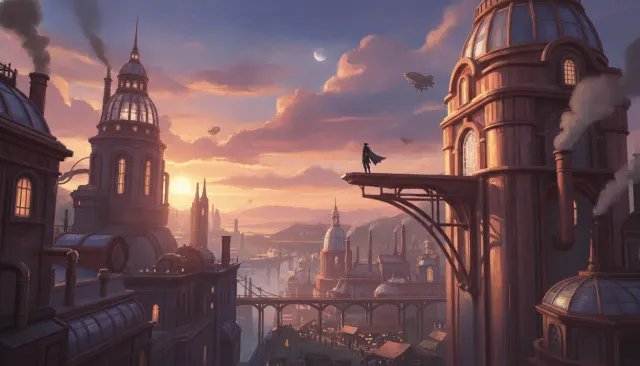
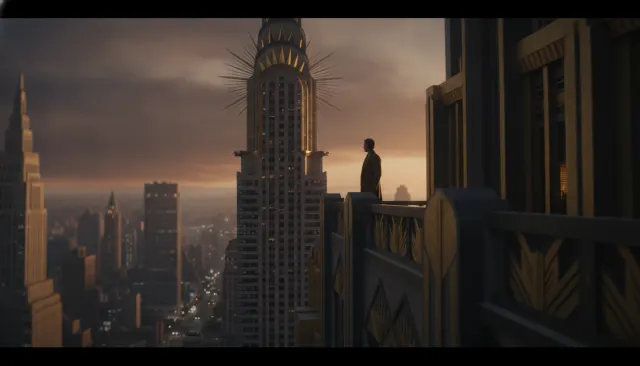
Stepped tower profiles, sunburst ornaments, and vertical emphasis in building design drawing directly on 1920s-30s New York, Shanghai, and Hong Kong architectural vocabulary.
Vehicles, appliances, and technology designed to 1930s streamline moderne aesthetic - rounded chrome forms, functional elegance, early-broadcast-era radio and telephone.
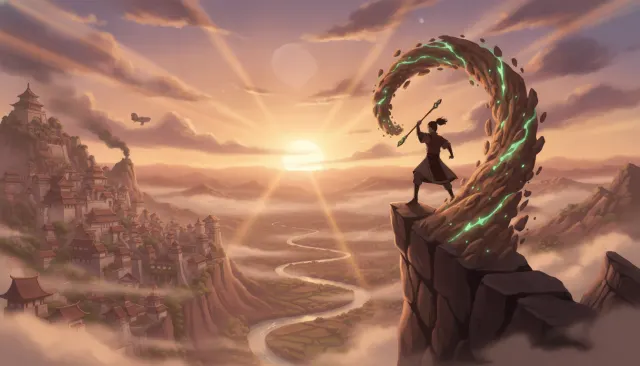
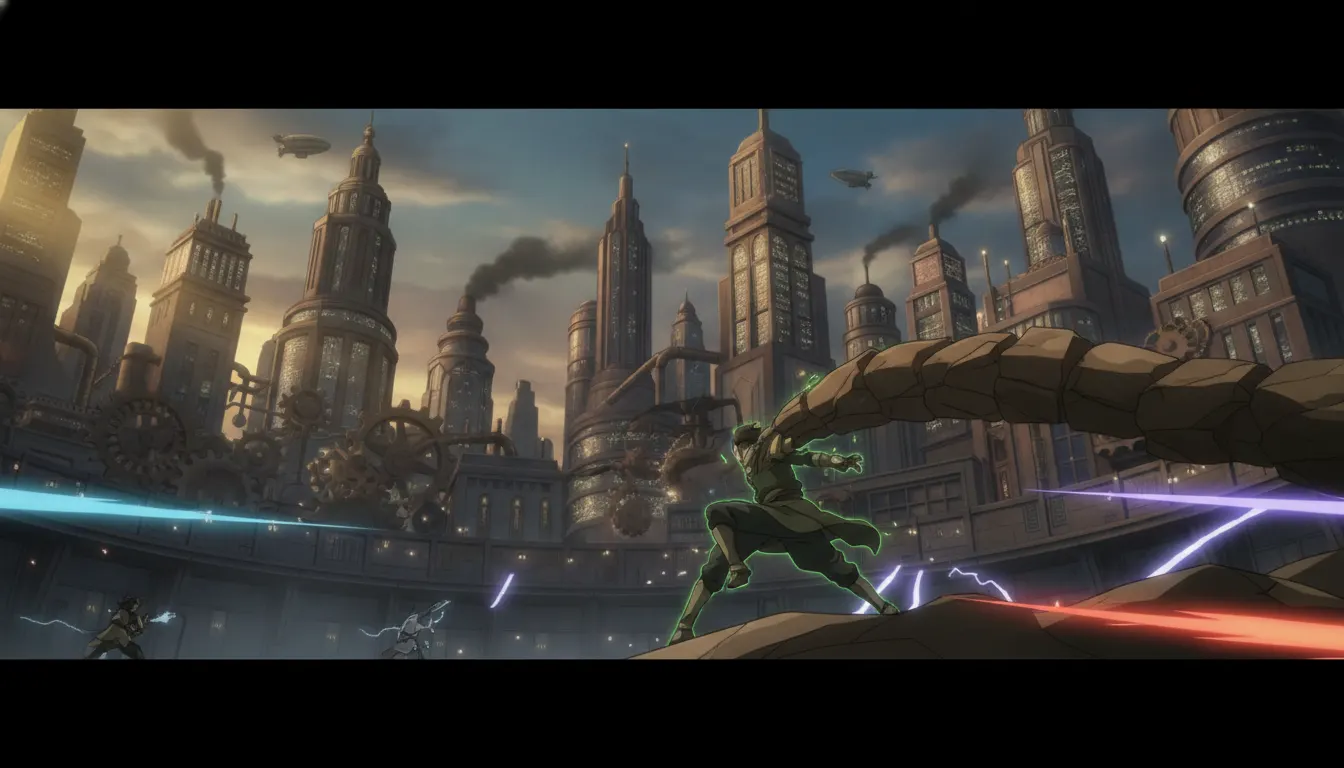
Fluid Studio Mir action animation applying martial arts choreography to elemental manipulation - each bending style references specific real-world martial art traditions.
Spirit World sequences use a deliberately different, flatter and more iconic visual language contrasting with the detailed Art Deco material world.
Floors, walls, and clothing feature period-accurate geometric tile and textile patterns - Art Deco's characteristic integration of ornament and geometry.
Each antagonist faction in different books uses distinct visual design language: Equalists use constructivist poster aesthetics; Red Lotus uses rough natural forms; Kuvira uses fascist-adjacent martial uniformity.
Character clothing references specific period fashion trends while maintaining bending-functional design requirements - flapper silhouettes, working-class immigrant dress, military influences.
The Legend of Korra is an animated television series created by Michael DiMartino and Bryan Konietzko that aired on Nickelodeon from April 14, 2012 to December 19, 2014. A sequel series to Avatar: The Last Airbender (2005-2008), the show is set approximately 70 years later in Republic City - a metropolis that synthesizes Art Deco architecture, 1920s-30s technology, and the elemental bending magic of the Avatar world. The result is one of the most visually sophisticated Art Deco settings in the history of animated television.
DiMartino and Konietzko made the creative decision to set Korra in a world analogous to the 1920s-1940s - the age of Art Deco architecture, radio broadcast, early automobiles, and political modernization. This gave the art department, led by production designer Kim Eun-Joo and background painting supervisor Angela Song Mueller, a cohesive period aesthetic to work from. Republic City draws explicitly on Shanghai, Hong Kong, and New York City's Art Deco skyline: stepped building profiles, sunburst ornamental patterns, geometric window arrangements, and grand civic architecture.
Art Deco is defined by geometric regularity, vertical emphasis, symmetrical ornament, and the integration of machine-age industrial forms with decorative elegance. In Korra, this translates to: skyline silhouettes with stepped tower profiles; interior architecture featuring geometric tile patterns, brass fixtures, and symmetrical doorway ornamentation; vehicles (cars, mopeds, speedboats, airplanes) with streamlined rounded forms characteristic of 1930s industrial design.
Character design by Bryan Konietzko builds on the established Avatar vocabulary but with an urban edge: clothing styles reference 1920s-30s fashion (flapper influences, military silhouettes, working-class immigrant dress) while maintaining the functional bending-compatible outfits of the earlier series.
The elemental bending animation in Korra, produced by Studio Mir in Korea, reached a new level of kinetic fluency. The 'Pro-bending' sports sequences in Book One apply the bending choreography to competitive team sport with specific tactical rules. Korra's own aggressive, earthbender-influenced waterbending style required new approaches to water and force animation. Studio Mir's contribution, particularly in the action sequences of Books Three and Four, is widely regarded as among the finest 2D action animation produced for TV.
Each of Korra's four books explores different visual tones: Book One (Air) uses the Art Deco period setting with optimism; Book Two (Spirits) introduces mythological spirit world sequences with a flatter, more iconic ancient-art design vocabulary; Book Three (Change) moves to a darker, more global scope; Book Four (Balance) uses fascist-adjacent imagery in its antagonist faction. The show's visual design tracks thematic content rather than maintaining a fixed aesthetic.
The show's Art Deco world-building has been widely cited by subsequent animation and game projects. The visual model of placing elemental fantasy action in a period industrial design context - 'Avatar meets 1920s Shanghai' - has influenced world-building in games, comics, and animation across the 2010s.
Michael DiMartino & Bryan Konietzko · 2012
Republic City introduction; Art Deco world-building and Pro-bending sports arc
Michael DiMartino & Bryan Konietzko · 2014
Peak action animation quality; Studio Mir's finest work on the series
Michael DiMartino & Bryan Konietzko · 2014
Fascist-aesthetic antagonist arc; most politically visually complex book
Michael DiMartino & Bryan Konietzko · 2005
Predecessor series establishing the bending world and character design vocabulary
Fortiche Production / Riot Games · 2021
Netflix animated series achieving comparable Art Nouveau/Deco industrial fantasy world-building
Fritz Lang · 1927
Silent film Art Deco industrial cityscape that directly influenced Republic City's visual language
A Look is not a filter. It is a set of stored decisions the pipeline reads before it makes a single frame, so two videos in the same Look actually match.