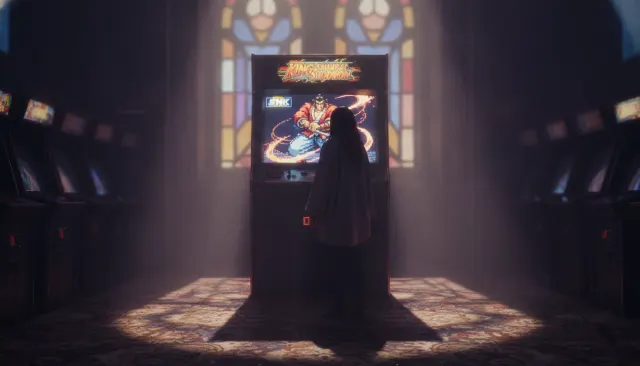
The King of Fighters '94
SNK, 1994 - debut of the team battle 3-on-3 format
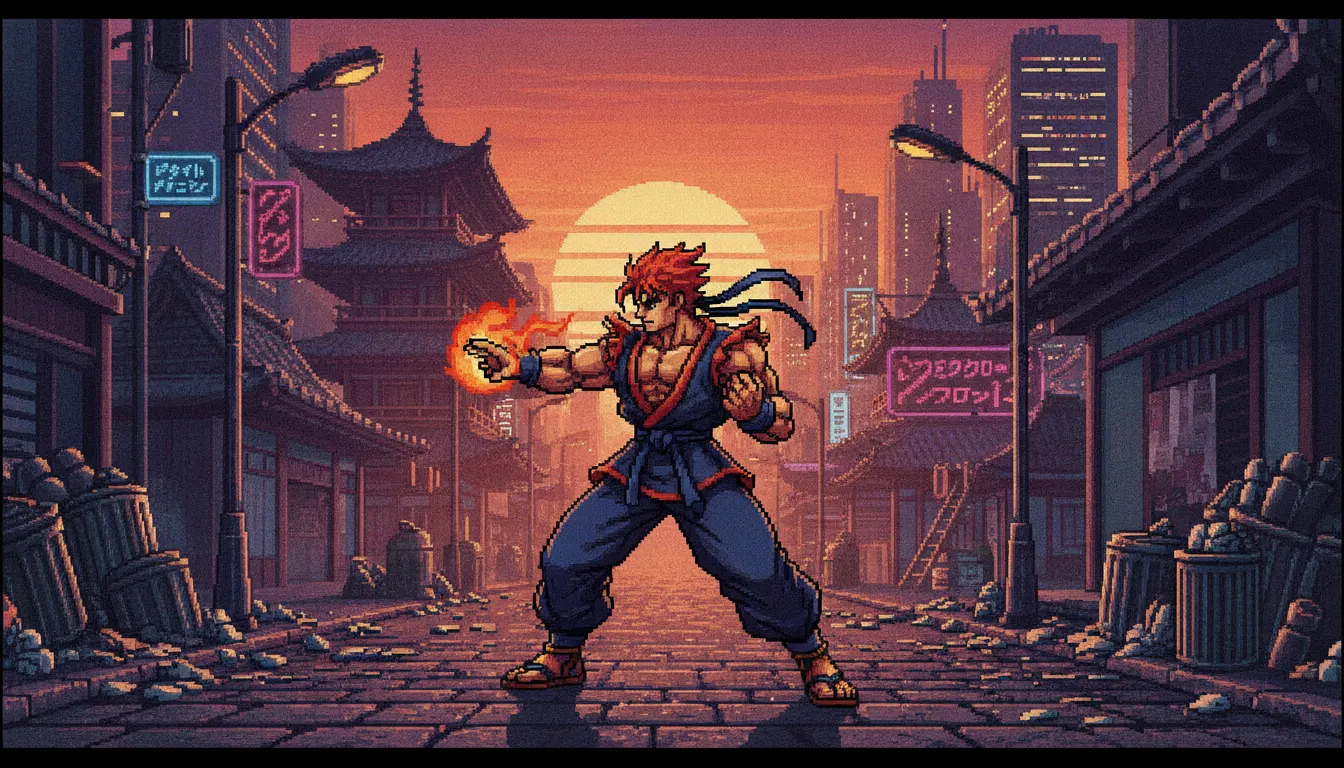
King of Fighters SNK Neo Geo 2D sprite aesthetic. Hand-drawn high-color fighter sprites, parallax stage layers, arcade-attitude character poses.
The moves a human crew would use to get here. Cue applies them for you, and knowing their names is how you ask for a change.
120px height range) with frame-by-frame hand-drawn animation for gestural quality
color-per-palette discipline creating strong silhouette-readable characters with decisive color identities
Kyo orange-red, Iori purple-crimson, Terry blue-red persist across redesigns
attack arcs show distorted mid-swing limb positions conveying speed
idle animations are rich multi-frame loops with breathing, weight shifts, and hair motion
era ultra-high-detail pixel sprites: functionally operating as hand-drawn digital illustration in motion
SNK's The King of Fighters series, launching in 1994 with KOF '94, became the definitive expression of large-scale hand-drawn fighting game sprite art. Where Capcom's Street Fighter (1987+) established the template, SNK refined it into a decades-long tradition of meticulous pixel craftsmanship on the Neo Geo MVS and AES hardware platforms.
KOF characters are rendered at large sprite sizes - approximately 80-120 pixels tall in the MVS era - with frame-by-frame hand-drawn animation. Every fighting stance, attack animation, and knockdown sequence is individually drawn rather than interpolated. The result is animation that carries the gestural quality of a skilled illustrator: Kyo Kusanagi's flame attacks snap with hand-drawn energy; Iori Yagami's claw slashes carry inked expressiveness that keyframe interpolation cannot replicate.
Neo Geo hardware imposed strict per-sprite palette limitations (16 colors per palette group), which the KOF artists turned into a design discipline. Character readability depended on strong silhouettes and decisive color assignment. Each fighter has a signature color identity: Kyo is orange-red, Iori is purple-crimson, Terry Bogard is red-and-blue. These color identities persist across decades of redesigns.
KOF '94 through KOF '98 represent the peak MVS sprite era. KOF '99 introduced assist characters and pushed sprite counts per match. KOF 2002 is considered by the fighting game community as the commercial and artistic peak - the sprites are at their most detailed, the backgrounds most elaborately illustrated. KOF XIII (2010) used hand-drawn sprites so detailed they appeared as HD illustrations in motion. KOF XV (2022) transitioned to 3D models with a 2D-filtered aesthetic.
KOF stage backgrounds are elaborately illustrated 2D paintings with animated elements - crowd NPCs, weather effects, destructible foreground objects. The backgrounds of KOF 2002, XI, and XIII are among the most detailed in fighting game history, functioning as independent pieces of illustration art.
SNK, 1994 - debut of the team battle 3-on-3 format
SNK, 1998 - widely regarded as the classic era peak in competitive balance
SNK Playmore, 2002 - community-considered commercial and artistic sprite apex
SNK Playmore, 2010 - the last hand-drawn sprite KOF, ultra-HD detail
SNK, 2022 - 3D transition while maintaining 2D-style aesthetic
SNK, 2025 - spiritual successor with 2D/3D hybrid aesthetics
the hardware context where all classic SNK sprite art lived
A Look is not a filter. It is a set of stored decisions the pipeline reads before it makes a single frame, so two videos in the same Look actually match.