David Brewster
1816
kaleidoscope patent , _Treatise on the Kaleidoscope_ (1819)
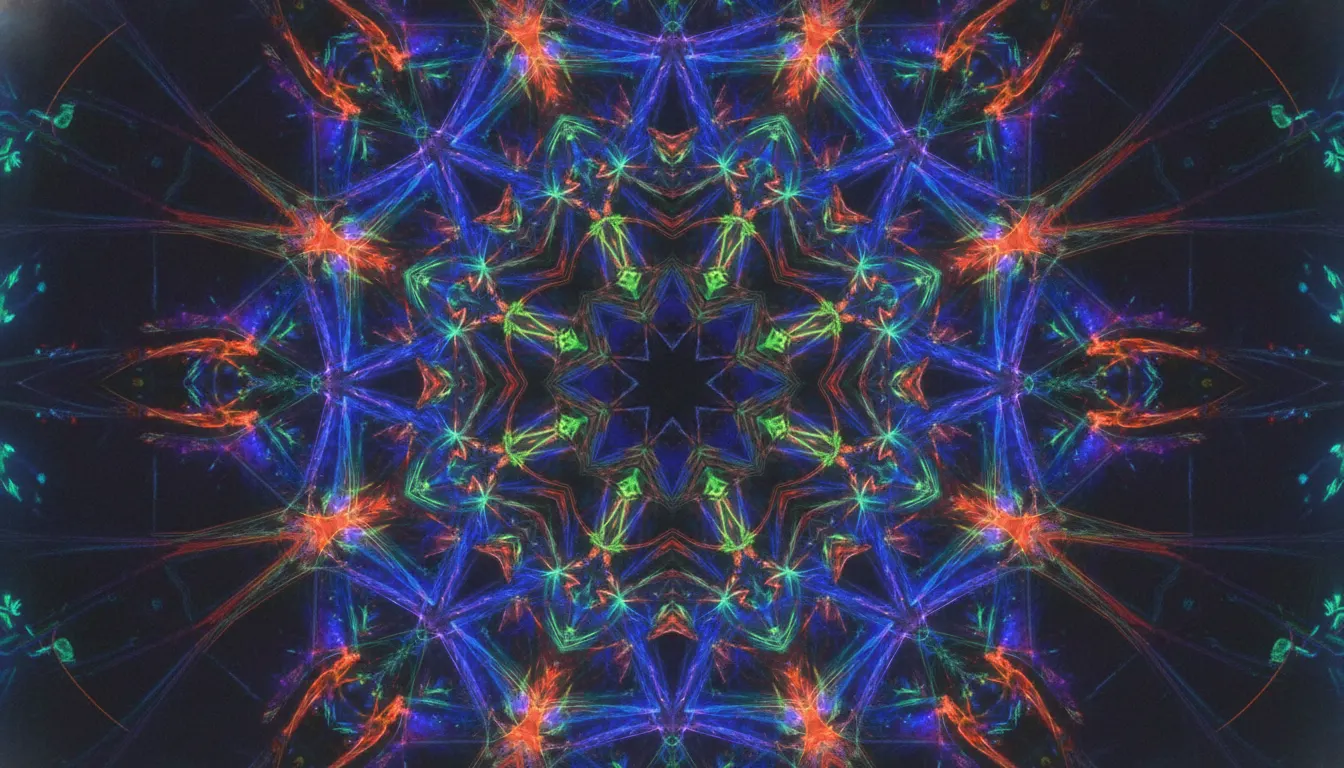
Kaleidoscope eight-way radial mirror symmetry. Subject fragmented and tiled into mandala, repeating pattern, dance-music-video aesthetic.
The moves a human crew would use to get here. Cue applies them for you, and knowing their names is how you ask for a change.
After Effects CC2017+ Mirror effect or Fusion's Mirror tool, fold count 6/8/12
to-rectangular coordinate transform to create radial-from-linear patterns (Photoshop Polar Coordinates filter)
slowly pan or zoom the source layer before folding to create continuously morphing pattern
point lock: pin the fold origin to a high-contrast or high-color focal point for visual anchoring
30% opacity in center to retain subject identity within abstract pattern
The kaleidoscope aesthetic arranges imagery in perfect rotational symmetry - most commonly 6-fold, 8-fold, or 12-fold - producing mandala-like, endlessly variable patterns from any source footage or photograph. The technical foundation is the multiple-reflection principle: place two mirrors at an angle of 60 degrees (for 6-fold symmetry) or 45 degrees (8-fold) and whatever sits between them replicates endlessly around a central point.
Sir David Brewster (Scottish physicist, 1781-1868) invented the kaleidoscope in 1816 and patented it the same year. Within three months of commercialization, an estimated 200,000 units had been sold in London and Paris alone, making it one of the fastest-adopted optical toys in history. Brewster's design used colored glass and metal foil fragments in a sealed end chamber, but he immediately recognized that substituting an open tube for the object chamber would allow any viewed scene to become the symmetrical source - a "telescope kaleidoscope" he called a polyangular microscope. The core geometry: reflections in two plane mirrors at angle A produce (360/A) reflections total, creating n-fold symmetry when 360 is divisible by A.
Kaleidoscopic imagery entered cinema with Busby Berkeley's 1930s MGM musical overhead dance formations - not optical kaleidoscopes but geometrically equivalent radial symmetry achieved with choreography and top-mounted cameras. _Gold Diggers of 1933_, _Footlight Parade_ (both 1933), and _42nd Street_ (1933) established the aesthetic as spectacular, jubilant, and maximalist. Andy Warhol's multi-panel silkscreens used bilateral symmetry as a structural motif. In the psychedelic era, kaleidoscope visuals became inseparable from light show performance - Joshua White's Joshua Light Show at Fillmore East (1968-1971) used oil-wheel and mirror projections to create real-time kaleidoscopic backdrops for Janis Joplin, Led Zeppelin, and The Doors.
Contemporary motion graphics and music video production use mirror-fold tools in After Effects, DaVinci Resolve Fusion, and dedicated apps like Kaleider to achieve the same geometry in real time on video.
1816
kaleidoscope patent , _Treatise on the Kaleidoscope_ (1819)
1933
overhead kaleidoscope choreography, _42nd Street_ and _Gold Diggers of 1933_
Joshua Light Show, Fillmore East live oil-and-mirror projections (1968-1971)
1966
_Tomorrow Never Knows_ promo film, kaleidoscopic super-8 collage
2011
_Countdown_ music video, kaleidoscope mirror sequences
2013
_Roar_ and _Dark Horse_ visual motifs using symmetry
live visuals, mirror-fold motion graphics (2000s-2010s)
A Look is not a filter. It is a set of stored decisions the pipeline reads before it makes a single frame, so two videos in the same Look actually match.