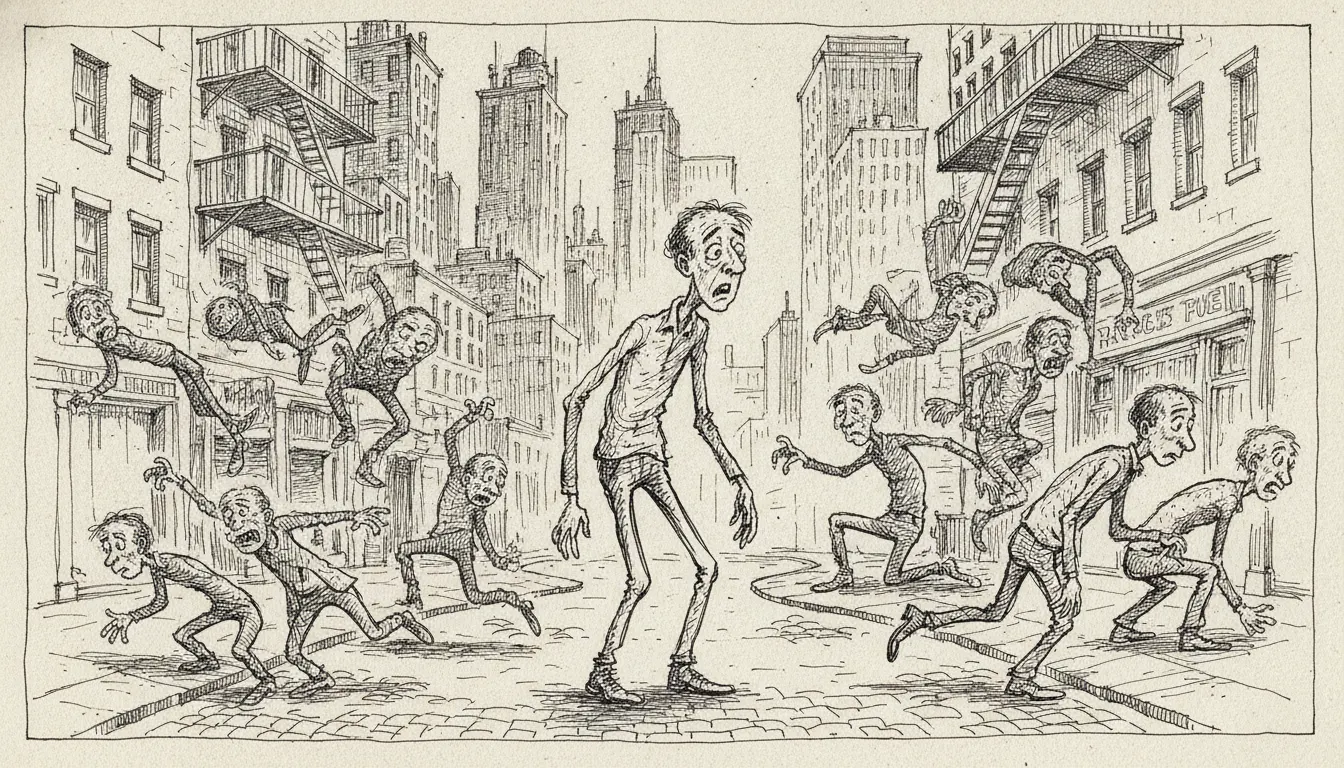
Sick, Sick, Sick / Feiffer (Village Voice strip)
Jules Feiffer · 1956-1997
Over 40 years in The Village Voice; the primary text of the political-psychological cartoon monologue form
Jules Feiffer Village Voice political cartoon. Scratchy expressive pen line, dance-of-anxious-figures sequence, neurotic urban dialogue strip.
The moves a human crew would use to get here. Cue applies them for you, and knowing their names is how you ask for a change.
Characters rendered in the fewest possible lines - a schematic suit, dot eyes, curved mouth, hands in expressive position - the entire figure as body-language notation rather than illustration.
Figures placed against pure white with no background detail, environment, or setting - all visual and narrative context comes from posture and dialogue alone.
The sequence of panel-to-panel body posture changes tells a psychological story visible before the text is read - beginning upright, progressing through hunching, falsely straightening, deflating.
Extended spoken text occupying most of the panel space, delivered by a single figure - the strip as a transcription of anxious interior speech.
From his apprenticeship under Eisner, Feiffer absorbed the understanding that the entire communicative content of a cartoon figure is its physical stance and gesture rather than its face.
Strips operate simultaneously as political commentary and as psychological case studies, the political content being the occasion for the psychological insight rather than its subject.
Jules Feiffer (born 1929) is an American cartoonist, playwright, and screenwriter whose weekly strip Feiffer (originally titled Sick, Sick, Sick in its Village Voice debut in 1956) established a visual and rhetorical mode unique in American cartooning: the political-psychological cartoon monologue, in which a single figure speaks at length about their anxieties, rationalizations, and self-deceptions, while the cartoonist's minimal line work captures the body language of a person convincing themselves of something they know to be false.
Feiffer began his career as an assistant to Will Eisner on The Spirit (1946-1951), absorbing Eisner's understanding of body language as narrative information. When he launched his own strip in The Village Voice in 1956 - at no pay initially - he departed from Eisner's dynamic, cinematic composition in favor of radical simplification: figures reduced to a gestural shorthand of a few lines, placed against a blank white ground, executing a single sequence of physical stances across the strip's panels.
The visual strategy is almost paradoxically minimal. Feiffer's line does not build up shaded form or architectural environment; a character is typically a few lines indicating a suit or dress, a schematic face (two dots for eyes, a curved line for a mouth), and hands in a posture that communicates the speaker's emotional state. The entire visual weight falls on the body posture sequence: in a strip about neurotic self-justification, the figure might begin upright, gradually hunch, then straighten with false conviction, then deflate - a physical narrative visible even before the text is read.
This approach derived from two sources: the psychoanalytic culture of New York intellectual life in the 1950s (Feiffer underwent analysis and the strip's subject matter is saturated with Freudian observation) and a specific cartoon economy that prioritized dance-like body movement over illustrative detail. Feiffer wrote that his figures 'dance' through their rationalizations, and the sequence of poses in a typical strip has the quality of choreographed movement.
The strip addressed McCarthyism, the Cold War, Vietnam, Nixon, feminism, the New Left, Reagan, and every major current of American political and social anxiety from the 1950s onward. Feiffer was awarded the Pulitzer Prize for Editorial Cartooning in 1986, and his strip was syndicated nationally from 1959 through The Village Voice and over 100 papers. His screenplay for Carnal Knowledge (1971, dir. Mike Nichols) and his Obie-winning play Little Murders (1967) extended his authorial voice into adjacent media.
Feiffer's body-language monologue approach was absorbed by Doonesbury (Garry Trudeau cited him as a primary influence), by underground comix cartoonists, and by the generation of alternative weekly cartoonists from the 1980s onward. His visual economy - maximum expression from minimum line - is directly relevant to digital and motion graphics contexts where simplified figure animation is a constraint.
Jules Feiffer · 1956-1997
Over 40 years in The Village Voice; the primary text of the political-psychological cartoon monologue form
Jules Feiffer · 1965-1982
Collected strip volumes documenting the full run of the strip
Jules Feiffer · 1967
Obie Award-winning play; the Feiffer satirical voice in theatrical form
Jules Feiffer (screenplay), Mike Nichols (dir.) · 1971
Feature film; Feiffer's psychological case-study mode adapted to cinema
Jules Feiffer · 1986
Recognition confirming the strip's standing as editorial rather than entertainment cartooning
Jules Feiffer · 1993
Children's picture book; minimum-line illustration applied to an autobiographical story about a young cartoonist
A Look is not a filter. It is a set of stored decisions the pipeline reads before it makes a single frame, so two videos in the same Look actually match.
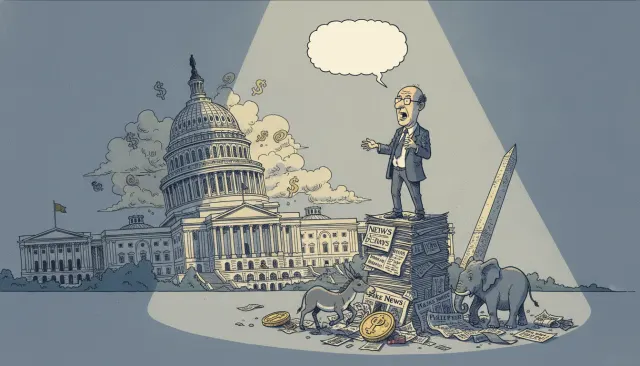 Illustrators ExtendedGarry Trudeau Doonesbury Political Strip
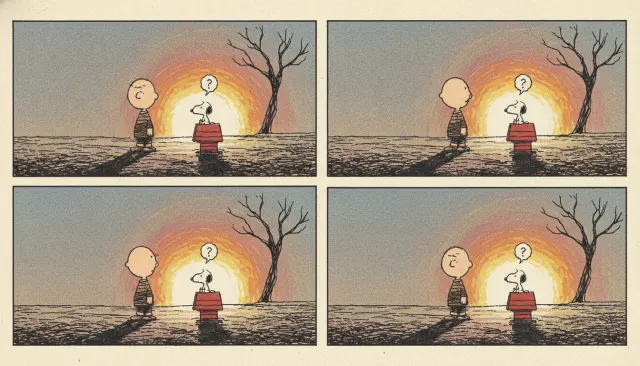 Illustrators ExtendedCharles Schulz Peanuts Minimalist Strip
 Illustrators ExtendedDaniel Clowes Deadpan Suburban Comic
 Illustrators ExtendedAdrian Tomine Clean Graphic Novel
 Illustrators ExtendedBill Watterson Calvin Hobbes Painted Sunday
 Adult Primetime ExpansionDaria MTV Flat Vector