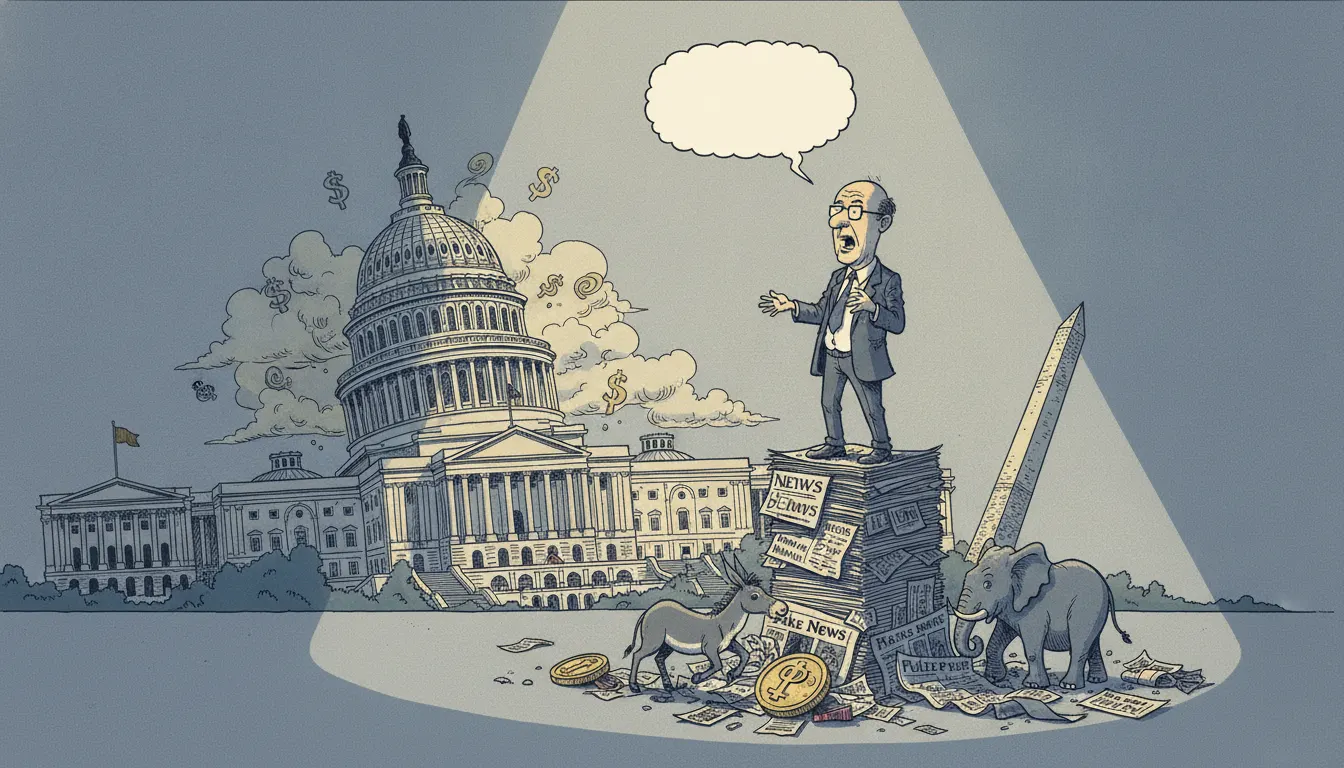
Doonesbury (syndication begins)
Garry Trudeau · 1970
Universal Press Syndicate syndication; the strip moves from Yale campus to national audience
Garry Trudeau Doonesbury political comic strip. Clean even pen line, talking-head dialogue, Washington-DC satire, Pulitzer-winning topical commentary.
The moves a human crew would use to get here. Cue applies them for you, and knowing their names is how you ask for a change.
Clean, relatively unexaggerated line work that refuses the visual fireworks of editorial cartooning tradition, placing satirical weight entirely in dialogue.
Political figures represented by their buildings, symbols, or possessions rather than caricatured faces - the White House windows for Nixon, a helicopter for a president - a rhetorical strategy as well as a practical one.
Four-panel daily and full Sunday page formats maintained throughout the strip's run, invoking the newspaper strip tradition as a formal frame.
Talk balloons carry dense, precisely worded prose - the satirical content is verbal, not visual, with images providing context rather than punchline.
Recurring characters who age in real time across the strip's 50+ year run, creating a continuity of political witness unavailable to single-panel editorial cartooning.
A structural feature of the strip's cultural position: content topical enough that newspapers regularly relocated it from comics to editorial pages, marking a category distinction within the form.
Garry Trudeau (born 1948) launched Doonesbury as a Yale Daily News strip in 1968 under the title Bull Tales, beginning syndication through Universal Press Syndicate in 1970. It is the longest-continuously running political comic strip in American newspapers and the first to win a Pulitzer Prize for Editorial Cartooning (1975), a category that had previously been reserved for single-panel editorial illustrations rather than ongoing narrative strips.
Trudeau's drawing style is remarkable for its deliberate modesty. Where the tradition of editorial cartooning prioritized bold, instantly legible caricature and strong graphic impact, Trudeau's line is quiet, even tentative - figures are drawn without exaggeration, in a consistent, slightly stiff middle-American realism that refuses the visual fireworks of conventional political illustration. This restraint was a conscious choice: the strip's political impact comes from dialogue, not from visual amplification.
Characters are rendered in a clean, simple line that changed relatively little between 1970 and the present. Faces are specific enough to be recognizable but resist the distorting exaggeration of caricature. Political figures when they appear are often represented metonymically - the Nixon White House years famously replaced Nixon himself with a floodlit building labeled 'White House,' later reduced to just the lit windows. This visual strategy - representing political power by its symbol rather than its face - was both a practical solution and a sophisticated rhetorical device.
Panel layout follows the strict four-panel Sunday-or-daily grid inherited from newspaper strip format. The backgrounds in earlier strips were sparse; over the decades, Trudeau's collaborators (primarily Don Carlton on backgrounds) developed more detailed environmental rendering. Talk balloons are standard, with Trudeau's crisp, satirically loaded prose occupying more visual real estate than the images.
Doonesbury addressed the Vietnam War while it was happening, Watergate as it unfolded, the Reagan presidency, the Clinton scandals, the Iraq War, and the Trump era - always from a recognizably liberal-interventionist political position. The strip was pulled from newspapers' comics sections and moved to editorial pages during controversies (the AIDS coverage in 1983, the Trump storylines from 2015 onward), acknowledging that its content was politically categorized in a way that conventional comic strips were not.
The strip's influence on political cartooning and comics journalism is substantial. Its model - a recurring cast of politically engaged characters navigating current events, with dialogue doing the satirical heavy lifting - was adopted by Pogo (retrospectively canonized as precedent), Li'l Abner, and a generation of alt-weekly political strips.
Garry Trudeau · 1970
Universal Press Syndicate syndication; the strip moves from Yale campus to national audience
Garry Trudeau · 1975
First comic strip to win the Pulitzer Editorial Cartooning prize; establishes strips as serious political commentary
Garry Trudeau · 1972-74
White House represented as building with lit windows; the metonymic representation strategy at its most sustained
Garry Trudeau · 1983
One of the first mainstream media treatments of AIDS; pulled from comics pages of some newspapers
Garry Trudeau · 2015-present
Regularly moved to editorial pages; some newspapers dropped the strip over political content
Garry Trudeau (script), John and Faith Hubley (animation) · 1977
Emmy-winning animated special translating the strip's visual register to animation
A Look is not a filter. It is a set of stored decisions the pipeline reads before it makes a single frame, so two videos in the same Look actually match.
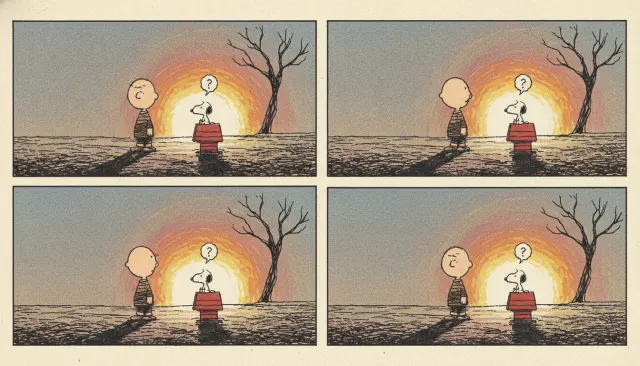 Illustrators ExtendedCharles Schulz Peanuts Minimalist Strip
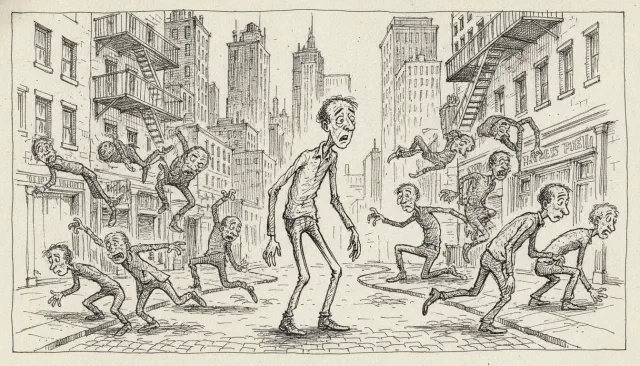 Illustrators ExtendedJules Feiffer Political Cartoon Line
 Illustrators ExtendedDaniel Clowes Deadpan Suburban Comic
 Adult Primetime ExpansionDaria MTV Flat Vector
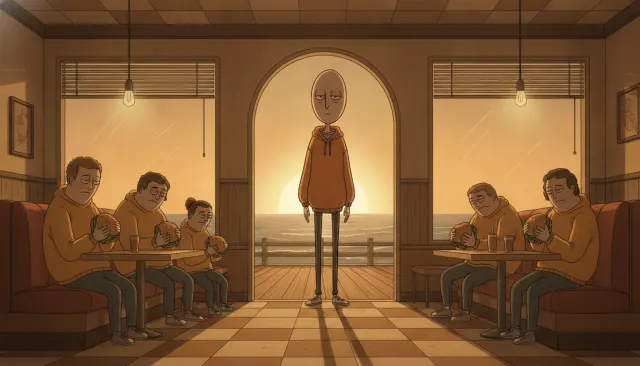 Adult PrimetimeBob's Burgers Warm Line
 Illustrators ExtendedBill Watterson Calvin Hobbes Painted Sunday