Jet Set Radio (Jet Grind Radio)
Smilebit / Sega AM8 / Masayuki Ueda · 2000
First commercial cel-shaded game, originating graffiti-skating fusion aesthetic and the Y2K Tokyo street visual language
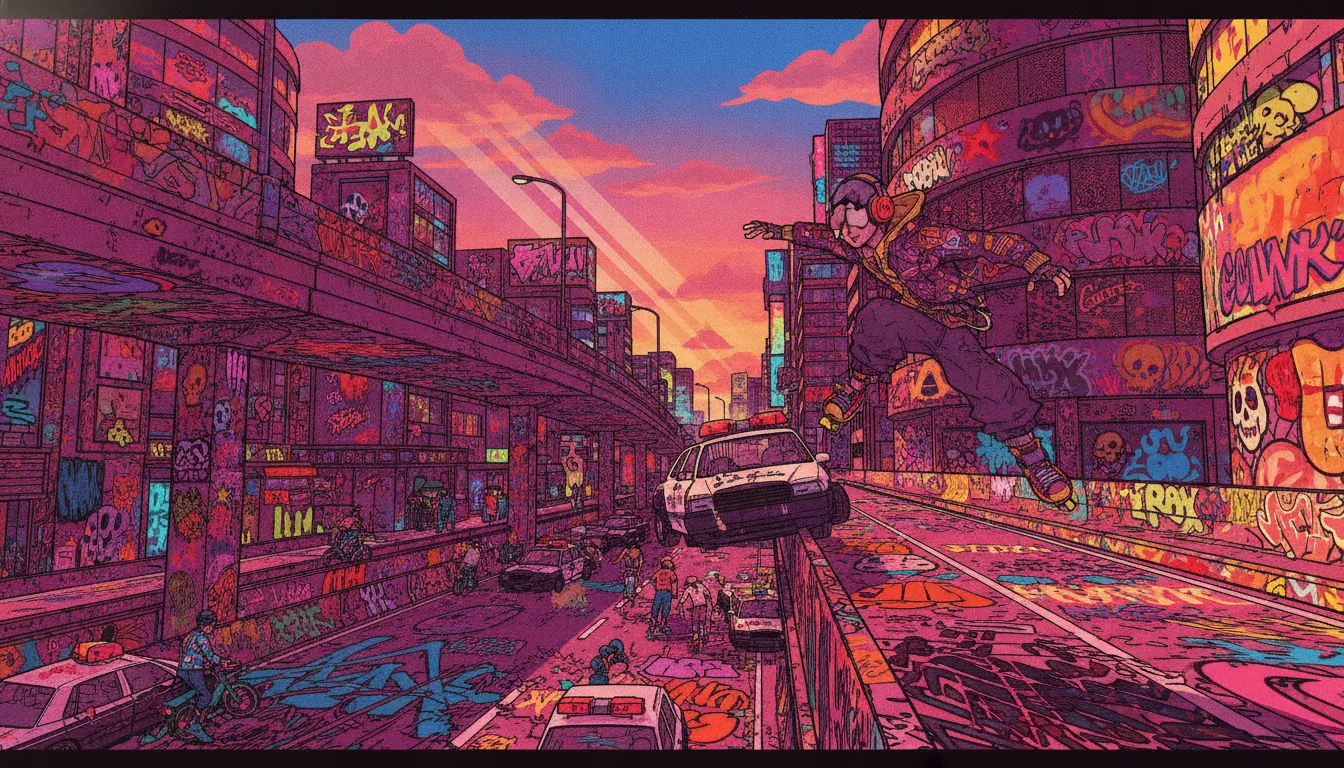
Jet Set Radio Sega Dreamcast cel-shaded. Funky graffiti culture, saturated street palette, kinetic skating chase camera.
The moves a human crew would use to get here. Cue applies them for you, and knowing their names is how you ask for a change.
Discrete color band light model with no gradient fills, originally developed for Dreamcast PowerVR hardware as the first commercial cel-shading implementation
Thick black edge lines using back-face-culled inverted mesh, giving every character and object a graphic art-marker outline quality
Spray-paint lettering, bubble-letter fonts, and sticker-style icons carrying the street art aesthetic into every UI layer
Acid yellow, electric blue, hot pink, and traffic orange in maximum saturation combinations referencing Tokyo street fashion circa 1998-2002
Environments layered with graffiti markings as world-building texture, every surface a document of the city's tagging history
Each character's palette, graffiti style, and skating technique designed as visual translations of their associated music genre
Sega's Jet Set Radio (2000, Japan release as Jet Grind Radio for North America, directed by Masayuki Ueda, Smilebit/Sega AM8) was the first commercially released game to implement cel-shading as a deliberate artistic strategy rather than a technical workaround. Set in the fictional Tokyo-to district of the Tokyo-to of the future, the game's visual language merged Japanese street fashion, graffiti art, and funk/hip-hop music into a unified aesthetic that remained influential for two decades.
Jet Set Radio's cel shading used a technique developed specifically for Dreamcast hardware: a pre-computed toon shader that quantized the lighting model into discrete color bands while preserving edge outlines via an inverted-hull method. The Dreamcast's PowerVR tile-based renderer made this technique economically viable for the first time. The result was characters and environments that looked like illustrations in motion -- a visual revolution that Zelda: Wind Waker (2002) and many others would follow.
Graffiti is not just the game's mechanic but its aesthetic DNA: characters wear tag-covered jackets, environments are surfaces waiting to be painted, and the game's UI uses spray-paint typography and sticker-styled icons. The graffiti style references 1990s New York and Tokyo street art -- blocky bubble letters, drip effects, overlapping layer textures. This visual system created the world's first graffiti-as-game-mechanic fusion, later followed by Marc Ecko's Getting Up (2006) and various Tony Hawk's series spin-offs.
Jet Set Radio's character designs use extreme fashion coordinates: oversized headphones, color-blocked sneakers, graphic tee-shirts, and the visible logos of fictional brands. Each character (Beat, Gum, Tab, Combo) uses a distinct color identity that matches their graffiti tag style. The overall palette is maximally saturated: acid yellow, electric blue, hot pink, traffic orange -- the colors of a Tokyo convenience store at midnight.
The game's soundtrack (produced by Hideki Naganuma) blended acid jazz, funk, hip-hop, and electronic music, and the visual aesthetic was designed as a direct translation of those sonic qualities into image. Naganuma's tracks set the rhythm for character animation and the pacing of the game's editing.
The Dreamcast (1998-2001) was Sega's final home console, and Jet Set Radio was one of its signature titles. The platform's failure means the game exists in a specific cultural category: a visually remarkable work produced for hardware that did not survive. This context adds a layer of pathos to the aesthetic's legacy -- the cel-shaded graffiti-funk visual language was developed at enormous creative investment for a platform that sold roughly 10 million units worldwide. The subsequent influence of that aesthetic on Nintendo, indie games, and contemporary titles like Bomb Rush Cyberfunk is disproportionate to the original commercial reach.
Jet Set Radio's fictional Tokyo-to is divided into districts -- Shibuya-cho, Benten-cho, Kogane-cho -- each with distinct visual identity that translates real Tokyo neighborhood coding into cel-shaded graphic form. Shibuya becomes hyper-commercial neon; the docks become industrial grey with orange rust; the sewers become alien teal-green. This district-based visual world-building, where each area has a dominant color temperature and material palette, directly influenced how subsequent open-world games structured their environmental color design.
Smilebit / Sega AM8 / Masayuki Ueda · 2000
First commercial cel-shaded game, originating graffiti-skating fusion aesthetic and the Y2K Tokyo street visual language
Smilebit / Sega / Xbox · 2002
Xbox exclusive sequel expanding the visual system to a larger Tokyo with higher-resolution cel shading
Nintendo EAD · 2002
Major title immediately following Jet Set Radio to adopt cel shading, demonstrating the aesthetic's genre versatility
Capcom / Clover Studio / Hideki Kamiya · 2006
Cel-shaded aesthetic applied to traditional Japanese ink-painting reference, extending the cel-shader canon into art historical citation
Team Reptile · 2023
Spiritual successor to Jet Set Radio developed with Hideki Naganuma contributing music, direct continuation of the visual vocabulary
Fusty Game / Merge Games · 2017
French indie title explicitly building on Jet Set Radio's cel-shaded graffiti skating aesthetic as a Kickstarter-funded spiritual successor
A Look is not a filter. It is a set of stored decisions the pipeline reads before it makes a single frame, so two videos in the same Look actually match.