Gundam Versus
Bandai Namco / Sunrise · 2017
Arena fighter with across-franchise suit roster demonstrating the cel-3D visual vocabulary at high fidelity
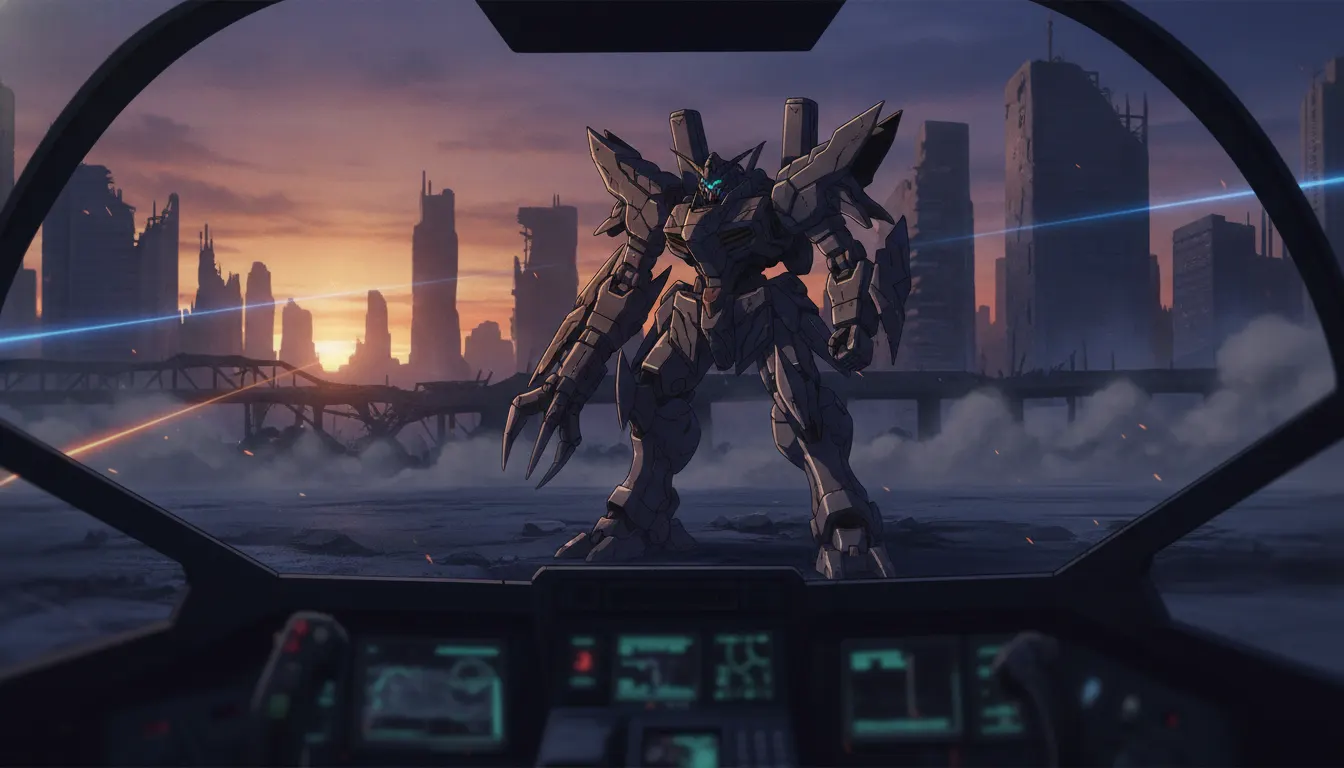
Gundam Versus and Breaker cel-shaded mecha. Hard-edge mecha cel render, panel-detail line work, anime-cockpit dynamic camera.
The moves a human crew would use to get here. Cue applies them for you, and knowing their names is how you ask for a change.
Surface panel details baked from high-poly sculpt into game-res normal map, preserving Gundam's mechanical complexity at real-time render budgets
Thick outer silhouette outlines thinning to hairlines at interior panel boundaries, referencing Sunrise's animation cel inking hierarchy
Discrete specular band on armor surfaces mimicking the bright metallic cel reflections in Sunrise's Gundam animation
Federation white/blue, Zeon grey/green, and AEUG red-white maintained as narrative-carrying color identities across all suits and environments
Bloom-composited additive passes on beam weapons and thruster exhausts referencing anime energy visual effects
Suit designs verified readable from simplified outline, ensuring the cel-3D adaptation preserves the original mechanical identity
The Gundam franchise -- Yoshiyuki Tomino's 1979 original Mobile Suit Gundam series through Bandai Namco's ongoing game adaptations -- has developed a distinctive cel-shaded 3D aesthetic for interactive media that honors the franchise's anime origins while exploiting the precision that 3D geometry brings to mechanical design. Games like Gundam Versus (2017), SD Gundam G Generation Cross Rays (2019), and Mobile Suit Gundam: Battle Operation series use hard toon shading, panel-line emphasis, and the franchise's iconic color-coded faction palettes.
Gundam's mechanical design language -- originated by Kunio Okawara in 1979 and evolved through Hajime Katoki's Ver. Ka line -- prioritizes panel lines, thruster exhausts, and modular joint visibility. In cel-3D adaptation, these surface details are preserved as normal-map or hand-painted texture bakes that remain legible at game resolution. The V-fin, mono-eye, and shield-arm silhouette language of Gundam is so established that partial-silhouette recognition became a design test: if you can identify the suit from a simplified outline, the cel-3D read is successful.
Gundam game cel shading uses two to four light bands, with a hard specular 'flash' pass that mimics the reflective metallic reads of Sunrise's animation cels. Camera-facing outlines use variable width: thick at outer silhouettes, thinner at internal panel lines. Thruster glows and beam saber energy are rendered with additive bloom that references the anime's energy visual effects vocabulary.
Faction palettes are rigid and carry narrative weight in the franchise: Earth Federation white/blue, Zeon grey/dark green, AEUG red-white. Cel-3D games preserve these hierarchies while adding material variation within each suit's color family -- different roughness values for armor panels vs. joint polyethylene vs. mono-eye sensor lens.
Gundam is Japan's defining mecha franchise, with the 1:1 scale RX-78-2 statue in Odaiba (18 meters, later relocated to Yokohama in 2020 as the articulated Unicorn Gundam) serving as a physical manifestation of the franchise's cultural scale. The cel-3D game aesthetic is the primary way new fans outside Japan encounter the franchise.
Bandai Namco's Gunpla (Gundam Plastic Model) business -- with over 700 million kits sold since 1980 -- creates a feedback loop with the cel-3D game aesthetic. Model kit designers must create mechanical suits whose surface detail is legible at 1:144 scale in physical plastic, which forces the same design discipline as the cel-3D game requirement: is the panel line visible? Does the faction color read from silhouette? Games like Gundam Breaker 4 (2024) directly reference Gunpla construction as a mechanic, making the physical-to-digital design translation loop explicit.
Gundam's cel-3D game aesthetic divides along a franchise-internal line: Universal Century (the original 1979 timeline through Unicorn) uses a more grounded, military-grey mechanical palette; Alternative Universe series (Wing, SEED, 00, IBO) use more saturated, character-expressive suit designs with stronger heraldic color relationships. Game aesthetic choices about which visual lineage to emphasize signal to franchise fans which era the production respects most.
Bandai Namco / Sunrise · 2017
Arena fighter with across-franchise suit roster demonstrating the cel-3D visual vocabulary at high fidelity
Bandai Namco / Tom Create · 2019
Strategy title spanning Wing, SEED, 00, and IBO eras with consistent cel-3D visual system
Bandai Namco Online · 2018
Free-to-play action game with real-scale suit combat demonstrating faction color logic in multiplayer context
Bandai Namco / Crafts & Meister · 2024
Gunpla customization game where the cel-3D aesthetic must honor both anime and physical model references simultaneously
Omega Force / Koei Tecmo · 2014
Musou-genre crossover demonstrating how cel-3D Gundam reads in mass enemy encounter compositions
Bandai Namco · 2020
Arcade-origin cel-3D title with some of the tightest toon shader implementation in the franchise game catalog
A Look is not a filter. It is a set of stored decisions the pipeline reads before it makes a single frame, so two videos in the same Look actually match.