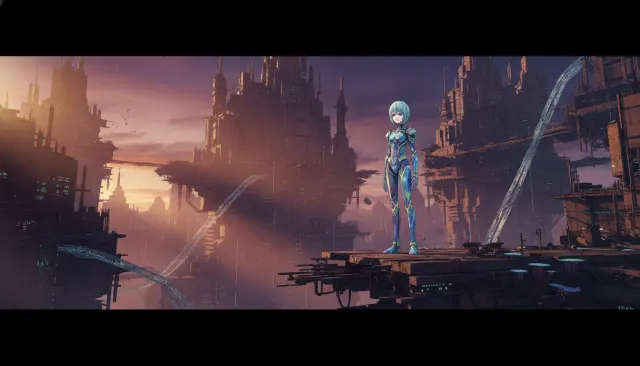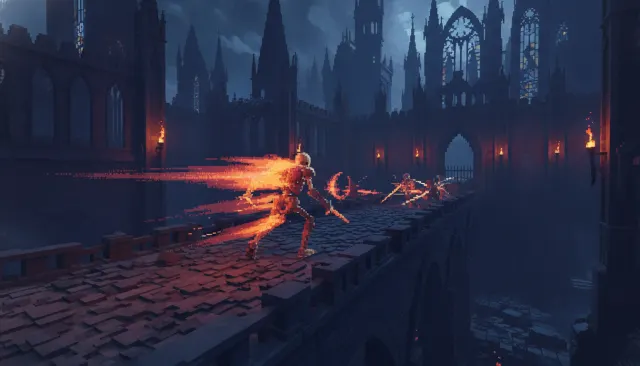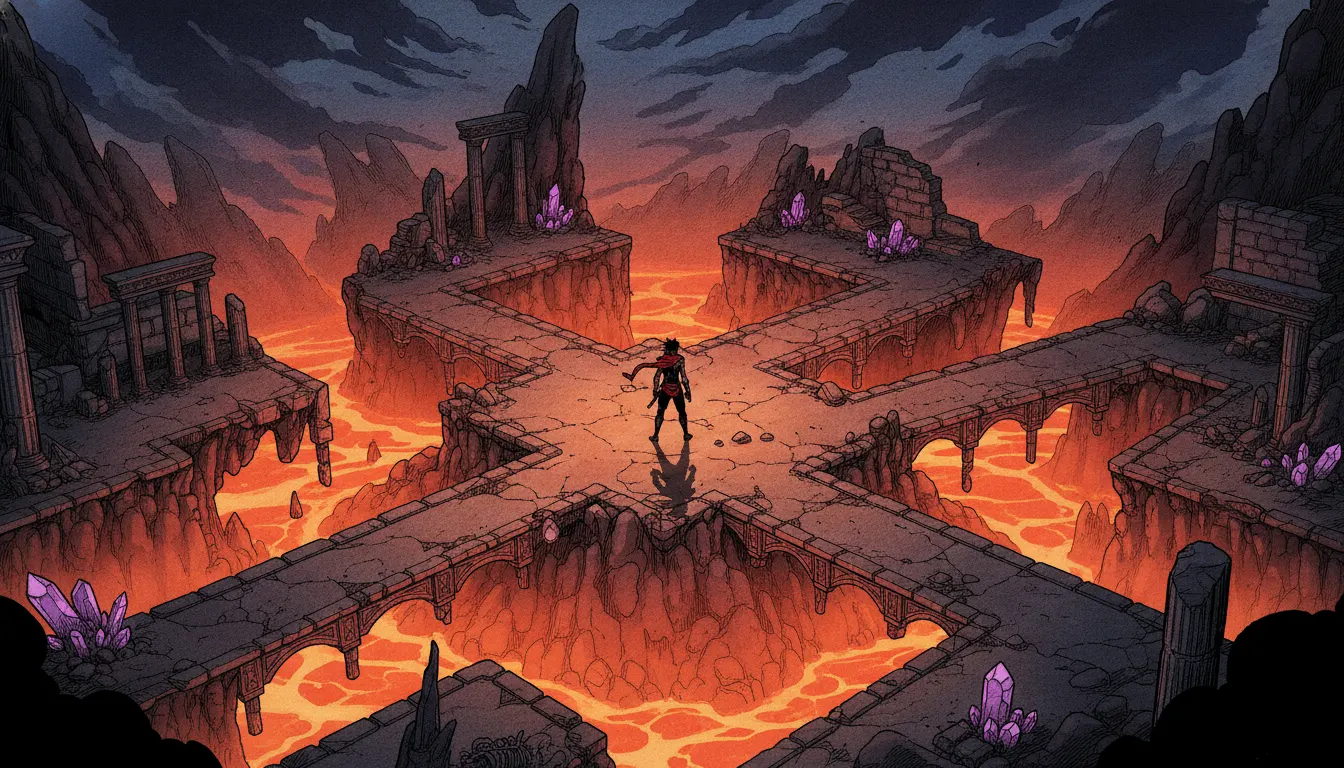
Hades
Supergiant Games / Jen Zee (art director) · 2020
Defining work: fully illustrated isometric underworld with 22,000 voiced lines and painterly 2.5D visual system
Hades Supergiant comic-game 2.5D. Hand-illustrated character art over isometric 3D arena, bold ink saturation.
The moves a human crew would use to get here. Cue applies them for you, and knowing their names is how you ask for a change.
Layered sprite planes with parallax depth creating three-dimensional space from flat illustrated assets, preserving painterly quality
Each major character assigned a dominant hue -- Zagreus red, Thanatos purple, Aphrodite pink -- readable at small sizes and across merchandise
Each underworld zone assigned a distinct atmospheric color key: deep blue for Tartarus, volcanic orange for Asphodel, warm gold for Elysium
Comic-weight ink outlines around characters layered over brushed-paint interior fills, combining comic clarity with illustration warmth
Profile poses and stylized musculature in character design referencing ancient Greek painted pottery within a contemporary illustration vocabulary
Character attack and dodge animations using foreshortened limb perspectives borrowed from comic book action conventions
Supergiant Games' Hades (2020, art director Jen Zee) established the most critically praised hand-crafted 2.5D game aesthetic of its generation. The studio, founded by Greg Kasavin and Amir Rao, had refined a signature style across Bastion (2011), Transistor (2014), and Pyre (2017) -- each pushing further toward the painterly, hand-finished quality that culminated in Hades' fully voiced, mythologically dense underworld.
Hades uses a roughly isometric camera with a slight downward tilt that creates the 2.5D illusion: characters and environments are rendered as layered flat-to-slightly-modeled sprites over fully illustrated backgrounds. The depth is achieved through parallax and careful z-ordering rather than full 3D geometry. This approach allows Jen Zee's painterly illustration style to remain dominant -- every room is a gallery piece.
Characters in Hades are drawn with a comic-book boldness: strong ink outlines, stylized musculature for the gods, and a rich variety of creature designs for the underworld enemies. Each major character has a distinct color identity -- Zagreus red-and-black, Thanatos purple-midnight, Aphrodite pink-gold. Facial expressions are highly readable at small screen sizes, with eyes and mouths using simplified but expressive geometry. The Greek mythological subjects allowed Zee to reference Attic vase painting geometry within a modern illustration vocabulary.
Hades uses aggressive color banding in its environments: Tartarus is deep blue-black with magenta fog; Asphodel is volcanic orange with ember particles; Elysium is warm gold with soft cyan ambient. These distinct color 'chapters' provide spatial orientation through an otherwise directionless roguelite structure and give the game its theatrical visual rhythm.
The line weight, dramatic foreshortening, and character close-up compositions in Hades reference European and American comic art -- particularly the dynamic poses of Jack Kirby and the character expressiveness of Craig Thompson. Hades 2 (Early Access 2024) extended the visual system with new character Melinoe and further refined the interplay between painted backgrounds and animated character sprites.
Hades' 22,000+ fully voiced lines required Supergiant to develop a portrait animation system where each character's close-up face portrait had hundreds of individually keyed expression states to match Greg Kasavin's dialogue. The portrait system is a key part of the visual identity: the oversized character portraits in the lower screen corners during dialogue reference the visual language of visual novels and Japanese dating sims, translated into a Greek mythology action game context.
Hades' roguelite structure means players see the same environments dozens of times per playthrough. The color-chapter system -- Tartarus blue-black, Asphodel orange, Elysium gold -- does double duty: spatial orientation for new players, and emotional conditioning for veterans who associate each palette with specific encounter difficulty and narrative content. The visual system had to work for a first-time visitor and remain engaging on a 50th run.
Supergiant Games / Jen Zee (art director) · 2020
Defining work: fully illustrated isometric underworld with 22,000 voiced lines and painterly 2.5D visual system
Supergiant Games / Jen Zee · 2024
Early Access sequel extending the visual system to new character Melinoe and expanded underworld environments
Supergiant Games · 2011
Supergiant's first title establishing the isometric painted aesthetic that Hades would fully develop
Supergiant Games · 2014
Science-fiction 2.5D entry with a more painterly art-deco color palette, demonstrating the style's genre flexibility
Supergiant Games · 2017
Sports-RPG hybrid pushing character portrait expressiveness and team-color identity further within the studio's 2.5D framework
Passtech Games / Focus Entertainment · 2021
Dark isometric action roguelite influenced by Hades' visual language, demonstrating wider aesthetic adoption
A Look is not a filter. It is a set of stored decisions the pipeline reads before it makes a single frame, so two videos in the same Look actually match.