Impression, Sunrise
Claude Monet · 1872
Le Havre harbor at dawn; the painting that named Impressionism; Musée Marmottan Monet, Paris
Claude Monet Impressionist plein-air. Broken brushstroke, water-lily light, atmospheric haze, pastel optical mixing.
The moves a human crew would use to get here. Cue applies them for you, and knowing their names is how you ask for a change.
Individual brushstrokes left unmixed and visible, building form through optical color mixing at viewing distance rather than physical mixing on the palette.
Color derived from direct observation of actual light conditions at a specific time of day and season, not from academic convention.
Shadows rendered in blue, violet, green, or warm orange depending on environmental reflection rather than neutral brown or black.
Distant forms dissolved into color and light rather than rendered with sharp edges, reflecting actual optical conditions of distance and air.
The same subject - haystacks, Rouen Cathedral, water lilies - painted dozens of times to isolate how light alone transforms visual experience of a stable form.
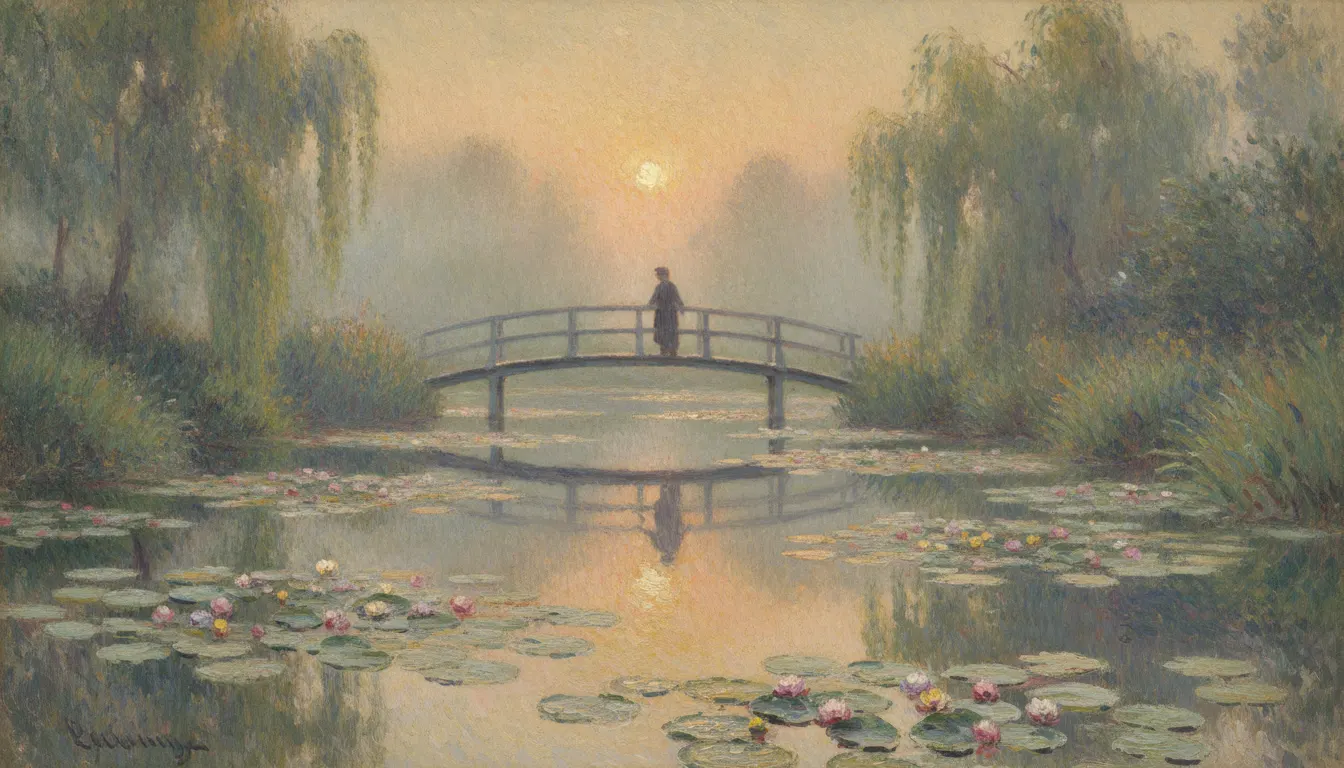
In the late Water Lilies, the elimination of horizon and ground in favor of a continuous reflective surface that merges sky and water, anticipating abstract color field.
Claude Monet (1840-1926) is the painter most completely identified with French Impressionism: the movement, named sarcastically after his painting Impression, Sunrise (1872) by critic Louis Leroy in Le Charivari, that transformed Western painting between 1870 and 1890 by substituting broken brushwork and direct optical observation for the glazed, blended finish of academic painting.
The Société anonyme des artistes peintres, sculpteurs, graveurs first exhibited in April 1874 at the Paris studio of photographer Nadar, in deliberate opposition to the official Salon. Monet's painting Impression, Sunrise - a small canvas showing the Le Havre harbor at dawn, orange sun on grey-blue water, the scene dissolved into the optical impression of a single glance - gave the movement its name and its defining concept: the rendering of a subjective perceptual impression rather than an objective description.
The Impressionist technique: short, broken brushstrokes that leave individual marks visible rather than blending them; painting en plein air (outdoors, in front of the subject) to capture actual light conditions; the observation that shadows are not brown or black but contain color reflected from the environment; the use of pure or near-pure pigment applied directly rather than mixed toward neutral tones.
Impression, Sunrise (1872, Musée Marmottan Monet, Paris) was the catalyst, but Monet's mature work developed in the series format: a single subject painted repeatedly under different light and weather conditions. The Haystacks series (1890-91, roughly 25 canvases) established the model - the same two haystacks in a Giverny field at dawn, noon, sunset, morning mist, winter snow, autumn light. The Rouen Cathedral series (1892-94, over 30 canvases) applied the same logic to an architectural subject: the west facade of Rouen Cathedral at different times of day, the stone surface dissolving into atmospheric color at noon, crystallizing into cool blue shadow in early morning.
The Water Lilies series (1896-1926, nearly 250 paintings) occupied the final 30 years of Monet's life and culminated in the large-format Nymphéas panels installed in the two oval rooms of the Orangerie in Paris (opened posthumously in 1927). These paintings - some measuring up to 14 meters wide - dissolve sky, water, and lily pads into a continuous field of color and brushwork without a horizon line, anticipating Color Field abstraction by three decades.
The Impressionist register translates to moving image through soft focus, shallow depth of field, high-key natural lighting, and the replacement of static documentary framing with observational camera work that accepts motion blur as a form of visual impression. Color grading toward warm light and cool shadow, with shadow areas exhibiting blue, violet, or green rather than grey-black, captures the Impressionist color observation.
Claude Monet · 1872
Le Havre harbor at dawn; the painting that named Impressionism; Musée Marmottan Monet, Paris
Claude Monet · 1890-91
~25 canvases; same Giverny field haystacks under dawn, noon, sunset, winter, autumn light - the series method established
Claude Monet · 1892-94
Over 30 paintings of the cathedral west facade at different times of day; stone dissolving into atmospheric color
Claude Monet · 1896-1926
~250 paintings; culminates in the Orangerie oval rooms (1927); the most sustained single-subject painting program in art history
Claude Monet · 1866-67
Early large-format en plein air work; dappled light on white dresses; pre-Impressionist breakthrough
Claude Monet (and simultaneously Pierre-Auguste Renoir) · 1869
Seine riverside recreation; the two painters working side by side; technical origin point of broken-brushwork Impressionism
Claude Monet · 1871
London atmospheric study; fog and mist dissolving architecture; later London series anticipates the Rouen Cathedral approach
A Look is not a filter. It is a set of stored decisions the pipeline reads before it makes a single frame, so two videos in the same Look actually match.