Woman with a Hat
Henri Matisse · 1905
The Salon d'Automne painting that crystallized the Fauvist critical controversy; portrait of Amélie Matisse in non-naturalistic color
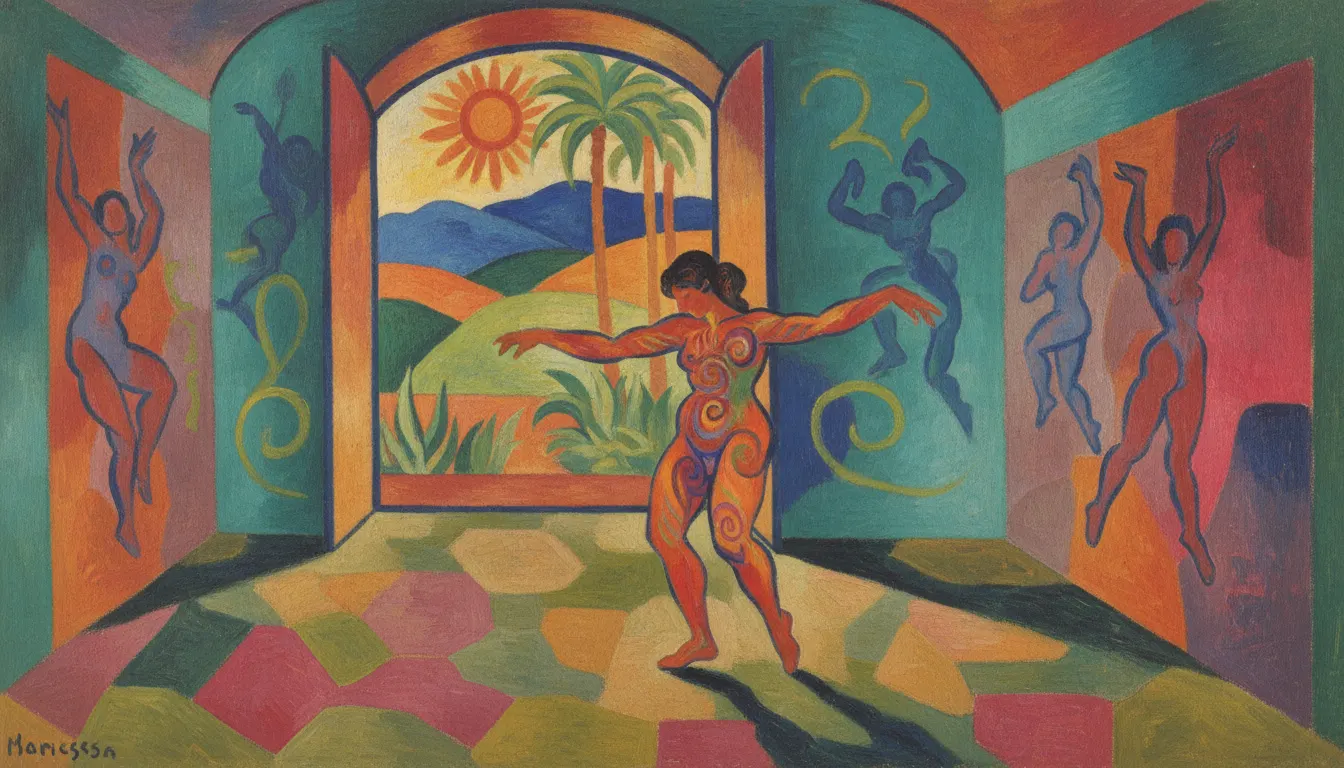
Henri Matisse Fauvist non-naturalistic color. Wild beast palette, flat patterned interiors, dancing figures, Mediterranean joy.
The moves a human crew would use to get here. Cue applies them for you, and knowing their names is how you ask for a change.
Color applied in broad, flat areas with no relation to observed natural light - a face might be green and purple, a sky orange, for structural or emotional reasons alone.
Outlines around figures and objects function as rhythmic decorative elements, not merely contours of form - they can exist without the form they describe.
Red against green, orange against blue, yellow against violet placed in close proximity create optical vibration that generates energy without movement.
Decorative textiles, wallpaper, and floor patterns placed on equal visual footing with figurative elements, creating dense, interlocking surface design.
Human forms reduced to bold silhouette shapes with minimal internal modeling, functioning as color-bearing planes rather than volumetric figures.
In later Matisse: sheets of paper painted in flat color, cut into shapes, and pinned or glued into compositions - the logical endpoint of Fauvist flatness.
Fauvism was the first major avant-garde movement of the 20th century, erupting at the 1905 Salon d'Automne in Paris, where a roomful of wildly color-distorted paintings by Henri Matisse, André Derain, Maurice de Vlaminck, and others prompted critic Louis Vauxcelles to describe the artists as 'fauves' - wild beasts. The movement was brief (roughly 1905-1908) but its impact was permanent: it severed color's obligation to describe natural appearances, freeing it to carry emotional, decorative, and structural weight independently.
Henri Matisse (1869-1954) is the central figure, and his work extends the Fauvist color revolution far beyond the movement's brief span into five decades of development. He studied under Gustave Moreau, absorbed Post-Impressionism through copying Chardin and Poussin at the Louvre, and encountered Cézanne's structural use of color around 1900.
Woman with a Hat (1905) was the painting that crystallized the critical controversy: a portrait of Matisse's wife Amélie, rendered with green and purple strokes across her face, a hat of orange, yellow, and blue, a background of rose and green. The color had no naturalistic justification - it was applied for structural and emotional effect. The painting was purchased by Gertrude and Leo Stein at the Salon d'Automne, conferring immediate critical attention.
The Joy of Life (La joie de vivre, 1905-06) is a large pastoral fantasy of figures dancing, reclining, and embracing in a landscape of acid green, pink, orange, and yellow. The figures are sinuous, unmodeled, their outlines functioning as decorative elements as much as contours. The Red Studio (1911) is a more austere achievement: a studio interior in which almost every surface - walls, floor, table - is a single field of cadmium red, against which objects (paintings, sculptures, vases) are outlined and positioned. The space is simultaneously flat and deeply real.
Dance (I) (1909) and Dance (II) (1910) show five figures in a circle against a ground of green (earth) and blue (sky), rendered with minimal modeling. These were among the most influential paintings of the early 20th century, combining Fauvist color with monumental scale and decorative simplification.
From the 1940s onward, Matisse's papiers decoupes (cut-paper works) - large compositions assembled from sheets of painted paper, including Jazz (1947) and The Snail (1953) - extended the color-field logic of Fauvism into pure abstraction.
The Fauvist-Matisse register: flat, unnaturalistic color applied in bold areas; outlines that function independently as decorative rhythm; figure-ground relationships in which objects are positioned within color fields rather than modeled by light and shadow; warm, high-energy palettes in which complementary color tensions generate visual vibration; decorative pattern integrated with figurative imagery.
Henri Matisse · 1905
The Salon d'Automne painting that crystallized the Fauvist critical controversy; portrait of Amélie Matisse in non-naturalistic color
Henri Matisse · 1905-06
Large pastoral with sinuous figures; acid green, pink, orange landscape; complementary color throughout
Henri Matisse · 1911
Studio interior in monolithic cadmium red; objects outlined and positioned in the color field
Henri Matisse · 1910
Five figures in circle against blue sky and green earth; monumental Fauvist simplification
Henri Matisse · 1905
The Fauvist breakthrough landscape; harbor view in acid green and pink
Henri Matisse · 1947
Papiers decoupes series; flat cut-paper color shapes extending Fauvist flatness into pure abstraction
Henri Matisse · 1953
Late cut-paper work; colored rectangles arranged in spiral; the complete abstraction of Fauvist color
A Look is not a filter. It is a set of stored decisions the pipeline reads before it makes a single frame, so two videos in the same Look actually match.