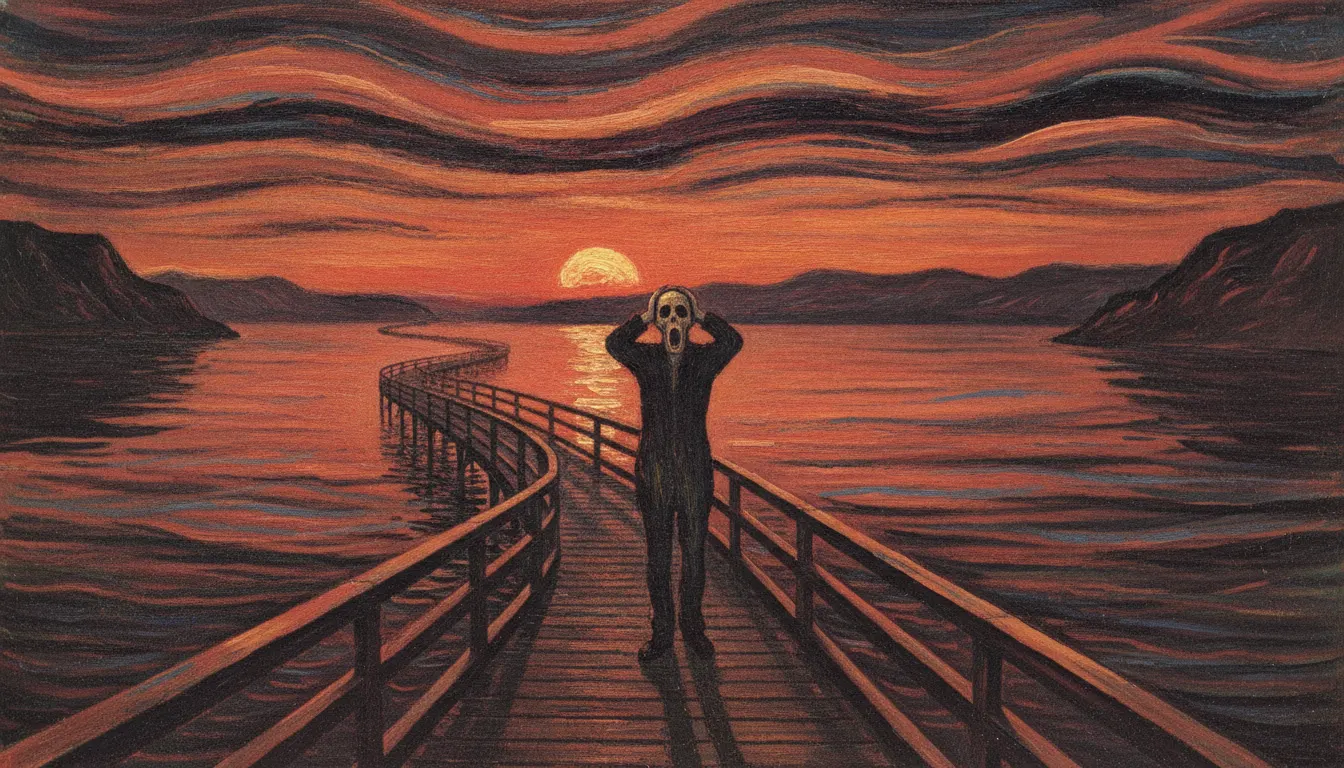
The Scream
Edvard Munch · 1893
Four versions; the 1893 oil-tempera-pastel is canonical; spectral figure on Oslo fjord walkway under blood-red sky
Edvard Munch The Scream Expressionism. Bleeding fjord sunset, undulating sky, anxiety-warped face, existential dread.
The moves a human crew would use to get here. Cue applies them for you, and knowing their names is how you ask for a change.
Natural forms - horizon lines, architecture, figures - bent and stretched by the emotional state of the perceiving subject; agitated mark quality amplifies internal states.
Sky rendered in blood-red and orange; water in acid blue-green; shadows in purple-black - color chosen for emotional rather than naturalistic accuracy.
Human subjects simplified toward archetypal emotional states - hands-to-face anguish, blank-eyed anxiety, closed-eye ecstasy - rather than individuated portraiture.
In The Scream and Anxiety, the ground plane and walkway hold their geometry while the sky writhes, creating a contrast that amplifies the subjective nature of the distortion.
In Madonna, the border of sperm and fetal forms extends the painting's symbolic argument beyond the image edge into the frame itself.
In prints, exposed wood grain texture creates an additional surface distortion layer, adding biological or geological pattern to the emotional distortion of form.
Edvard Munch (1863-1944) is the Norwegian painter whose work constitutes the single most important precedent for German Expressionism, and whose painting The Scream (1893) became the 20th century's most universally recognized image of psychic anguish. Expressionism as a formal movement prioritizes subjective emotional experience over objective representation: the world is distorted by the feeling of the person perceiving it.
Munch was born in Loten, Norway, and lost his mother and sister to tuberculosis in childhood - experiences that persisted as formative emotional material throughout his career. He studied in Oslo and Paris, absorbing Post-Impressionist color from Gauguin and Van Gogh, but pushed toward a more radical psychologizing of the painted surface.
The Scream exists in four versions: two pastels (1893, 1895) and two paintings (1893 oil-tempera-pastel on cardboard, 1910 tempera). The 1893 version, owned by the National Museum of Norway in Oslo, is the canonical image. Munch described its origin in his diary: walking near Oslo, he stopped on a path while his companions walked ahead, felt an 'infinite scream passing through nature,' and saw the sky turn 'blood-red.' The painting renders this subjective experience: a spectral figure on a walkway, hands pressed to its face, while the sky above the Oslo fjord writhes in bands of red, orange, and blue. The horizon is stable; the sky is turbulent; the figure occupies the border.
Madonna (1894-95) shows a nude female figure with closed eyes in an attitude between ecstasy and death, surrounded by a red halo and a frame of sperm forms. The Dance of Life (1899-1900) arranges figures in circular motion suggesting birth, attraction, and decay. Anxiety (1894) uses the same blood-red sky of The Scream over a crowd of spectral faces, multiplying the individual terror into collective dread.
Munch worked in both oil and printmaking, and his woodcut prints - particularly Kiss (1897-1902) and The Vampire (1895) - developed a graphic language of visible grain and bold simplified form that directly influenced German Expressionist printmakers.
The defining visual properties of the Munch-Expressionist register include: sinuous, agitated brushstroke or line that distorts natural form in the direction of emotional emphasis; unnatural, psychologically charged color (the reds and oranges of existential dread, the blue-greens of isolation); perspectival distortion that destabilizes the viewer's spatial position; figures reduced to emotional archetypes rather than individualized portraits.
Die Brücke (The Bridge, 1905-1913) - Ernst Ludwig Kirchner, Karl Schmidt-Rottluff, Erich Heckel - and Der Blaue Reiter (The Blue Rider, 1911-1914) - Wassily Kandinsky, Franz Marc - directly extended Munch's emotional-distortion vocabulary in painting and printmaking. The Expressionist aesthetic flowed into Expressionist cinema (The Cabinet of Dr. Caligari, 1920; Nosferatu, 1922) and from there into virtually every dark-toned visual medium of the 20th century.
Edvard Munch · 1893
Four versions; the 1893 oil-tempera-pastel is canonical; spectral figure on Oslo fjord walkway under blood-red sky
Edvard Munch · 1894
Nude figure in ecstatic-death posture; red halo; frame of sperm motifs
Edvard Munch · 1894
Crowd of spectral faces under the same blood-red sky as The Scream; collective terror
Edvard Munch · 1899
Circular dance of figures representing the life cycle from desire to age
Edvard Munch · 1897
Two figures merging at lips against wood-grain background; the printmaking translation of Expressionist line
Robert Wiene (dir.) · 1920
German Expressionist cinema; painted distorted sets in direct lineage from Munch's spatial distortion
Edvard Munch · 1911
University of Oslo mural; Expressionist technique applied at monumental scale
A Look is not a filter. It is a set of stored decisions the pipeline reads before it makes a single frame, so two videos in the same Look actually match.
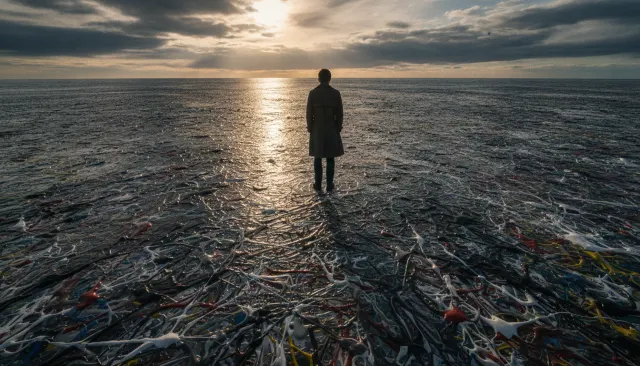 Art Movement ModernAbstract Expressionism Pollock
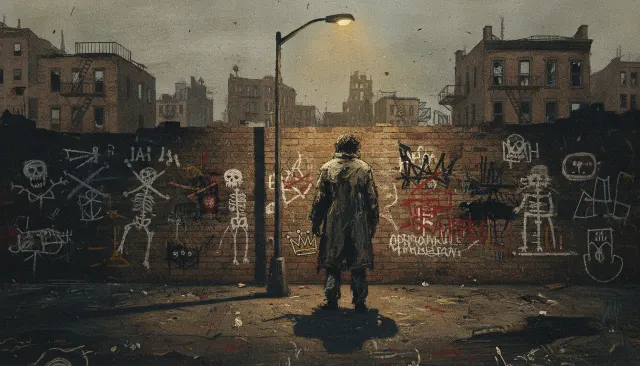 Pop And Street ArtBasquiat Graffiti Neo-Expressionism
 Director Aesthetic ModernDavid Cronenberg Body Horror Clinical
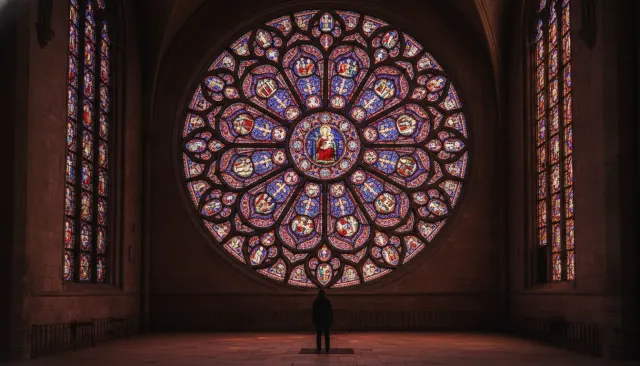 Medieval VictorianGothic Cathedral Stained Glass
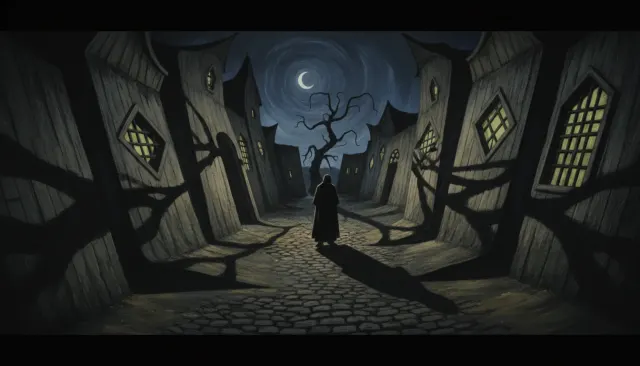 Cinema Era VintageGerman Expressionism Caligari 1920
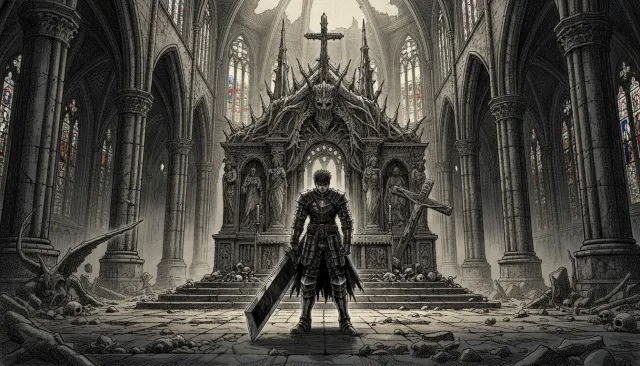 90S Manga AestheticsBerserk Dark Fantasy Ink Detail