Chartres Cathedral Windows
Various medieval workshops · c.1150-1250
The most complete surviving Gothic glass program; 176 windows, 10,000 sq ft; the Three West Lancets (c.1150) among the oldest Gothic glass
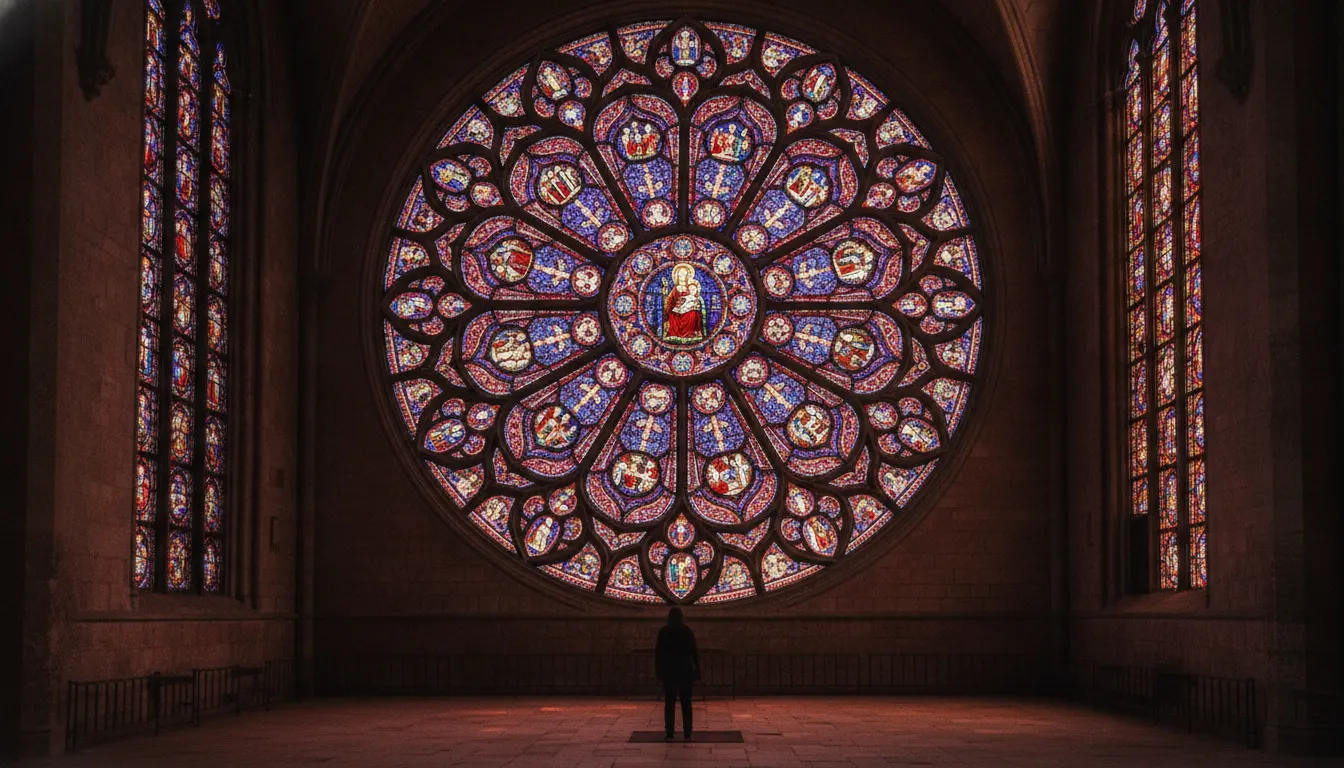
Chartres Gothic stained-glass window. Lead-came outlined jewel panes, backlit cobalt and ruby, saints and biblical narrative round.
The moves a human crew would use to get here. Cue applies them for you, and knowing their names is how you ask for a change.
Cobalt blue, ruby red, emerald green, and golden yellow glass at high saturation, requiring transmitted light to activate - colors appear luminous rather than pigmented.
H-profile lead channels joining glass pieces create a black linear network that functions simultaneously as structural element and graphic outline.
Figures scaled by theological importance rather than spatial logic - Christ or the Virgin larger than apostles, apostles larger than donors - without perspectival depth.
Black iron-oxide paint applied to glass surface and kiln-fired for facial features, drapery folds, and architectural details - creating line detail that cannot be achieved by glass color alone.
Individual scenes enclosed in circular medallions, quatrefoil lobes, or lancet panels arranged in vertical registers, creating an episodic visual narrative across a single window.
Circular rose windows divided into radiating sections by stone tracery, creating mandala-like compositions that organize complex iconographic programs within formal symmetry.
Gothic stained glass is the defining visual medium of the High Gothic cathedral program in Europe (roughly 1140-1350), and remains one of the most technically demanding and visually powerful forms of architectural art. Unlike most visual media, stained glass is transmissive rather than reflective - it requires light to pass through rather than bounce off it, making the viewing environment (the interior of a stone cathedral with limited ambient light) an essential part of the visual experience.
The Gothic stained glass tradition began with the rebuilding of the Abbey Church of Saint-Denis near Paris under Abbot Suger (c.1135-1144). Suger's theological program, influenced by Pseudo-Dionysian mysticism, held that divine light entering the stone structure could transport worshippers toward spiritual experience. The technical innovation that enabled this was the development of blue glass with intense color saturation - the 'Chartres blue,' a cobalt-based glass of distinctive hue that transformed the interior of Chartres Cathedral (rebuilt after the 1194 fire) into the most complete surviving Gothic stained glass program.
Chartres Cathedral contains 176 windows with approximately 10,000 square feet of medieval glass, ranging from the three west lancet windows (c.1150, among the oldest surviving Gothic glass) to the rose windows of the north and south transepts (c.1230). The iconographic program encompasses the life of Christ, Old Testament narratives, hagiography, and donor portraits (guilds of merchants and craftsmen who funded individual windows).
Sainte-Chapelle in Paris (consecrated 1248), built by Louis IX to house the Crown of Thorns, takes the Gothic glass program to its extreme: 15 windows of 50 feet each, covering 6,458 square feet of wall area with almost no stone visible in the upper chapel. The interior is effectively a glass lantern with structural ribs.
The Canterbury Cathedral windows (c.1180-1220) in England, the Grisaille windows of York Minster (c.1290), and the Gothic revival glass of the 19th century (Edward Burne-Jones's windows for Morris & Co., 1860s-1890s) extend the tradition chronologically.
The defining visual language: intense, saturated jewel tones (cobalt blue, ruby red, emerald green, golden yellow) separated by lead cames (H-profile lead channels joining individual glass pieces); flat, hierarchically scaled figures without perspectival depth; bold black-paint detail lines (grisaille painting on the glass surface for facial features and drapery folds); narrative compartment organization using circular, quatrefoil, and lancet panel shapes; and the fundamental condition of transmitted rather than reflected light, which makes the colors appear luminous from within.
Various medieval workshops · c.1150-1250
The most complete surviving Gothic glass program; 176 windows, 10,000 sq ft; the Three West Lancets (c.1150) among the oldest Gothic glass
Various medieval workshops (commissioned by Louis IX) · c.1243-1248
6,458 sq ft of glass in 15 windows; the extreme limit of the Gothic glass-wall program
Various English workshops · c.1180-1220
Early English Gothic glass; narrative typological windows relating Old and New Testament
York workshops · c.1260
Grisaille (uncolored grey-white) glass in lancet panels; non-narrative decorative Gothic program
Edward Burne-Jones (designer), William Morris (manufacturer) · 1860s-1890s
Gothic Revival stained glass; Pre-Raphaelite figure style translated into medieval technique
Louis Comfort Tiffany · 1890s-1930s
American Art Nouveau glass; opalescent glass technique developing the medieval tradition into a new material register
A Look is not a filter. It is a set of stored decisions the pipeline reads before it makes a single frame, so two videos in the same Look actually match.