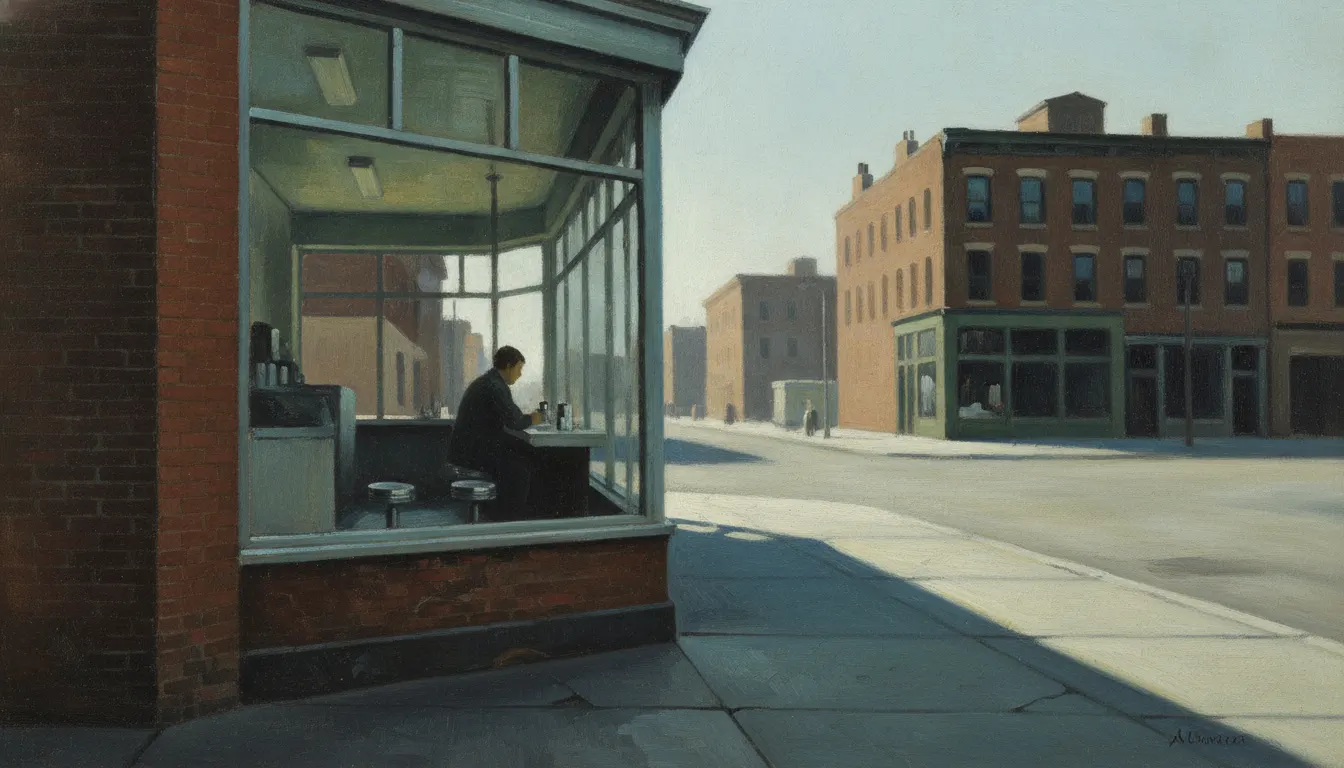
Nighthawks
Edward Hopper · 1942
All-night Greenwich Village diner; fluorescent light on empty street; the definitive urban American solitude painting
Edward Hopper Nighthawks American realism. Painted urban loneliness, hard daylight on brick, glass-front diner, isolation in shared space.
The moves a human crew would use to get here. Cue applies them for you, and knowing their names is how you ask for a change.
Light enters from one direction - usually a large window or artificial source - throwing geometric shadows and isolating figures against lit planes.
The inside of a lit room against an exterior of dark blue or black night, or vice versa, creating a sense of enclosure and separation from the world outside.
Human subjects turned away from viewer, absorbed in private thought, or positioned as compositional elements rather than emotional focal points.
Buildings and interiors reduced to essential geometric planes, eliminating decorative detail to concentrate formal and emotional weight.
Warm light sources in yellow, amber, and green-white contrasted with cool blue-grey shadows and exterior tones.
Human figures occupy less frame space than architecture, reinforcing smallness and psychological exposure within large institutional or domestic spaces.
Edward Hopper (1882-1967) is the painter most completely identified with a particular quality of American solitude: the quality of being alone in a public or domestic space, aware of other lives continuing elsewhere, in strong directional light. His canvases are not photographs - they are architectural and psychological constructions, painstaking arrangements of observed American spaces that transform into emotional arguments.
Hopper studied under Robert Henri at the New York School of Art (1900-1906), traveled to Europe three times (1906-1910), and worked as a commercial illustrator for two decades while building his fine art career. The New York Realist tradition he inherited pushed toward documentary observation; Hopper steered it toward psychological isolation.
His working method was famously slow and deliberate. Sketches accumulated over months; final canvases often required weeks of revision. He worked primarily in oil on canvas and watercolor, and his architectural subjects - diners, gas stations, hotel rooms, office buildings, lighthouses on the New England coast - were drawn from direct observation but then radically simplified and rearranged.
Nighthawks (1942) is the most replicated American painting of the 20th century: four figures in an all-night diner at a corner in Greenwich Village, seen from outside through a curved glass wall, the diner's cold fluorescent light throwing a green-white pool onto the empty street. No door is visible. The painting was executed from sketches made at a diner on Greenwich Avenue that no longer exists.
Automat (1927) shows a woman alone at a table in a large automat restaurant, cup of coffee in hand, staring downward. One glove remains on her hand; the other has been removed and placed on the table. The window behind her reflects the lights of the interior - outside is only darkness. Gas (1940) shows a rural gas station at dusk, an attendant working the pumps, the road disappearing into a dark tree line. Nighthawks, Automat, Gas, New York Movie (1939), and Morning Sun (1952) collectively define the visual and emotional territory.
Hopper's paintings are characterized by strong raking light entering from a single direction - sunlight through tall windows, fluorescent commercial light against exterior darkness. Shadows are solid and geometric, simplifying architectural forms. Color leans toward yellow-white light sources, warm ochre walls, and cool blue-green shadows.
Figures are present but psychologically unavailable: turned away, absorbed in private thought, occupying the same space as the viewer but operating in a different register of attention. Scale relationships between figures and architectural settings tend to diminish the figures, making them elements of the composition rather than its emotional center.
Hopper directly influenced cinematographers Vilmos Zsigmond, Conrad Hall, and Gordon Willis, and his compositions are quoted explicitly in films from Psycho (1960, Saul Bass's storyboards) to *Wim Wenders's work. His gas station paintings are the visual template for countless road-trip and crime-film compositions.
Edward Hopper · 1942
All-night Greenwich Village diner; fluorescent light on empty street; the definitive urban American solitude painting
Edward Hopper · 1927
Woman alone with coffee in a large restaurant; window reflecting interior lights against outside darkness
Edward Hopper · 1940
Rural filling station at dusk; attendant at pumps; road disappearing into dark tree line
Edward Hopper · 1939
Movie theater usherette standing alone in a side corridor while a film projects behind her
Edward Hopper · 1952
Woman on a bed in a sunlit room, staring out a window at a city exterior
Edward Hopper · 1940
Boss and secretary in a late-night office; artificial light, psychological distance
Edward Hopper · 1939
Couple on a porch with a dog; the domestic setting rendered melancholy through stillness
A Look is not a filter. It is a set of stored decisions the pipeline reads before it makes a single frame, so two videos in the same Look actually match.