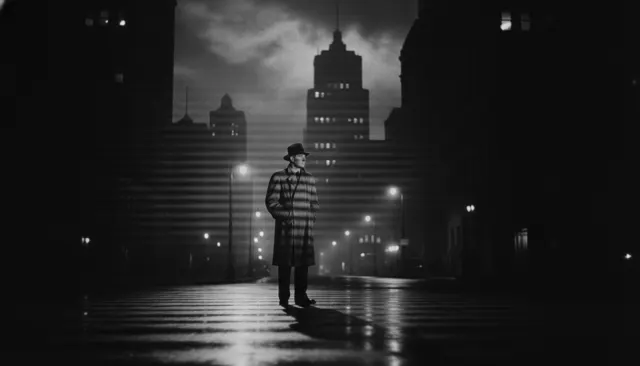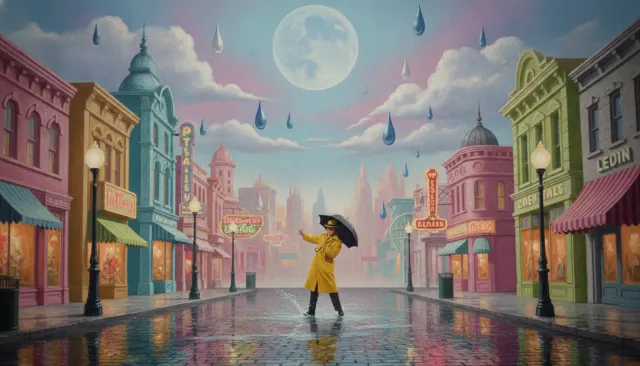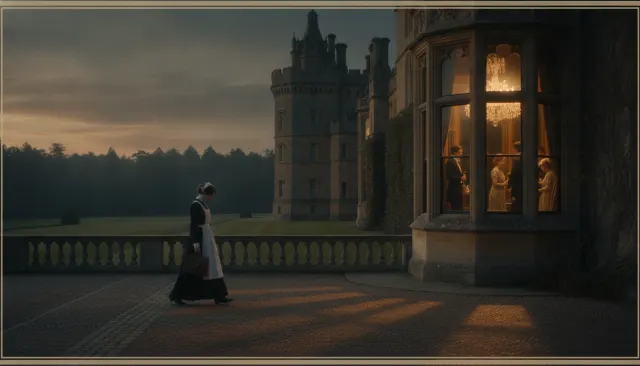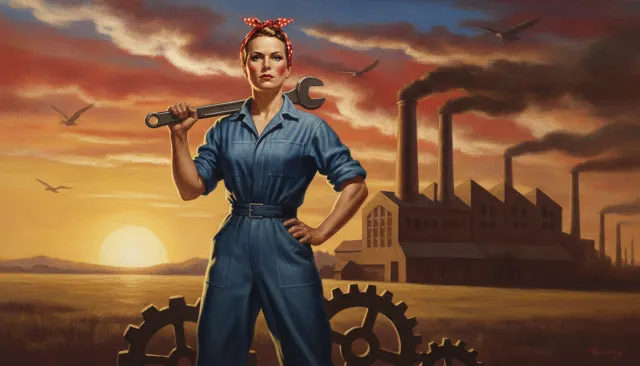
Leave Her to Heaven
John M. Stahl / Leon Shamroy (DP) · 1945
The defining color-noir; Academy Award-winning Technicolor cinematography
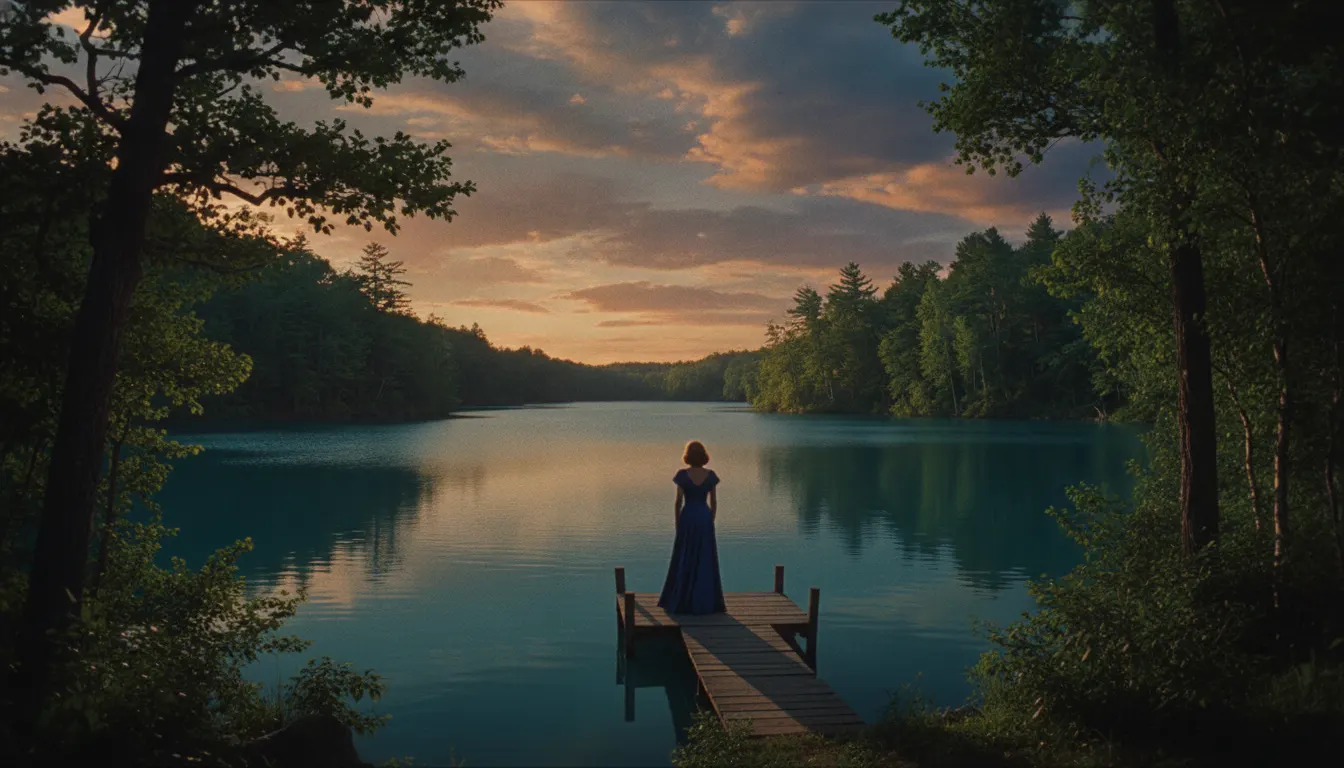
Rare 1940s noir shot in three-strip Technicolor. Leave Her to Heaven blood-red lipstick against teal lake, lush saturated dread.
The moves a human crew would use to get here. Cue applies them for you, and knowing their names is how you ask for a change.
Primary colors boosted 15-25% to match the richness of physical three-strip Technicolor dye-transfer printing.
Warm amber key light paired with teal or cool-green fill creates raking colored shadow on faces.
Small aperture keeps foreground objects and background set detail simultaneously sharp, layering menace across the full frame.
Specular highlights in the red channel bleed softly outward, mimicking optical printer artifacts of period Technicolor prints.
Period-accurate lap dissolves replace cuts, softening temporal jumps while maintaining continuity with 1940s editing grammar.
Camera placed below eye-line looking up at the protagonist, amplifying power and visual dominance within the ornate color field.
Film noir is remembered as a world of shadows and black-and-white, yet a small, luminous subset of 1940s crime pictures were photographed in three-strip Technicolor - and the contrast between the aesthetic's moral darkness and the process's hyper-saturated palette produced some of the most unsettling images in Hollywood history.
Three-strip Technicolor, perfected by the mid-1930s, required a proprietary Technicolor camera and a team of company-appointed color consultants. Most studios used the process for musicals and adventure epics where vivid color was a selling point. In 1945, John M. Stahl and cinematographer Leon Shamroy turned that logic inside out with Leave Her to Heaven, photographing Gene Tierney's poisonous domestic obsession in colors so lush they became sinister: blood-crimson lipstick against deep teal lake water, sun-bleached Arizona sandstone, a picnic tableau that feels wrong because everything is too beautiful. The film earned Shamroy an Academy Award.
Niagara (1953, cinematographer Joseph MacDonald) extended the tradition, wrapping Marilyn Monroe in saturated greens and pinks against the roaring falls - a femme fatale in Technicolor spectacle rather than shadow.
The three-strip process separated the image through a beam-splitter prism onto three strips of black-and-white film, each recording one primary color. During printing, cyan, magenta, and yellow dye-transfer layers were applied to a final print, yielding a richness no later photochemical process matched until digital intermediate.
For noir application, cinematographers deployed primary-color gel fills to sculpt faces with raking colored shadow - a warm amber key against a cool teal fill was a period standard. Deep focus kept both foreground objects and background architectural detail sharp, allowing the composition to layer menace across the entire frame rather than isolating it with shallow focus. Dissolves averaging 440ms served as transitions, softening temporal cuts while maintaining period continuity.
The use of Technicolor in noir functioned as an inversion of genre expectation. Audiences associated saturated hues with escapism; placing morally compromised characters inside that palette made familiar domestic spaces feel predatory. The strategy anticipates Todd Haynes's Far from Heaven (2002) and Douglas Sirk's Technicolor melodramas of the 1950s, which similarly deployed gorgeous color to comment on social repression.
Digital colorists reference this look through hyper-saturation curves that push reds and teals simultaneously while preserving skin luminance. The LUT family built around Leave Her to Heaven typically boosts primary channels 15-25%, crushes midtones slightly, and introduces a warm halation bloom around specular highlights. Contemporary productions invoking period dread - true-crime reconstructions, historical thrillers - reach for this palette when they want menace that feels gilded rather than shadowed.
John M. Stahl / Leon Shamroy (DP) · 1945
The defining color-noir; Academy Award-winning Technicolor cinematography
Henry Hathaway / Joseph MacDonald (DP) · 1953
Marilyn Monroe femme fatale in saturated Technicolor spectacle
Gene Kelly / Harold Rosson (DP) · 1952
Peak three-strip exuberance against which noir color reads as inversion
Todd Haynes / Edward Lachman (DP) · 2002
Digital revival of Sirkian Technicolor to encode social repression
Delmer Daves / Bert Glennon (DP) · 1947
Rural color thriller using pastoral greens to heighten dread
William Dieterle / Charles Lang (DP) · 1949
Desert noir in saturated Technicolor heat haze
A Look is not a filter. It is a set of stored decisions the pipeline reads before it makes a single frame, so two videos in the same Look actually match.