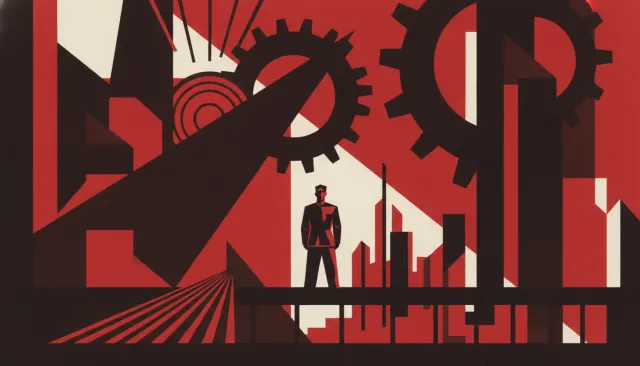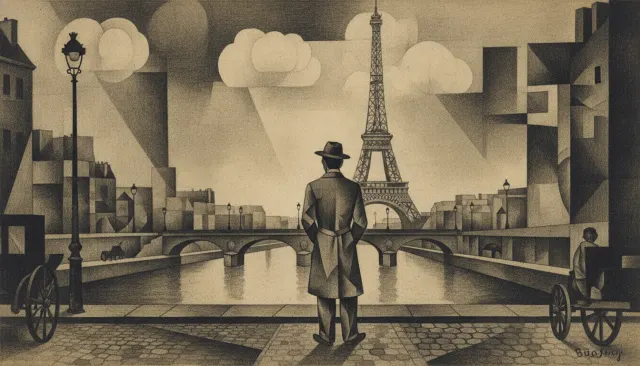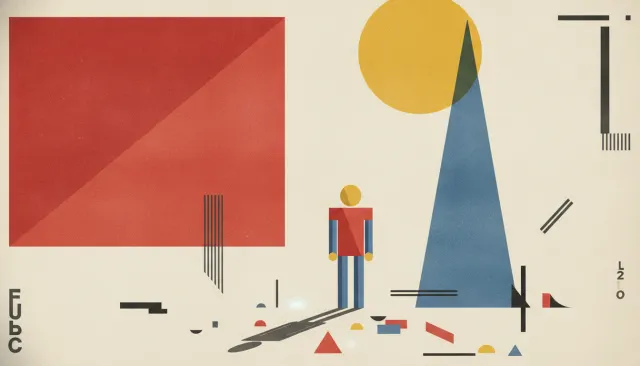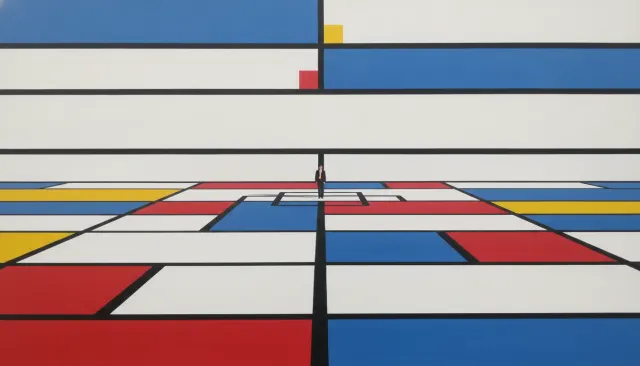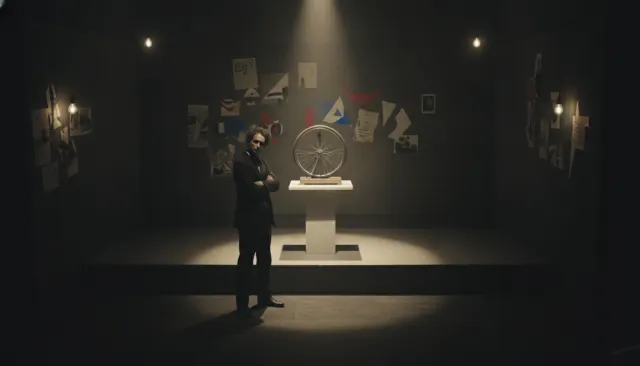
Manifesto of Futurism
F.T. Marinetti · 1909
Published in Le Figaro; the founding document declaring war on the past and celebrating speed, technology, conflict
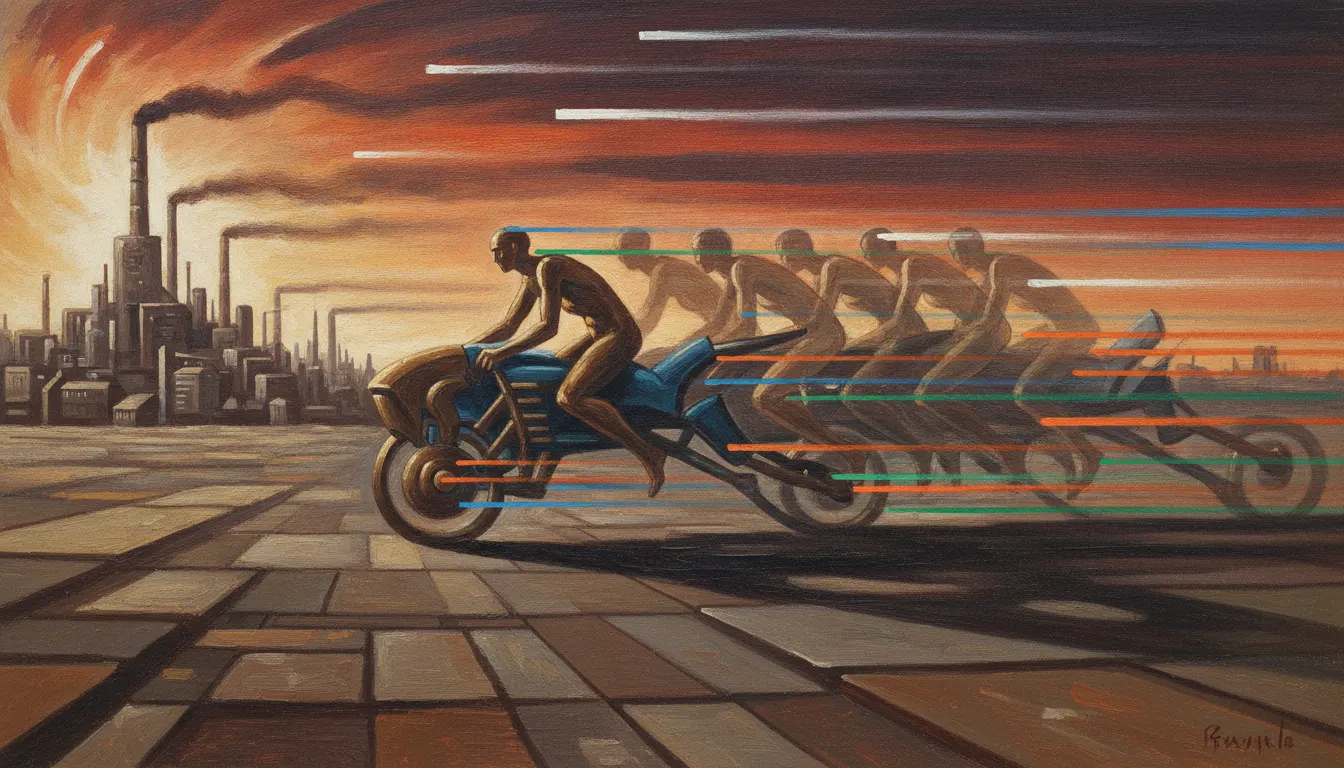
Italian Futurism Marinetti manifesto era. Speed lines, machine dynamism, force lines, Boccioni dog-on-leash motion blur.
The moves a human crew would use to get here. Cue applies them for you, and knowing their names is how you ask for a change.
Strong diagonal lines radiating from moving subjects, suggesting directional force and speed - the foundational Futurist motion mark.
A moving subject shown in multiple overlapping positions simultaneously, creating the visual blur of motion as in Balla's Dachshund (1912) or Boccioni's Soccer Player (1913).
Figures and environments dissolve into each other through overlapping translucent color planes, eliminating the boundary between subject and context.
Arrow or triangular wedge shapes embedded in the composition suggesting kinetic forces acting on and through subjects.
Orange, red, and yellow for energy and heat; blue, grey, and mechanical green for machine-world elements - the color grammar of the Futurist dynamic.
Multiple moments in time collapsed into a single image, prioritizing the experience of a process over any single documentary instant.
Italian Futurism was the first 20th-century art movement to make speed, technology, and industrial power its explicit subject matter. Founded with the publication of Filippo Tommaso Marinetti's Manifesto of Futurism in the Paris newspaper Le Figaro on February 20, 1909, it declared war on the past - museums, libraries, academies, and every form of cultural stasis - and celebrated the machine, the automobile, the airplane, the electric city, and the energy of modern industrial life.
Marinetti (1876-1944), poet and provocateur, announced Futurism as a rejection of everything old in favor of velocity, conflict, and the machine aesthetic. The Futurist painters - Umberto Boccioni (1882-1916), Giacomo Balla (1871-1958), Carlo Carrà (1881-1966), Gino Severini (1883-1966), and Luigi Russolo (1885-1947) - published their own Manifesto of the Futurist Painters (1910) and Technical Manifesto of Futurist Painting (1910), which articulated the visual program: the simultaneous representation of multiple moments in time within a single image, the interpenetration of forms to convey motion, the use of color and line to produce what they called 'dynamism.'
Umberto Boccioni's States of Mind: The Farewells (1911) shows a train departure as a swirl of interpenetrating forms - locomotive, figures, steam, emotion - in a composition that dissolves the boundary between figure and environment. His Dynamism of a Soccer Player (1913) renders a moving figure as a cascade of overlapping translucent planes. Giacomo Balla's Dynamism of a Dog on a Leash (1912) - popularly known as the Dachshund painting - shows a small dog and its leash as a blur of overlapping multiple-exposure legs and chain links, capturing motion in a single static image.
Balla's Abstract Speed + Sound (1913-14) went further: traffic and its noise rendered as pure geometric form, a composition of interpenetrating arrow-like shapes and diagonal color bands without any recognizable figurative reference.
The Futurist visual vocabulary is built from diagonal lines suggesting velocity and direction; repeated forms creating the stroboscopic blur of motion; arrows and wedge shapes implying forces in conflict; interpenetrating transparent planes showing simultaneous positions; and color that shifts from warm-energy tones (orange, red, yellow) to cool-mechanical tones (blue, grey) within a single field.
Futurism's visual language was directly absorbed by Russian Constructivism (1915-1930s), the international avant-garde, Art Deco streamlining, and eventually 20th-century motion graphics. Its vocabulary of speed-lines, motion blur, diagonal dynamism, and industrial color appears in everything from 1930s aerodynamic design to contemporary action sports photography.
F.T. Marinetti · 1909
Published in Le Figaro; the founding document declaring war on the past and celebrating speed, technology, conflict
Giacomo Balla · 1912
Dachshund in motion rendered as overlapping multiple-exposure legs; accessible demonstration of Futurist simultaneity
Umberto Boccioni · 1911
Train departure as swirl of interpenetrating forms; locomotive, figures, steam, emotion dissolved together
Umberto Boccioni · 1913
Moving figure as cascade of overlapping translucent planes; the figure-as-motion-field
Giacomo Balla · 1913-14
Traffic and noise as pure geometric form; the complete abstraction of Futurist velocity
Umberto Boccioni · 1910
Large-scale industrial scene; horses and workers in swirling energy; transitional pre-Futurist to Futurist work
Boccioni, Carrà, Russolo, Balla, Severini · 1910
Collective theoretical statement; the visual program for dynamism and simultaneity
A Look is not a filter. It is a set of stored decisions the pipeline reads before it makes a single frame, so two videos in the same Look actually match.