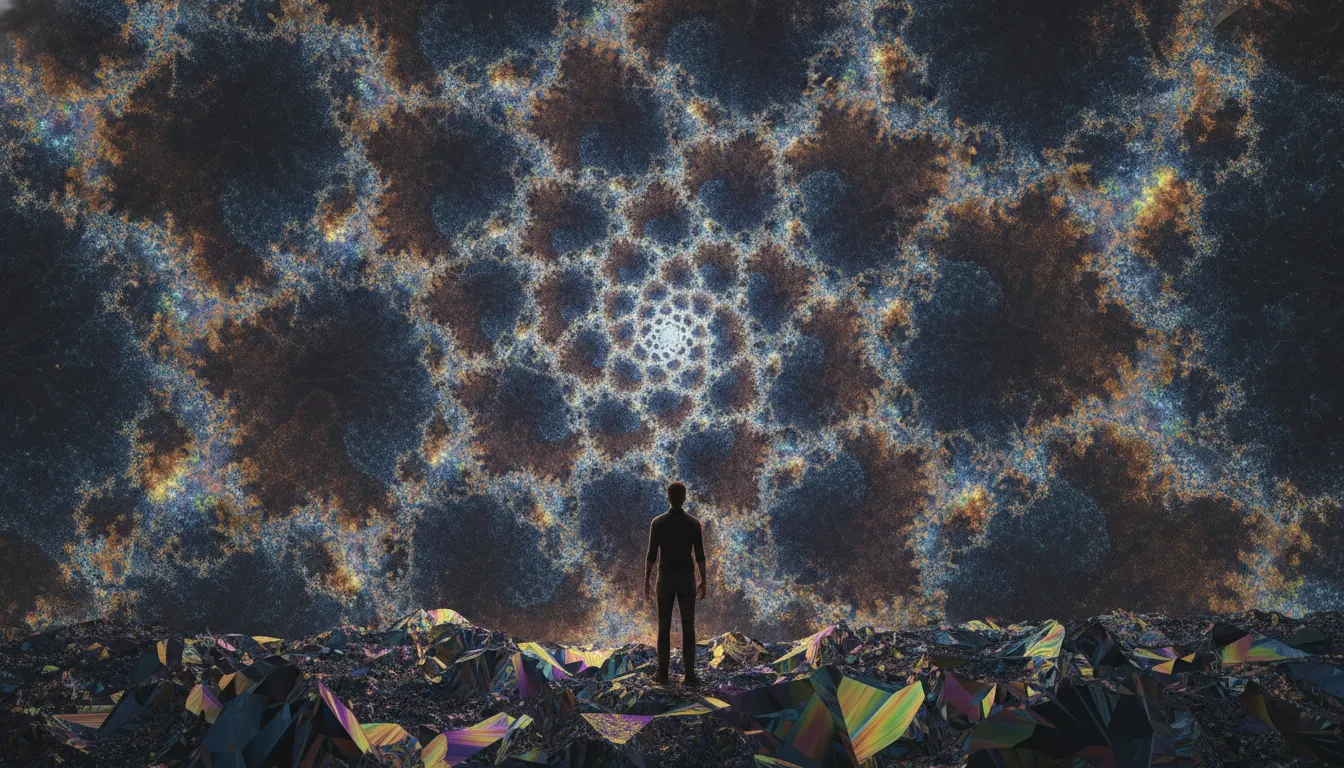
Benoit Mandelbrot first Mandelbrot set computations (IBM Watson Research, 1980)
origin event
Mandelbrot set fractal aesthetic. Infinite-zoom self-similar pattern with iridescent color cycling through escape-time iteration count, mathematical beauty.
The moves a human crew would use to get here. Cue applies them for you, and knowing their names is how you ask for a change.
velocity coloring: hue mapped to iteration count at escape threshold, producing characteristic banded rainbow gradients
eliminates banding by interpolating fractional escape count, producing smooth gradient fields
exponential camera move into the Mandelbrot boundary, maintaining a fixed target point across billions of iterations
companion set derived from a fixed C value, sharing boundary structure with the Mandelbrot set but with different topology
rotating the color lookup table through time without recomputing the fractal, creating hypnotic motion
volumetric extension of the Mandelbrot formula into three dimensions, producing sculptural organic structures
density-colored iterated function system producing feather-like organic fire and plasma forms
The Mandelbrot set was computed and visualized by Benoit Mandelbrot at IBM's Thomas J. Watson Research Center in 1980, building on the mathematical work of Pierre Fatou and Gaston Julia from the early 20th century. The set is defined by the iteration of the complex quadratic polynomial Z_{n+1} = Z_n² + C: a point C in the complex plane belongs to the Mandelbrot set if iterating this equation from Z_0 = 0 never causes the magnitude |Z| to exceed 2. Points inside the set are conventionally colored black; points outside are colored by their escape velocity - how many iterations before they exceed the threshold - producing the characteristic banded color gradients surrounding the main cardioid and bulbs.
Mandelbrot's initial computational images were produced on IBM mainframes at low resolution, printed on line printers or dot-matrix devices. The key mathematical insight - infinite self-similar boundary complexity at every scale of magnification - could only be partially glimpsed in these early images. As computing power increased through the 1980s, the fractal's infinite depth became accessible: each zoom reveals the same cardioid-and-bulb structure at arbitrarily fine scales, with new complexity emerging at every level. Heinz-Otto Peitgen and Peter Richter's 'The Beauty of Fractals' (Springer, 1986) brought high-quality fractal visualizations to a broad scientific and artistic audience, establishing the aesthetic canon.
By the early 1990s, Mandelbrot set posters decorated dormitory rooms globally; the imagery became synonymous with the mathematical sublime and computer graphics capability. Tools including Fractint (1988, Stone Soup Group, the defining freeware fractal renderer), Ultra Fractal (1999, Frederik Slijkerman), Mandelbulb3D (2009, Jesse for 3D fractal rendering), and Frax (2012, iOS) have kept fractal rendering accessible. Contemporary zooms by Maths Town on YouTube achieve depths of 10^1000 and beyond, taking advantage of arbitrary-precision arithmetic and GPU acceleration.
Benoit Mandelbrot's broader contribution was the concept of fractal geometry as a description of natural forms - he coined the term 'fractal' (from Latin fractus, broken) in 1975, and his 1982 book 'The Fractal Geometry of Nature' (W.H. Freeman) argued that coastlines, mountain ranges, clouds, and river networks are statistically self-similar at multiple scales in ways that Euclidean geometry cannot describe. The Mandelbrot set's infinite boundary complexity embodies this principle mathematically. This natural-world connection - fractal patterns appear in broccoli (Romanesco, D~2.7), fern fronds, lightning branching, snowflake crystallization, and retinal blood vessels - gives fractal aesthetics a dual character: simultaneously rigorously mathematical and organically natural.
Beyond the Mandelbrot set specifically, the fractal aesthetic encompasses Julia sets, Newton fractals, Barnsley fern iterated function systems (IFS), Lyapunov fractals, and fractal flames (Scott Draves, 1992 - generalized IFS with logarithmic density coloring). These related forms share self-similarity, recursive depth, and organic-mathematical complexity that resonates in psychedelic, new age, mathematical, and generative art contexts. The demoscene embraced fractal rendering as a benchmark: producing real-time Mandelbrot zoom demos on Amiga 500 hardware (1989-1992) demonstrated programming expertise, and fractal scenes remain a staple of demo competitions including Revision (Germany, annual) and Assembly (Finland, annual).
origin event
aesthetic canonization
democratizing fractal rendering
1994
most-watched fractal documentary, with voice of Clarke
defining animated fractal flame form
fractal flame animation at network scale
deepest accessible fractal zooms for general audiences
fine art fractal rendering benchmark
A Look is not a filter. It is a set of stored decisions the pipeline reads before it makes a single frame, so two videos in the same Look actually match.
 Ai Generated AestheticDeep Dream Hallucinated Eyes Fur
 Light ExperimentalBioluminescent Glow Low Light
 Media Decay PhysicalDouble Exposure Portrait Nature
 Art Movement ModernAbstract Expressionism Pollock
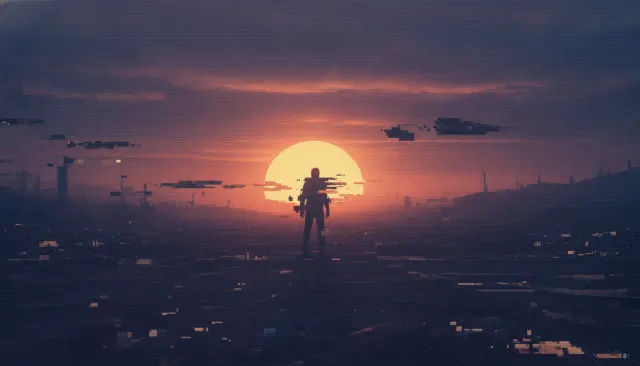 Digital DecayDatamosh Pixel Sorting Corruption
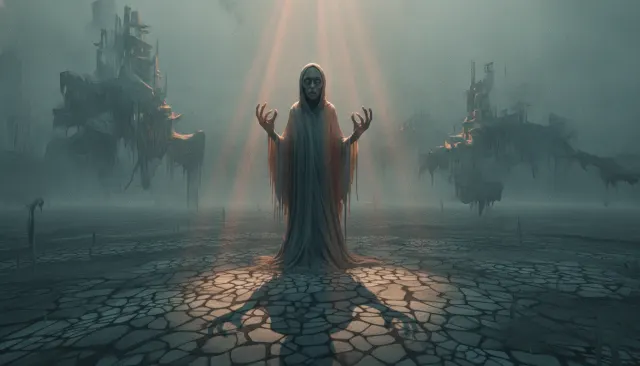 Ai Generated AestheticEarly Stable Diffusion Uncanny 2022