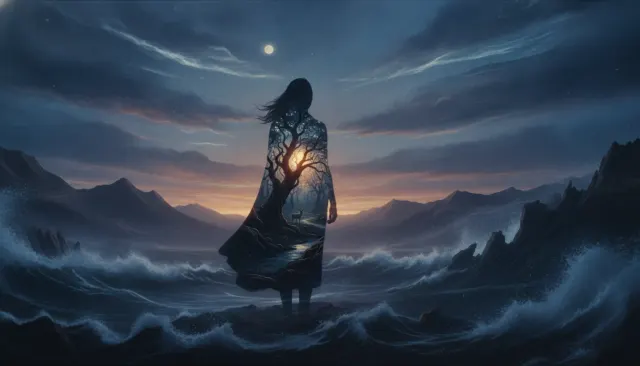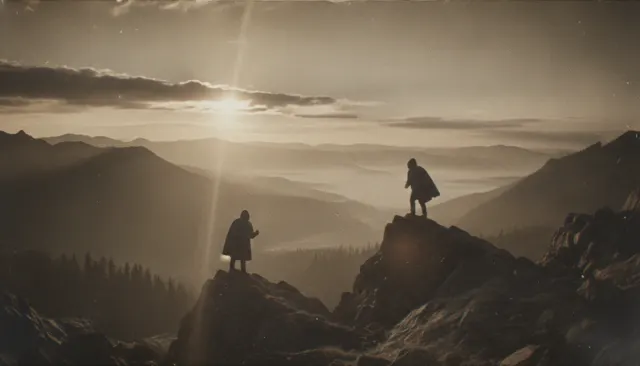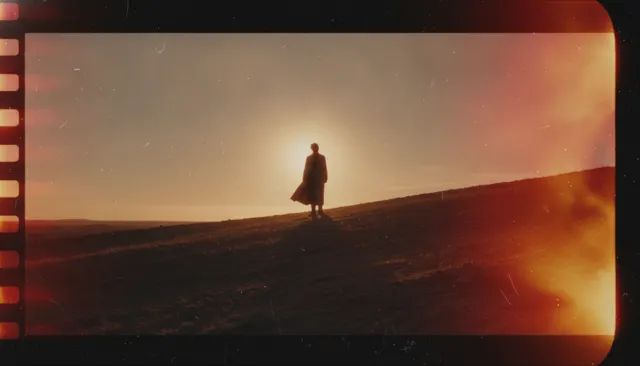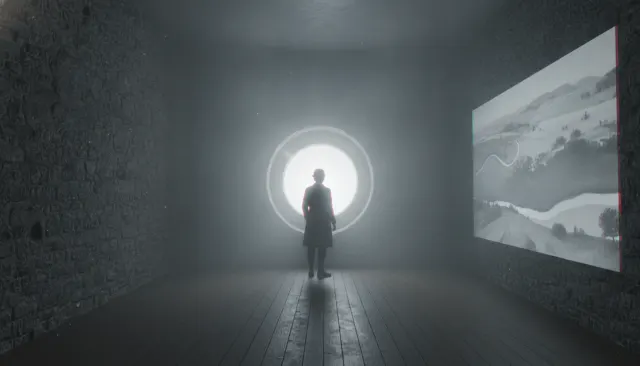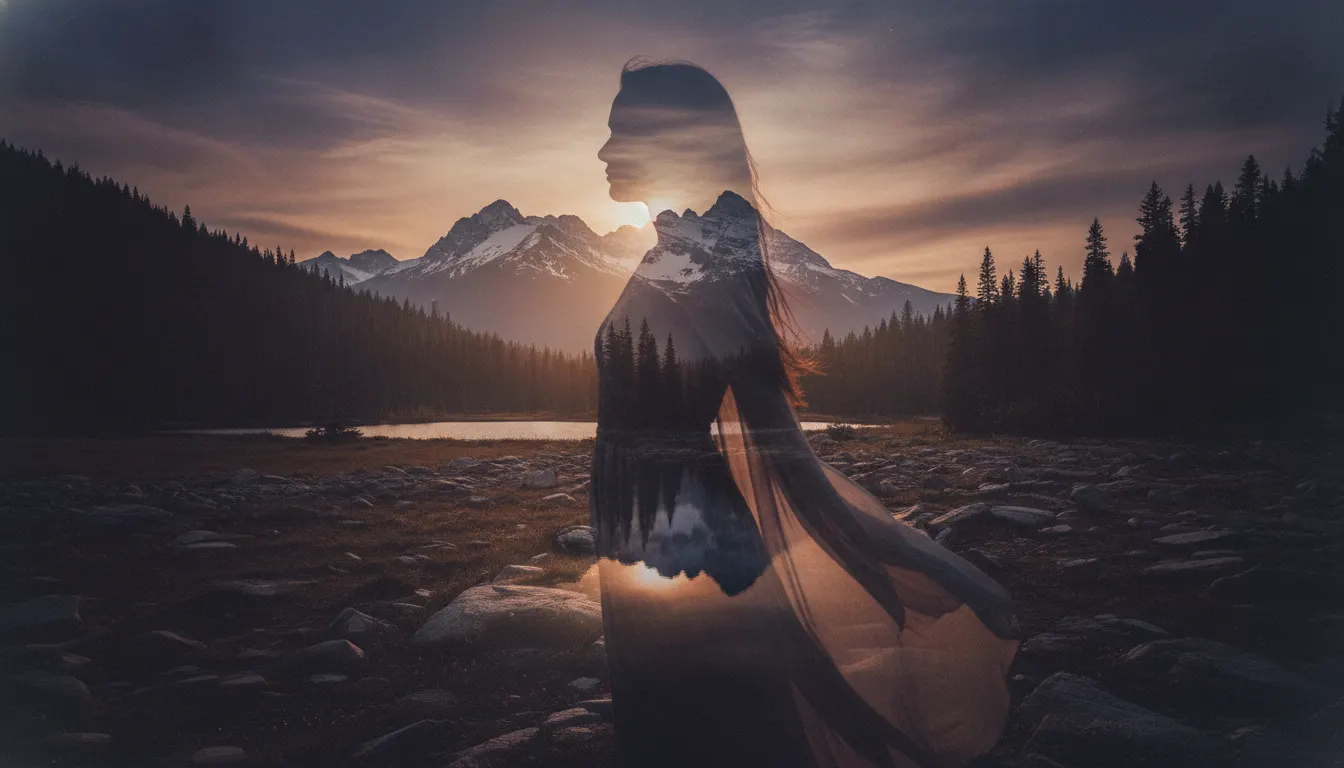
Christoffer Relander 'Reverie' series (2012-2014)
defining contemporary portrait-nature double exposure
Portrait silhouette double-exposed with nature scene. Profile filled with forest or mountain, organic film blending, contemplative editorial-fashion aesthetic.
The moves a human crew would use to get here. Cue applies them for you, and knowing their names is how you ask for a change.
key background: overexposed backdrop creates clean silhouette for masking
based masking: Screen blend mode allows bright nature areas (sky, sunlight) to appear through the portrait form
key white halo at portrait edge: 1-3px feathered white fringe from background overexposure - the analog signature
Hue/Saturation adjustment layer over the composite brings portrait and nature into shared tonal register
angle shot as the most common and effective nature infill (light gaps create natural brightness distribution)
single unified grain overlay on the composite prevents the 'pasted-together' read of mismatched noise
sharpness in the eyes and key facial features while allowing the nature infill to soften toward edges
The double exposure portrait-nature composite sits at the intersection of fine art photography, analog technique, and digital compositing craft. In its analog form, the technique requires two camera exposures on the same film frame: a portrait against a white or overcast backdrop (providing the silhouette), and a landscape, forest, or sky scene providing the infill detail. In its dominant contemporary form since approximately 2012, it is executed digitally: a portrait is masked, its silhouette is used as a clipping container, and a nature scene - forest canopy, mountain range, ocean waves - is placed inside. The blend mode (Screen or Lighten for light areas of the nature scene to show through; Multiply for dark areas) determines the tonal integration.
The portrait-nature double exposure became one of the dominant visual aesthetics on Instagram and photography blogs between 2012 and 2016. Photographers like Christoffer Relander (Finnish, b. 1986) were central to popularizing it: his 'Reverie' series used Nikon in-camera multiple exposure to blend Finnish forest and portrait with exceptional technical care, achieving over a million social shares. Elena Kalis's underwater composite photography (2008-2012) and photographers using the Photoshop 'Blend If' technique contributed to a widespread DIY tutorial ecosystem that made the look accessible to amateur photographers globally.
The portrait-nature double exposure carries consistent symbolic weight: the subject contains the landscape, or is contained by it - identity fused with environment, self and nature interpenetrating. This makes it particularly popular for yoga, wellness, environmental advocacy, and spiritual brand content. The palette implications follow the nature infill: forest portraits are cool green-teal; desert portraits are warm amber; ocean portraits are blue-grey. A high-key white edge around the portrait silhouette (from the overexposed background) is characteristic of the analog version and widely emulated digitally.
The form has spawned several sub-variants that have extended its life beyond the 2012-2016 saturation peak. City-scape double exposures (portrait filled with architecture rather than nature) emerged from the same community but carry different conceptual weight - identity constituted by urban environment rather than wilderness. Abstract infills using macro photography of paint, water, or smoke create a painterly variant with stronger graphic design application. Animal silhouette fills - a wolf or bear shape containing a forest or mountain landscape - emerged as a related form around 2014-2016, applied heavily to sports brand and outdoor gear marketing. In each variant, the core mechanism of 'container / contained' provides the metaphorical logic.
By 2017-2018 the look had become associated with stock photography and over-exposure; its critical reputation declined in the photography community. However, it has persisted as a durable editorial, wellness, and music cover aesthetic - appearing on album artwork, book covers, and outdoor brand campaigns. Well-executed versions with unusual species (insects, birds, microscopically detailed flora) or unexpected portrait-nature pairings continue to feel fresh. Christoffer Relander moved to more complex multi-layer composites from 2018 onward, demonstrating that the technique can evolve past its saturation point with sufficiently inventive subjects.
defining contemporary portrait-nature double exposure
fine art precedent for layered portraiture
widely circulated tutorial-format demonstrations
surrealist nature-portrait tradition
adjacent water-environment portrait work
portrait photography with nature texture overlay elements
institutional recognition
2017
portrait-nature double exposure at mainstream pop scale
A Look is not a filter. It is a set of stored decisions the pipeline reads before it makes a single frame, so two videos in the same Look actually match.