Behzad
illustrations in *Khamsa of Nizami* (1494–95), British Library, London
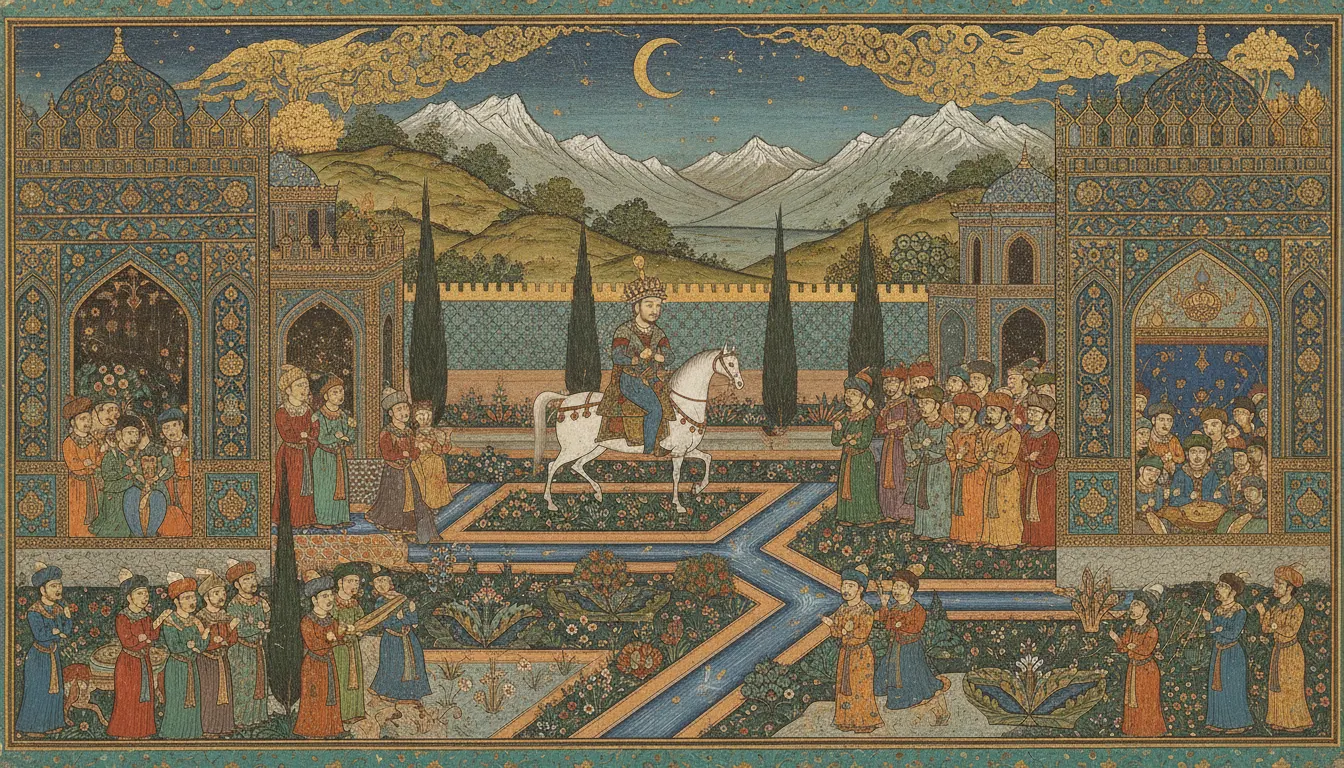
Inspired by the Persian miniature painting tradition of the Safavid and Timurid courts. Court scenes with tiled architecture, garden parties, and Shahnameh epic illustration.
The moves a human crew would use to get here. Cue applies them for you, and knowing their names is how you ask for a change.
deeper and more precious than any alternative
and-side architectural elevation showing building interiors and exteriors together
green, vermilion, and lead-white costume fills
detail surface rendering: every carpet, tile pattern, and textile motif completed in miniature
Persian miniature painting (negār-garī) is the courtly manuscript illustration tradition that reached its classical peak in the Timurid and Safavid periods (15th–17th centuries), produced in royal kitābkhāna (book-house workshops) that combined calligraphers, illuminators, painters, binders, and gilders under a single roof.
Behzad is the supreme master of the tradition – often called 'the Raphael of the East' by European art historians. Working first at the Timurid court of Sultan Husayn Bayqara in Herat (present-day Afghanistan) under the patronage of the poet-minister Mir Ali Shir Nava'i, and later heading the Safavid royal library in Tabriz under Shah Ismail I and Shah Tahmasp I, Behzad transformed Persian figure painting: his figures are psychologically individualized, architecturally placed in convincing spatial settings, and arranged in complex narrative compositions that go far beyond the diagrammatic figure conventions of earlier manuscript illustration. Key works include illustrations in the Khamsa of Nizami (British Library, 1494–95), the Bustan of Sa'di (Egyptian National Library, Cairo, 1488), and the Zafarnama of Timur (Johns Hopkins Walters Art Museum, c. 1467–1468).
The Tabriz school under Shah Tahmasp I (r. 1524–1576) produced the most ambitious manuscript in Persian art history: the Shahnameh of Shah Tahmasp (c. 1520–1535, 258 surviving paintings from an original ~742), now split between the Metropolitan Museum of Art and the Museum of Islamic Art, Doha, with individual folios in major collections worldwide. Tabriz work is dense, architecturally complex, and uses the deepest ultramarine and gold grounds. The Shiraz school was more commercial, with stylized figure types and more schematic architecture; it supplied the export manuscript market across Persia and into Ottoman Turkey and Mughal India.
Persian miniature compositions are built on an isometric rather than perspectival spatial system: figures occupy a tilted ground plane that reads upward as spatial recession, architecture is shown in simultaneous front and side elevation, and the horizon does not compress distant objects. The palette is defined by lapis lazuli ultramarine, malachite green, lead white, vermilion, and pure gold leaf (zarnigar). Figures are rendered with lyrical line and flat color; landscape elements (rocky outcrops, flowering trees, cloud-scroll skies) are stylized into heraldic emblems. Every surface of the composition – architectural tiles, carpet patterns, textile motifs – is rendered in full detail.
illustrations in *Khamsa of Nizami* (1494–95), British Library, London
1488
*Bustan of Sa'di* illustrations , Egyptian National Library, Cairo
258 surviving paintings, Metropolitan Museum of Art / Museum of Islamic Art, Doha
Safavid single-page paintings (early 17th c.), Tehran Museum of Contemporary Art
British Library – post-Behzad Tabriz school masterwork
finest public collection of Persian manuscript paintings outside Iran
A Look is not a filter. It is a set of stored decisions the pipeline reads before it makes a single frame, so two videos in the same Look actually match.