Katsushika Hokusai
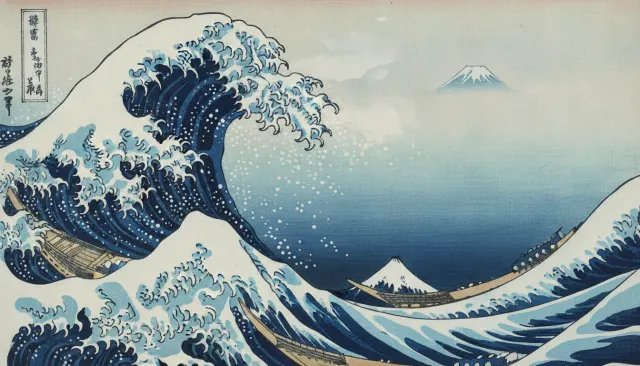
*The Great Wave off Kanagawa* (c. 1831), Metropolitan Museum of Art / British Museum
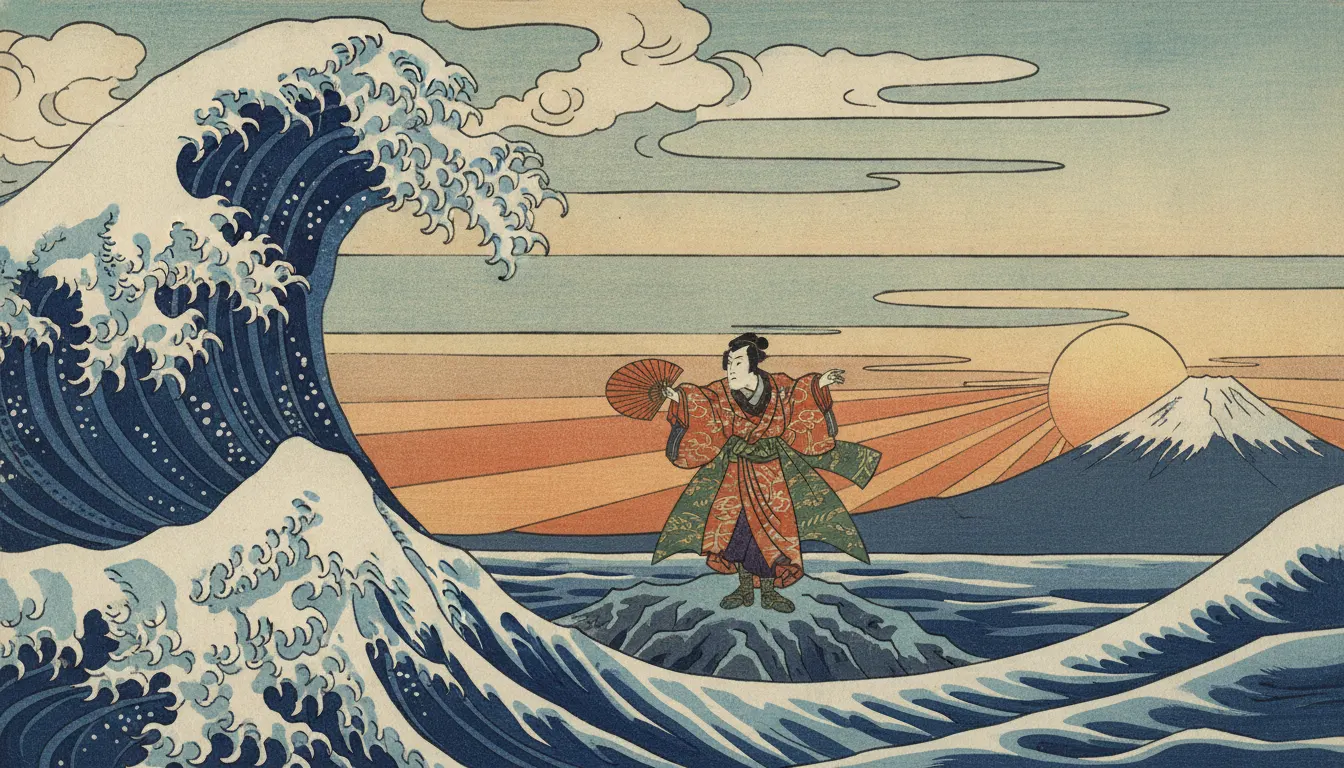
Inspired by the Japanese ukiyo-e woodblock tradition of Katsushika Hokusai and Utagawa Hiroshige. Flat carved color, Prussian blue waves, Mt Fuji, kabuki actor portraits.
The moves a human crew would use to get here. Cue applies them for you, and knowing their names is how you ask for a change.
ai*) as dominant hue with ochre, vermilion, and white supporting palette
wash variation within a single shape
dot crests in the Hokusai manner
style) Japanese perspective rather than Western vanishing-point construction
registration suggesting hand-pulled printing
Ukiyo-e (浮世絵) – 'pictures of the floating world' – flourished during Japan's Edo period (1603–1868), when the merchant class of Edo (modern Tokyo) created a booming print culture around theater, courtesans, travel, and nature. Woodblock printing democratized images: a single carved keyblock (kento-zuri) could produce thousands of identical impressions, distributing pictorial culture across all social strata at affordable prices.
Hokusai dominates the tradition in global recognition. His 36 Views of Mount Fuji series (published 1831–1833, actually 46 prints) reframed Fuji as a constant backdrop to everyday Edo life, visible from fishing boats, rice fields, and the Nihonbashi highway. The Great Wave off Kanagawa – technically Kanagawa-oki nami-ura – is arguably the world's most reproduced work of art. Its composition: two curved wave arms framing a distant Fuji, executed in Prussian blue (bero-ai, a newly imported European pigment), yellow ochre, and white foam dots, achieves a mathematical tension between chaos and calm. Hokusai's Manga sketchbooks (15 volumes, 1814–1878) catalogued thousands of figure types, creatures, landscapes, and architectural details that became a visual encyclopedia for Edo-period artists.
Hiroshige Utagawa (1797–1858) rivaled Hokusai with his 53 Stations of the Tokaido (1833) and 100 Famous Views of Edo (1856–1858), emphasizing rain, snow, and atmospheric perspective. Kitagawa Utamaro (1753–1806) perfected the bijin-ga (beautiful woman) portrait with elongated necks, layered kimono, and close-cropped compositions. Tōshūsai Sharaku (active 1794–1795) produced 145 yakusha-e actor portraits in a single year with radical close-up okubi-e format.
The look is defined by: flat color areas separated by bold outlines (the hanshita key-block line), registration marks (kento) visible as fine hairlines at block edges, Prussian blue + yellow ochre + vermilion as the primary palette, bokashi (graded color wash within a single area), and stylized cloud/wave/pine-needle motifs. Perspective follows Japanese oblique rather than Western vanishing-point systems.
For video, ukiyo-e translates as bold outlines over flat-color backgrounds with visible texture suggesting washi paper grain, animated wave or cloud elements in the Hokusai style, and a palette anchored in indigo blue with ochre and red accents.
A finished ukiyo-e print required the combined labor of three specialists: the designer (eshi) who drew the composition in ink on thin hanshi paper; the carver (horishi) who pasted the design face-down onto a cherry-wood (yamazakura) block and cut away all areas that should not print, preserving the outline in relief; and the printer (surishi) who applied pigment to successive color blocks and registered each impression using the kento corner-notch system. A complex Hokusai design might require 10–15 separate blocks for all its color separations. The entire team worked under a publisher (hanmoto) who owned the blocks, held the copyright, and bore financial risk – the Edo equivalent of a content studio.
*The Great Wave off Kanagawa* (c. 1831), Metropolitan Museum of Art / British Museum
*36 Views of Mount Fuji* series (1831–1833), multiple collections worldwide
*Hokusai Manga* sketchbooks, Volumes 1–15 (1814–1878)
1833
*53 Stations of the Tokaido* , Hiroshige Museum, Ena
*100 Famous Views of Edo* (1856–1858), Brooklyn Museum collection
*Ten Studies in Female Physiognomy* (c. 1792–1793)
1794
*Kabuki Actor Ōtani Oniji III* , Tokyo National Museum
A Look is not a filter. It is a set of stored decisions the pipeline reads before it makes a single frame, so two videos in the same Look actually match.