Joseon court minhwa
*Horangi wa Kkachi* (Tiger and Magpie) screens, multiple examples at the National Folk Museum of Korea, Seoul
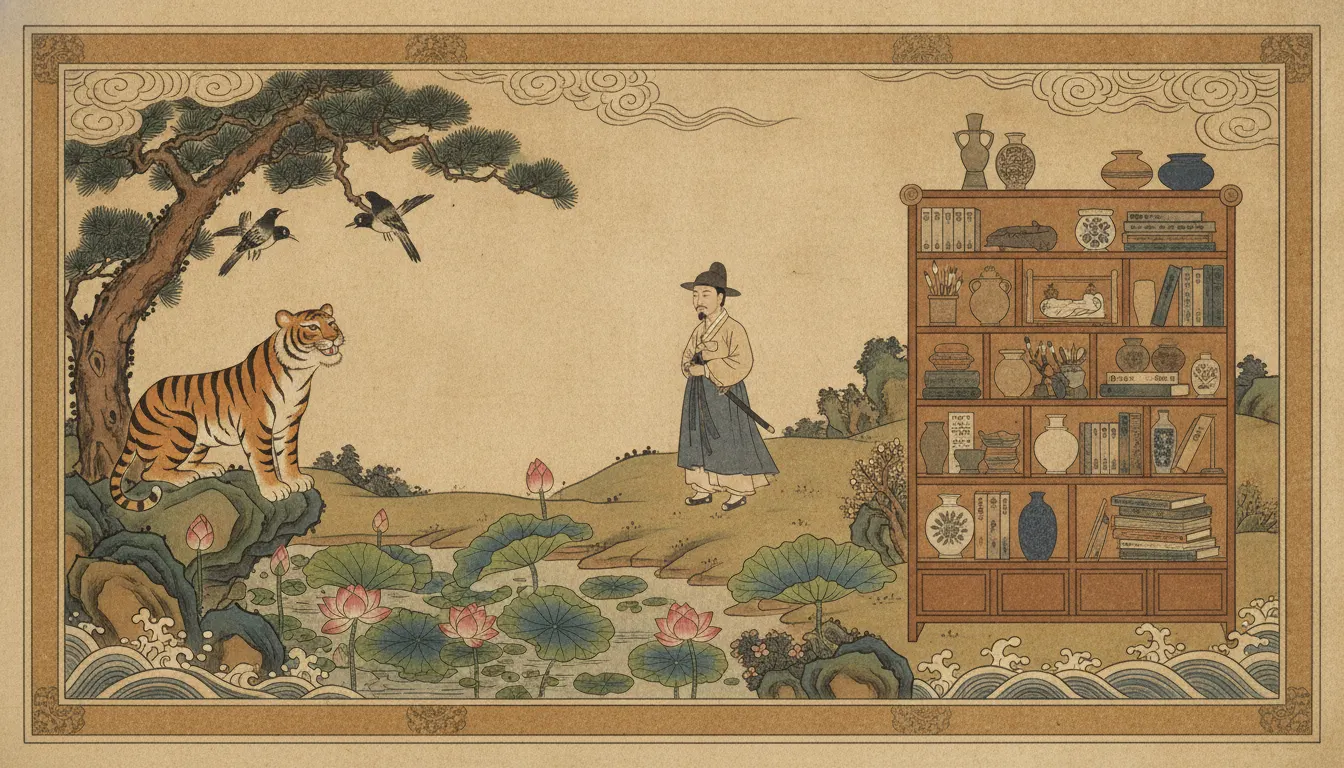
Inspired by the Korean minhwa folk painting tradition of the Joseon era. Charming naive tiger, magpie, lotus, and bookshelf compositions in mineral pigment.
The moves a human crew would use to get here. Cue applies them for you, and knowing their names is how you ask for a change.
and-magpie composition with cartoonishly wide-eyed tiger under pine tree
coral red, malachite green, azurite blue, yellow orpiment on cream hanji
brush black or iron-red outlines and deliberate anatomical informality
l'oeil crowded with books, ceramics, and scholar's objects
crane, deer, turtle, pine, cloud, water, stone, sun, mushroom, bamboo
Minhwa (민화, 'people's painting') is the popular pictorial tradition of Korea's Joseon dynasty (1392–1897), produced by anonymous itinerant painters (hwajang) who traveled the country fulfilling commissions from ordinary households, temples, and palaces alike. Unlike the court literati painting tradition (muninhwa) that prized Chinese aesthetic references and brushwork virtuosity, minhwa was unapologetically decorative, symbolic, and joyful.
The tiger-and-magpie (horangi wa kkachi) pairing is minhwa's most iconic motif: a tiger – simultaneously fearsome deity and bumbling comic figure – sits wide-eyed beneath a pine tree while a chattering magpie perches above. The tiger represents the mountain spirit (Sansin) and a guardian against evil; the magpie is a bearer of good news. The combination wards off ill fortune and invites luck into the home.
Munjado (文字圖) paintings embed Confucian virtues into Chinese characters: the character for filial piety (孝) is inhabited by carp leaping from water, the character for loyalty (忠) by birds and bamboo. Chaekgeori (책거리) compositions depict scholars' shelves stacked with books, porcelain, brushes, inkstones, and curiosity objects in a trompe-l'oeil style influenced by Qing Chinese still-life but thoroughly Korean in its crowded inventory of learning. The sipjangsaeng (ten longevity symbols) series pairs deer, cranes, turtles, pine trees, clouds, water, stone, sun, mushroom of immortality (yeongji), and bamboo – a complete cosmological wish for long life.
Minhwa painters used mineral pigments ground from malachite (green), azurite (blue), red ochre, yellow orpiment, and chalk white on hanji (Korean mulberry paper) or silk. The characteristic tonal range is warm and vivid: coral-red backgrounds, bright turquoise, deep navy, and grass-green. Outlines are painted with a fine brush in black or dark red iron oxide, then flat fills are applied – multiple thin layers building up to saturated brightness. The drawing style is deliberately non-academic: proportions are joyfully distorted, perspective is intuitive rather than geometric, and the overall effect is warm-hearted and accessible.
Contemporary Korean artists including Kim Ki-chang, Ohwon, and the Minhwa Association have revived and recontextualized the genre. Minhwa motifs appear regularly in Korean fashion, packaging, and K-drama set design as markers of national cultural pride.
*Horangi wa Kkachi* (Tiger and Magpie) screens, multiple examples at the National Folk Museum of Korea, Seoul
*Scholar's Accoutrements* (18th–19th c.), National Museum of Korea collection
20th-century revival minhwa, Kim Ki-chang Memorial Museum, Seoul
Confucian virtue characters (18th–19th c.), Leeum Samsung Museum of Art
permanent minhwa collection spanning Joseon dynasty
A Look is not a filter. It is a set of stored decisions the pipeline reads before it makes a single frame, so two videos in the same Look actually match.