Thomas Luraas
painted storage trunks (c. 1790–1820), Telemark Museum, Skien
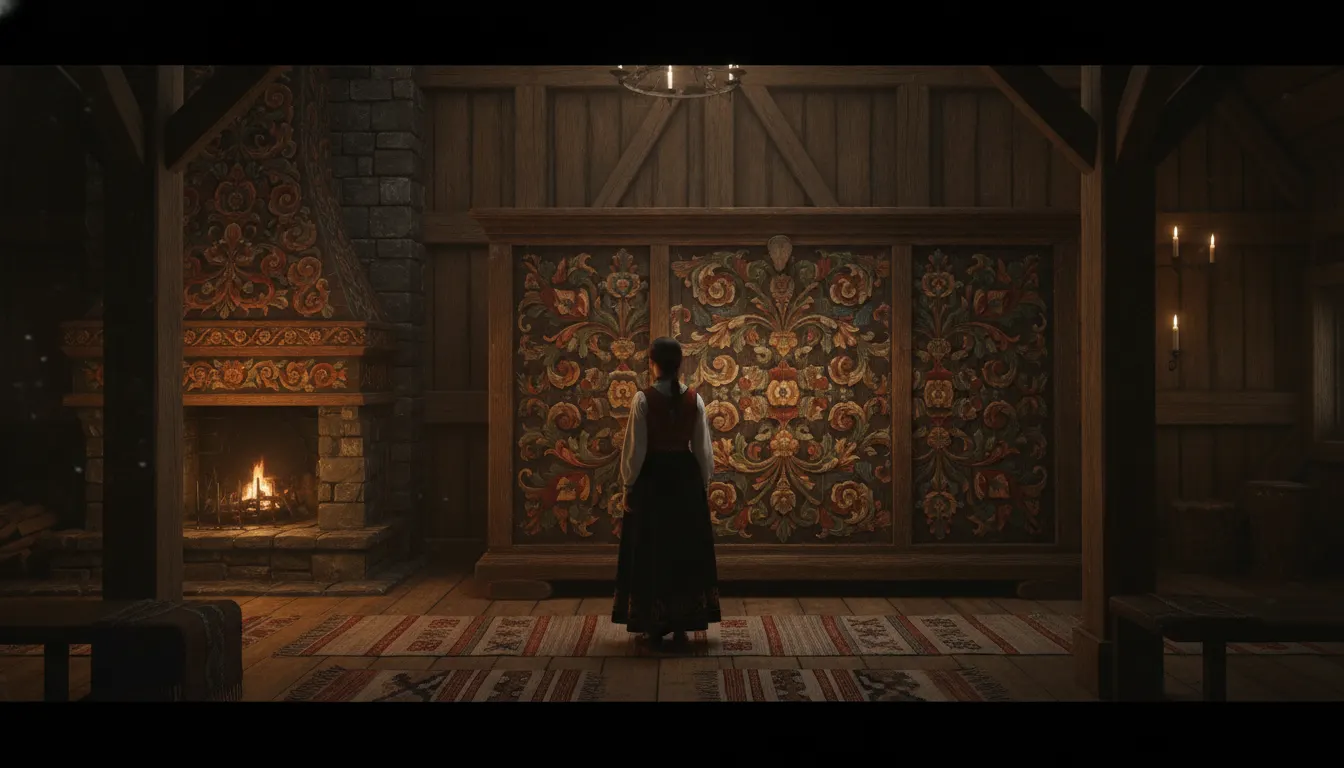
Inspired by Norwegian rosemaling decorative painting tradition. Swirling baroque flowers and acanthus scrolls on dark wood, painted on church interiors and folk furniture.
The moves a human crew would use to get here. Cue applies them for you, and knowing their names is how you ask for a change.
curve and S-curve brushstrokes tapering from wide to fine in a single loaded-brush stroke
paint palette: red-orange, deep blue, forest green, yellow-gold on dark blue-black or green ground
on-wet petal graduation from light to dark within a single floral form
Rosemaling (literally 'rose painting' in Norwegian) is the tradition of decorative painting on wood – furniture, storage trunks (kister), interior walls, wooden utensils, and household objects – that flourished in rural Norway from approximately 1750 to 1850 and has been revived as a living folk art since the mid-20th century.
The tradition developed most distinctively in two Norwegian valleys: Telemark and Hallingdal, each developing a recognizable regional style, and from these spread through Numedal, Valdres, Rogaland, and other Norwegian regions. Norwegian emigrants carried rosemaling to the American Midwest – particularly Wisconsin, Minnesota, and Iowa – where it remains active as an immigrant heritage art.
Telemark rosemaling is the most widely recognized international form: asymmetric, flowing compositions built from C-curves and S-curves, layered acanthus-leaf forms sweeping across a dark blue, green, or black background, interspersed with stylized roses, tulips, and carnations. The Telemark style is painterly rather than geometric – brushstrokes are loose and confident, with petals painted wet-on-wet for tonal graduation. Key historic practitioners include Thomas Luraas (1763–1828) and Knut Opstad (1807–1865).
Hallingdal rosemaling is more formal and symmetrical: figures face a central axis, acanthus forms are stiffer and more heraldic, and the palette tends toward warmer reds and ochres. Borders are more prominent and architecturally precise.
Beyond these two centers, Rogaland rosemaling in southwestern Norway employs a distinctive style with spiky, pointed leaves and strong primary colors; Gudbrandsdal work favors dense floral bouquets.
Rosemaling is painted with a rounded soft brush loaded with oil paint, using pulled brushstrokes that taper from wide to fine within a single stroke. The characteristic palette combines rich red-orange, deep blue, forest green, yellow-gold, and white or cream highlights against backgrounds of deep blue-black, forest green, or red ochre. Comma strokes and C-stroke petals are the technical building blocks; master painters combine hundreds of single strokes into complex compositions.
Norwegian-American rosemaling instructor Sigmund Aarseth (born 1929) is credited with the modern international revival. The Vesterheim Norwegian-American Museum in Decorah, Iowa holds the most significant collection of American rosemaling and awards the National Heritage Fellowship in Rosemaling.
painted storage trunks (c. 1790–1820), Telemark Museum, Skien
interior wall panels (mid-19th c.), folk museum collections, Telemark region
largest rosemaling collection outside Norway
decorated interiors from Telemark and Hallingdal farmhouses
contemporary Telemark master, revival teacher, Vesterheim award recipient
annual Norsk Høstfest juried competitions, Minot, North Dakota
A Look is not a filter. It is a set of stored decisions the pipeline reads before it makes a single frame, so two videos in the same Look actually match.