Johnny Ott
hex signs produced 1950s–1970s, Lenhartsville, PA; collected at the Berks County Heritage Center
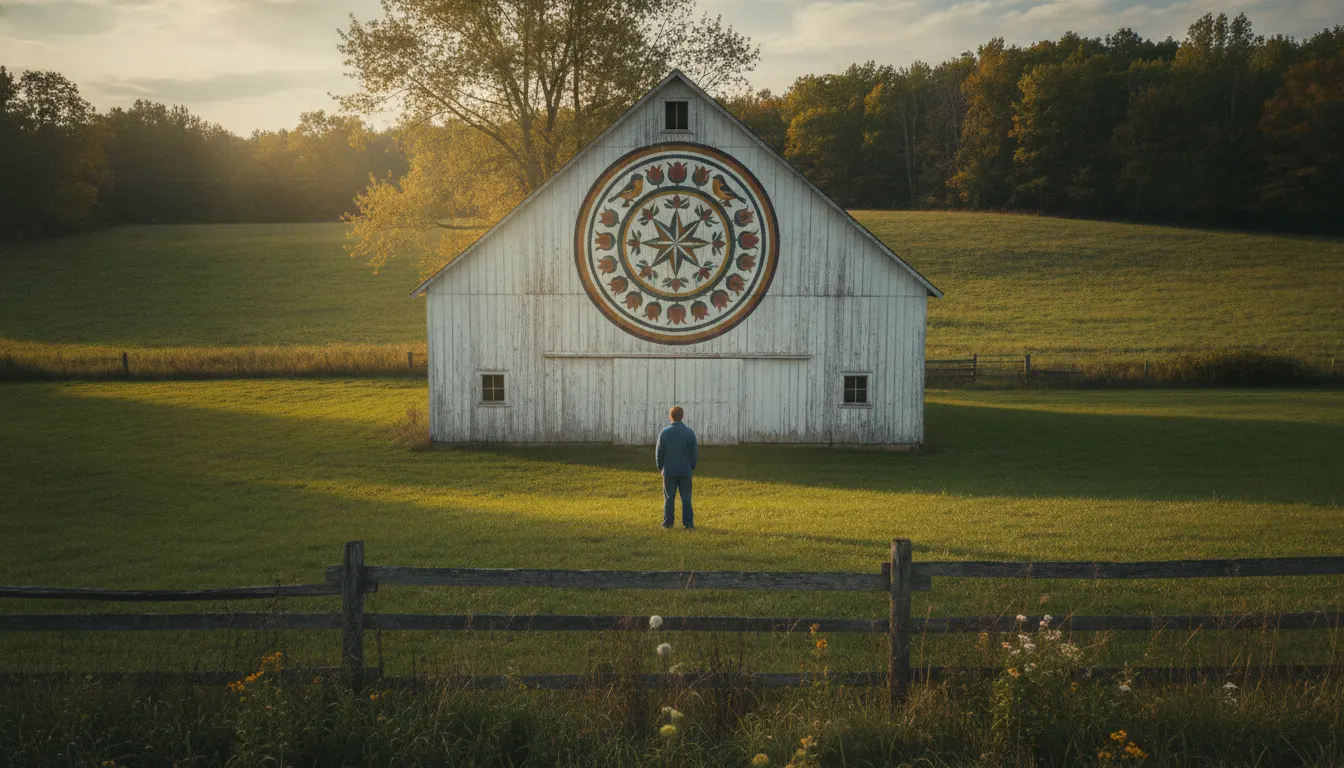
In the tradition of Pennsylvania Dutch hex-sign painting on Amish and German-American barns. Circular geometric rosette of stylized tulip, distelfink bird, and star inside concentric rim.
The moves a human crew would use to get here. Cue applies them for you, and knowing their names is how you ask for a change.
, 4-, 6-, or 8-fold) as the governing structure
pointed rosette star built from two overlapping equilateral triangles inscribed in the circle
red, blue, yellow, green, black on white or cream ground
purely graphic surface decoration
and-straightedge geometric understructure visible in precise symmetry of final design
The round, colorfully decorated signs painted on barn doors and facades of Berks, Lebanon, and Lancaster counties in southeastern Pennsylvania are among the most distinctively American folk art forms: brightly geometric, cheerfully symbolic, and rooted in the German-speaking Protestant immigrant communities (Pennsylvania Deutsch, corrupted in English to 'Dutch') who settled the region from the 1680s through the 18th century.
Art historians continue to debate whether hex signs were painted for protective magical purposes ('hexing', from German Hexe, witch) or purely as decorative expressions of pride and craft. The earliest documented barn decorations appear in the 1820s–1840s; the round medallion format with geometric symbols rose to prominence in the late 19th century and was photographed and catalogued by American folklorists from the 1930s onward. Contemporary scholarship favors the decorative interpretation – the symbols were expressions of communal prosperity, religious faith, and aesthetic tradition rather than apotropaic magic. The Berks County region of Pennsylvania remains the geographic heart of the tradition.
The most common motifs are: the distelfink (German for goldfinch – stylized into a blue and yellow bird with curling tail feathers, a symbol of good fortune and happiness); the six-pointed rosette star (or hex star) inscribed within a circle, built from two overlapping triangles; the tulip (faith, love, luck in Pennsylvania Dutch symbolic vocabulary); the heart (love and affection); the oak leaf and acorn (strength); four-pointed compass stars suggesting the cardinal directions; and raindrops (abundant harvest). These elements are combined within a circular format divided into radial symmetry – typically three, four, six, or eight-fold.
Hex signs are traditionally painted in house paint on whitewash-prepared barn siding, using compass and straightedge to establish the geometric grid before filling in color. The palette is bright and high-contrast: red, blue, yellow, green, black, and white on a white or cream ground. Each completed hex is a flat, graphic image without shading or perspective.
Johnny Ott (1906–1981) of Lenhartsville, Pennsylvania is the most famous commercial hex sign painter of the 20th century, responsible for establishing many of the standardized symbol-meaning associations now sold in tourist markets. Jacob Zook (1905–1968) and his descendants continued production in Paradise, PA. The tradition remains actively practiced by Pennsylvania Dutch artisans today.
hex signs produced 1950s–1970s, Lenhartsville, PA; collected at the Berks County Heritage Center
hex sign production, Paradise, PA (1940s–1968); tradition continued by Zook family
permanent collection of historical barn decorations
Pennsylvania German folk art collection including painted furniture and hex-decorated objects
early photography of Berks County barns (1910s), Mercer Museum, Doylestown, PA
regional archive of Pennsylvania Dutch material culture
A Look is not a filter. It is a set of stored decisions the pipeline reads before it makes a single frame, so two videos in the same Look actually match.