Maqsud Kashani
*Ardabil Carpet* (1539–40), Victoria and Albert Museum, London – finest signed carpet in existence
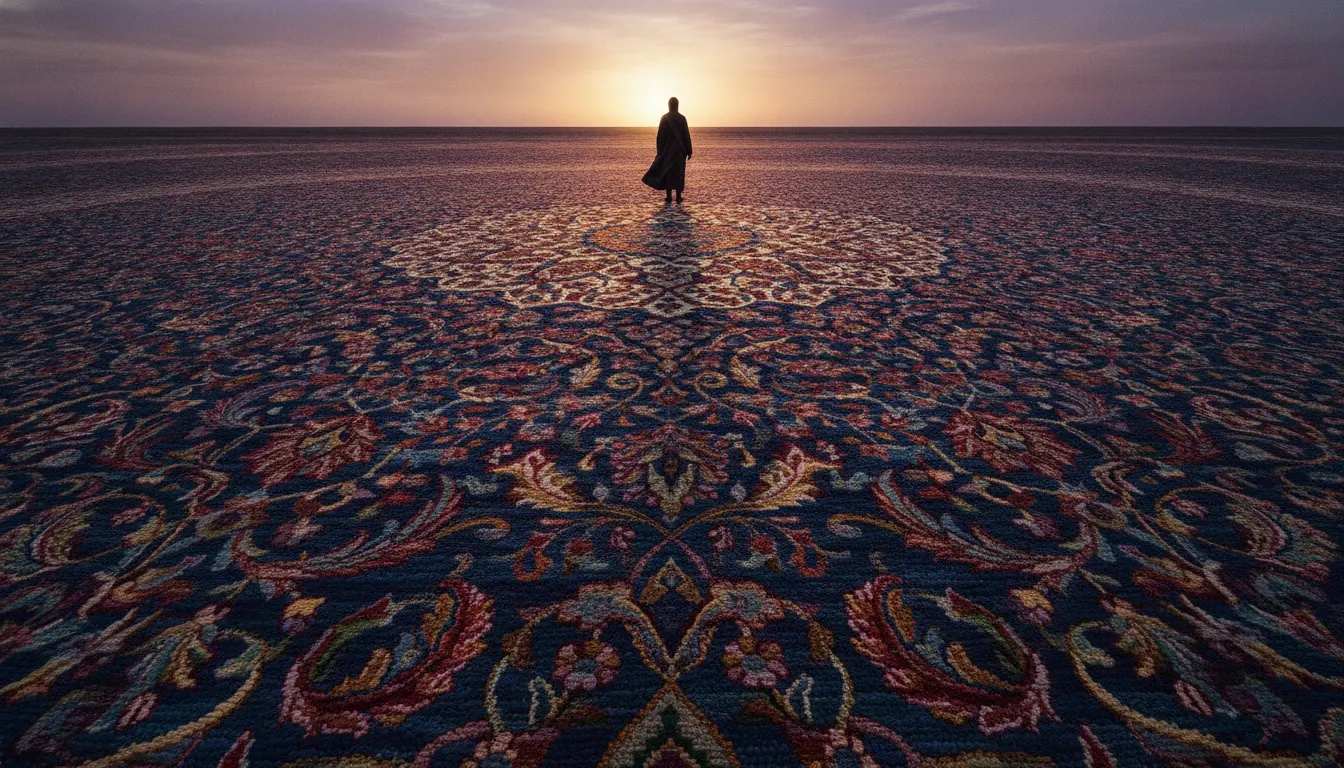
In the tradition of Persian medallion-rug weaving from Tabriz, Isfahan, and Kashan. Central rosette medallion surrounded by intricate floral arabesque and stylized boteh paisley field.
The moves a human crew would use to get here. Cue applies them for you, and knowing their names is how you ask for a change.
medallion corner fills (*lachak*) at four corners
and-arabesque scrolling field filling all space between medallion and border
lake red ground with midnight navy secondary and ivory tertiary as the classical palette
band border system: inner guard stripe, main border with cartouches, outer guard stripe
band (*abi*) Chinese-influenced scroll motifs woven through the arabesque field
The Persian carpet (farsh, قالی) is among the most internationally traded and widely recognized luxury objects in world history. The medallion carpet – organized around a central radial medallion (toranj) with quarter-medallion corner fills (lachak) and a multi-band ornamental border – is the defining format of classical Persian carpet design, developed in the great weaving centers of northwestern and central Iran.
Tabriz (northwestern Iran) is the oldest continuously active carpet-weaving center, with documented production reaching back to the 15th century. Tabriz carpets typically use wool pile on a cotton foundation, with the Turkish knot (ghiordes) rather than the Persian (senneh) knot, and favor elaborate medallion-and-arabesque designs in deep red, navy, ivory, and gold. The Ardabil Carpet (1539–40, Victoria and Albert Museum, London; second example at the Los Angeles County Museum of Art) is the world's most celebrated signed carpet, woven at the Ardabil shrine by master weaver Maqsud Kashani.
Kashan (central Iran) is synonymous with fine wool pile on cotton foundations using the asymmetric Persian knot at very high density (typically 200–500 knots per square inch). Kashan medallion carpets feature dense palmette-and-arabesque fields in crimson-lake red, ivory, and midnight navy. The Hunting Carpet (mid-16th century, Museum of Applied Arts, Vienna; fragments elsewhere) is the finest surviving example of the hunting-scene medallion carpet.
Isfahan (Safavid capital, 1598–1722) produced the most refined court-quality workshop carpets in Persian history, under the patronage of Shah Abbas I who is credited with standardizing the vase carpet and garden carpet formats alongside the medallion type. Isfahan carpets are identifiable by their cloud-band (abi) fill motifs, precisely drawn arabesque scrolls, and palette that extends into pale pink, turquoise, and saffron.
Qom (Qum) emerged as a weaving center only in the 20th century but is now associated with the finest silk pile carpets produced in Iran – sometimes reaching 1,500 knots per square inch on pure silk foundations.
The shared classical vocabulary includes: the medallion (toranj) – a central radial starburst or ogival form; the palmette (gol, flower motif); the arabesque (eslimi) – a continuous spiral vine supporting leaves and flowers; the cloud band (abi) – a Chinese-influenced cloud form scrolling through the field; the cartouche border with calligraphic inscriptions; and the hunting scene (shekar-gah) with horsemen, prey animals, and fanciful landscapes.
*Ardabil Carpet* (1539–40), Victoria and Albert Museum, London – finest signed carpet in existence
definitive national collection spanning all weaving regions and periods
A Look is not a filter. It is a set of stored decisions the pipeline reads before it makes a single frame, so two videos in the same Look actually match.