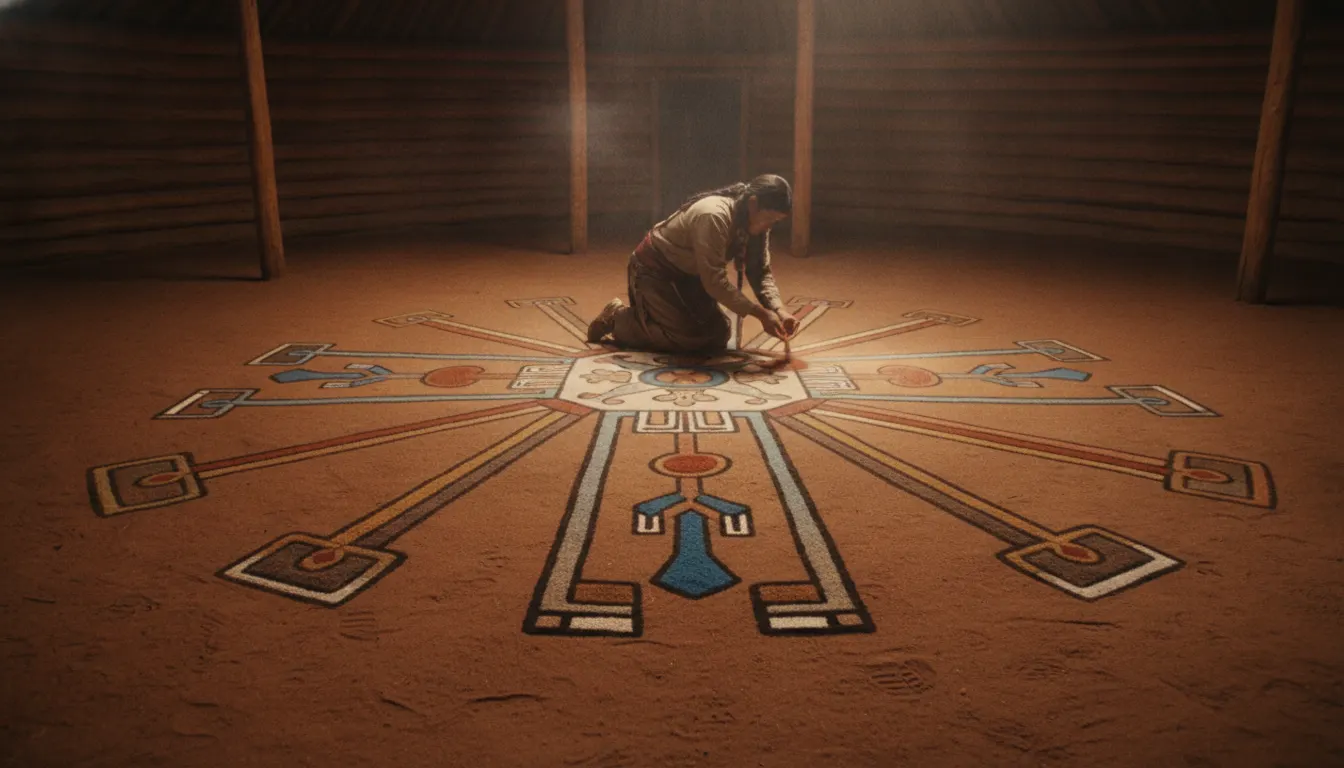
Nightway (*Yé'ii bicheii*) ceremony sand paintings
1902
documented by Washington Matthews in *The Night Chant*
Inspired by Navajo Dine sand-painting tradition used in healing ceremonies. Colored mineral sand poured by hand into symmetric Yei figure compositions on the hogan floor.
The moves a human crew would use to get here. Cue applies them for you, and knowing their names is how you ask for a change.
white East, blue South, yellow West, black North
mineral palette: white gypsum, yellow ochre, red sandstone, charcoal black, blue-grey blended powder
no smooth color fills
Navajo sand painting (iikááh, or 'place where the Holy People come and go') is a sacred ritual art form of the Diné (Navajo) people of the American Southwest, created by a hataalii (medicine singer/ceremonial practitioner) as part of multi-day healing ceremonies called chantways. The sand painting is not made to be preserved – it is destroyed by nightfall on the day it is completed, its colored minerals scattered to return to the earth.
Navajo ceremonies addressing illness, imbalance, or significant life transitions may employ sand paintings as the visual and spiritual core of the healing process. The most complex ceremonies – the nine-night Nightway (Yé'ii bicheii), Mountainway, and Blessingway – may use dozens of distinct sand painting designs across the ceremony's duration. The patient sits on the completed sand painting to absorb the healing powers of the depicted Holy People (Diyin Dine'é).
The paintings are created directly on the hogan floor from colored dry materials: white cornmeal or gypsum, yellow ochre pollen, red sandstone, black charcoal, blue-gray powder from mixed charcoal and white corn, and ground plant materials. The hataalii trickles the powder between thumb and forefinger with extraordinary precision to build figures that may be 10–20 feet in diameter for major ceremonies.
Sand painting compositions follow a strict iconographic vocabulary: Yei figures (the Holy People) appear as elongated, frontally oriented spirit beings with stylized headdresses, kilts, and ceremonial objects, always oriented by cardinal directions. The four sacred mountains of the Navajo homeland bound the composition's corners. Rainbow guardian (Naalyéhé ba hooghan) arcs around three sides of the composition as a protective border. Pollen footprints, corn plants, lightning arrows, and sun and moon discs fill the compositional field according to the specific ceremony being conducted.
The color system is directional and cosmological: white = East, blue = South, yellow = West, black = North, with pink, red, and multi-colored elements for specific Holy People. The characteristic aesthetic is simultaneously geometric and symbolic: precise bilateral or radial symmetry, bold forms, and a palette of earth-mineral intensity.
Due to demand from tourists and collectors, Navajo artisans developed a separate tradition of commercial sand painting on sandboard (c. 1930s onward), using non-sacred designs. These are sold legally and distinguish themselves clearly from ceremonial works. Artists including David Chethlahe Paladin and many Navajo craft co-ops have made the commercial tradition a significant art market category.
1902
documented by Washington Matthews in *The Night Chant*
largest collection of sand painting documentation and ceremonial art
commercial sand paintings, mid-20th century, multiple gallery collections
permanent collection of Navajo material culture and sand painting records
1937
*Sandpaintings of the Navajo Shooting Chant* , scholarly visual record
historical record of Navajo craft including sand painting
A Look is not a filter. It is a set of stored decisions the pipeline reads before it makes a single frame, so two videos in the same Look actually match.
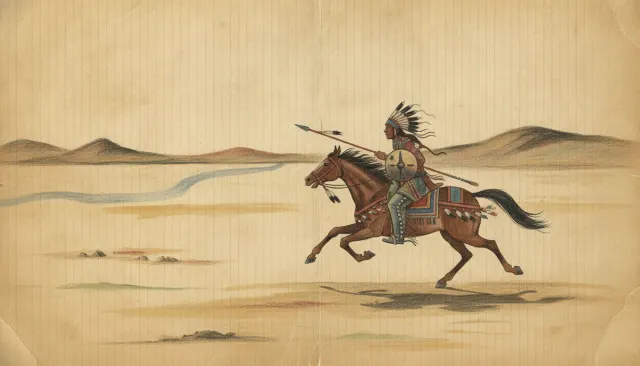 Indigenous AmericasPlains Native American Ledger Art
 Indigenous AmericasPacific Northwest Formline Totem
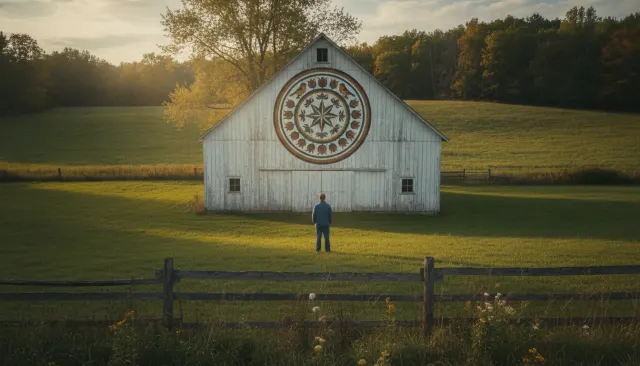 North American FolkPennsylvania Dutch Hex Sign Barn
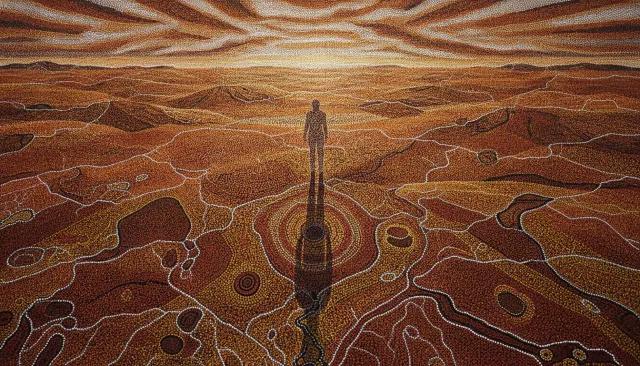 Indigenous Australia OceaniaAboriginal Dot Painting (Australia)
 Middle Eastern North AfricanMoroccan Zellige TileAsian ExtendedMongolian Traditional Carpet Pattern