Clifford Possum Tjapaltjarri
1977
*Warlugulong* , Art Gallery of New South Wales
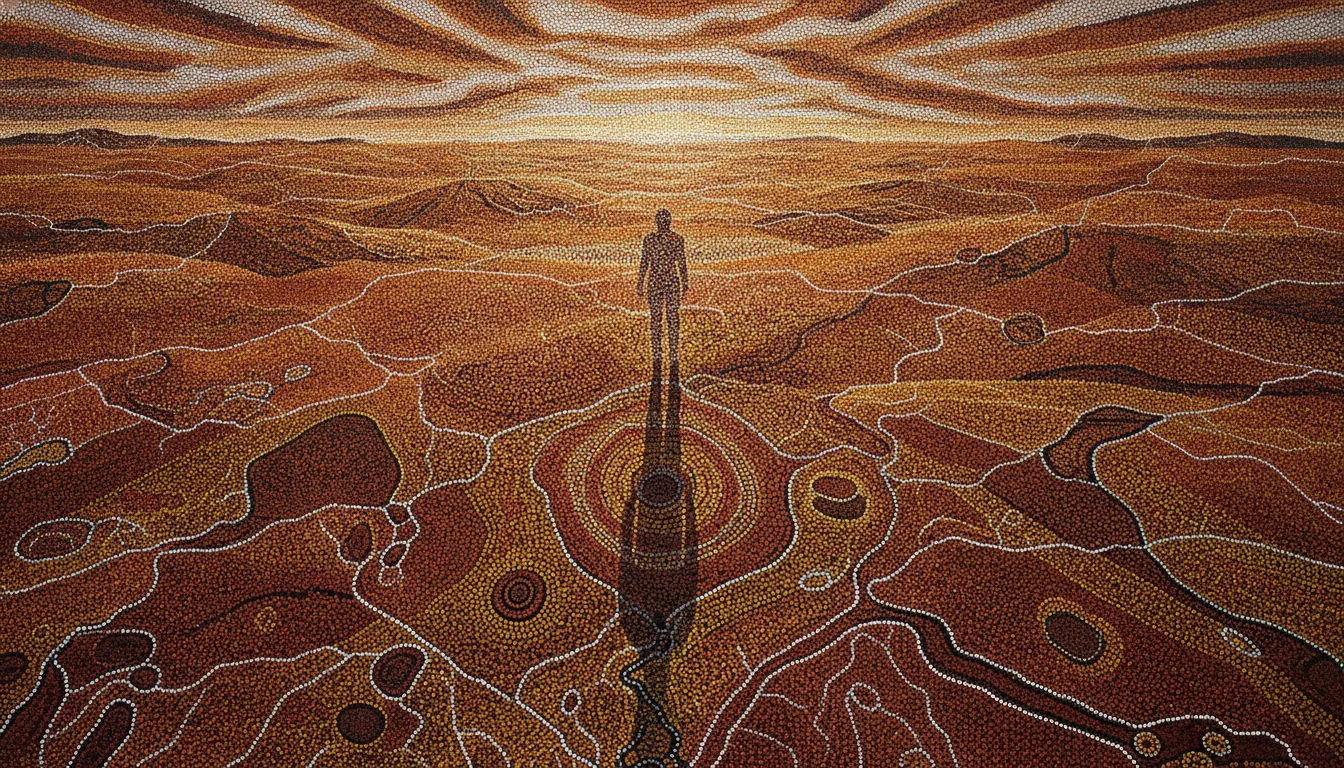
Inspired by the tradition of Western Desert Aboriginal dot painting from communities such as Papunya. Concentric circle motifs and ochre dot fields express songlines and country.
The moves a human crew would use to get here. Cue applies them for you, and knowing their names is how you ask for a change.
applied dot fields over an ochre, black, or deep-red ground layer
to four-color palette dominated by earth ochres, white, and black with optional terracotta or sage accent
In the tradition of the Western Desert Aboriginal painters who gathered at Papunya in 1971, this look draws on one of the most transformative moments in 20th-century art: the moment when senior Luritja, Warlpiri, and Aranda men began translating their sacred ground designs onto board and canvas.
The Papunya Tula movement emerged when schoolteacher Geoffrey Bardon encouraged elders to paint a mural on the Papunya school wall. Artists such as Clifford Possum Tjapaltjarri, Tim Leura Tjapaltjarri, and Johnny Warangkula Tjupurrula developed the vocabulary we now associate with the style: concentric circles marking sacred sites, connecting lines tracing Dreaming tracks, and the dense overlay of dots that both revealed and respectfully concealed ceremonial knowledge from uninitiated viewers.
The palette originates in desert country – red and yellow ochre, white pipe clay, charcoal black, and the muted sage of mulga scrub. Contemporary practitioners using acrylics on linen extend these into deeper burgundy, burnt sienna, and warm ivory. The dot itself is the defining mark: applied with a sharpened stick, the end of a brush, or a rounded tool, dots cluster into fields that vibrate optically, creating the shimmering heat-haze effect that viewers associate with Central Australian light.
Compositions are typically overhead map views of Country, with U-shapes representing seated figures, wavy lines denoting water or desert oak roots, and concentric circles identifying waterholes or campfire sites. The layering of dots over an underpainting builds richness without outlining individual forms.
Clifford Possum Tjapaltjarri's monumental Warlugulong (1977) set auction records and now resides in the Art Gallery of New South Wales. Emily Kame Kngwarreye, working from Utopia Station, developed a more gestural, impressionistic variant. Dorothy Napangardi's salt-lake maps and Kathleen Petyarre's storm-country canvases extended the tradition into the 1990s and 2000s.
To apply this look in video, photography, or graphic work: establish a warm ochre or deep charcoal ground layer, build fields of closely-spaced dots in two to three tonal values, and repeat concentric circle motifs as compositional anchors. Avoid mechanical perfection – slight irregularity in dot spacing conveys hand-made authenticity. Overlaid dot textures work as screen-blend overlays on footage, adding a ceremonial warmth to landscape shots.
1977
*Warlugulong* , Art Gallery of New South Wales
*Dreamtime Story* (c. 1974), early Papunya board paintings
1995
*Anwerlarr anganenty (Big Yam Dreaming)* , National Gallery of Victoria
2006
*Sandhills of Mina Mina* , auction record series
1997
*Mountain Devil Lizard Dreaming After Rain*
1972
*Water Dreaming at Kalipinypa*
*Body Paint* series (2000s), bold gestural dot fields
A Look is not a filter. It is a set of stored decisions the pipeline reads before it makes a single frame, so two videos in the same Look actually match.