Jonathan Holstein and Gail van der Hoof collection
*Abstract Design in American Quilts*, Whitney Museum 1971
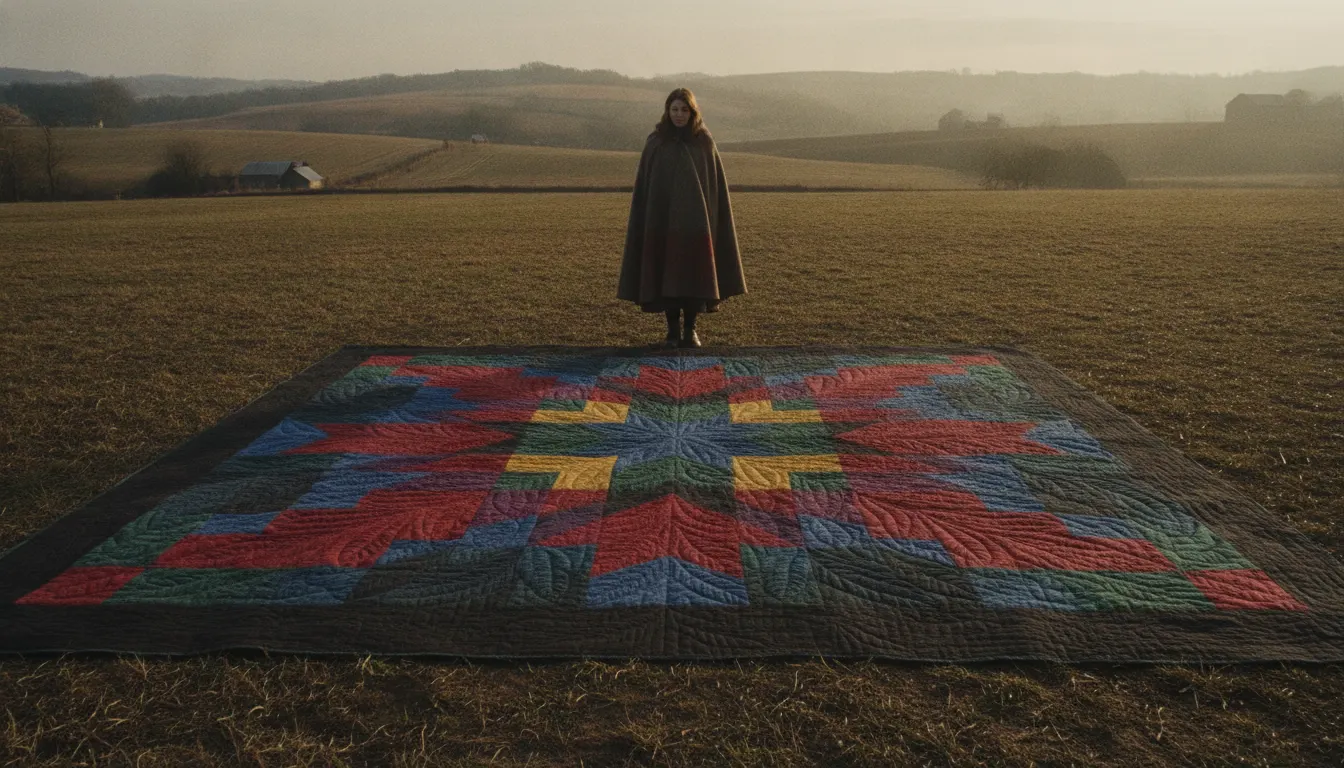
In the tradition of Amish quilting from Lancaster County, Pennsylvania. Bold Broken Star or Lone Star pattern in saturated solid wool blocks on a deep black field, hand-quilted feather stitching.
The moves a human crew would use to get here. Cue applies them for you, and knowing their names is how you ask for a change.
pointed Broken Star constructed from precisely cut diamonds in alternating solid colors
tone solid wool palette: burgundy, forest green, sapphire blue, teal, purple, and ochre on black or dark navy ground
color border bands framing the central star composition
quilting in feather, cable, and clam-shell patterns visible in raking light or close-up
negative space as active design element
strict solid-color discipline
In the tradition of Amish quilters of Lancaster County, Pennsylvania – a practice that flourished from the 1880s through the mid-20th century – the Broken Star quilt represents one of American folk art's most dramatic geometric achievements: a radiating eight-pointed star, each point subdivided into diamond-shaped sections that fracture and recombine across the quilt's surface in rich, resonant solid-color wool.
Amish quiltmaking developed as a community tradition in the late 19th century, with Lancaster County's Old Order Amish communities producing what are now considered the most distinctive American quilts. Unlike the pieced-cotton, print-fabric quilts of the broader American tradition, Amish quilts were made from solid-color wool (and later cotton sateen) in deep, saturated hues – deep burgundy, forest green, sapphire blue, teal, purple, and always set against expansive black or dark gray grounds.
The Broken Star – also called the Dutch Rose or Lone Star variant – is among the most complex Amish patterns, requiring precise diamond cutting and matching to align the star's radiating points without distortion. Unlike English-paper-pieced stars made in the British tradition, Amish quilters worked freehand, relying on community transmission of technique rather than written patterns.
Amish quilts served strictly functional purposes – bed coverings for farm households – but their aesthetic sophistication was recognized by the art world in the 1970s when Jonathan Holstein and Gail van der Hoof's landmark 1971 exhibition Abstract Design in American Quilts at the Whitney Museum of American Art positioned Amish quilts as sophisticated abstract art objects comparable to Ellsworth Kelly and Kenneth Noland.
The Broken Star is composed of eight large diamond-shaped segments, each built from smaller diamonds of alternating colors, arranged so the color progressions across adjacent points create either a starburst or a breaking/fragmenting effect. The star floats on a dark solid ground, typically surrounded by wide border bands in complementary colors.
The hand quilting is as important as the piecing: dense running-stitch patterns in contrasting thread (often white or cream on dark ground) fill every background section with feather plumes, clam shells, floral wreaths, and cable chains. This quilting texture, visible primarily in raking light, constitutes a second layer of design.
*Abstract Design in American Quilts*, Whitney Museum 1971
landmark Lancaster Amish holdings
significant Amish quilt collection
community-held Amish textile archives
Lancaster Broken Star quilts achieving $5,000-$50,000+ at auction
2004
*Unconventional and Unexpected* , scholarly Amish quilt documentation
A Look is not a filter. It is a set of stored decisions the pipeline reads before it makes a single frame, so two videos in the same Look actually match.