Bogolan Kasobane collective exhibitions
Centre Culturel Francais, Bamako (1980s-1990s)
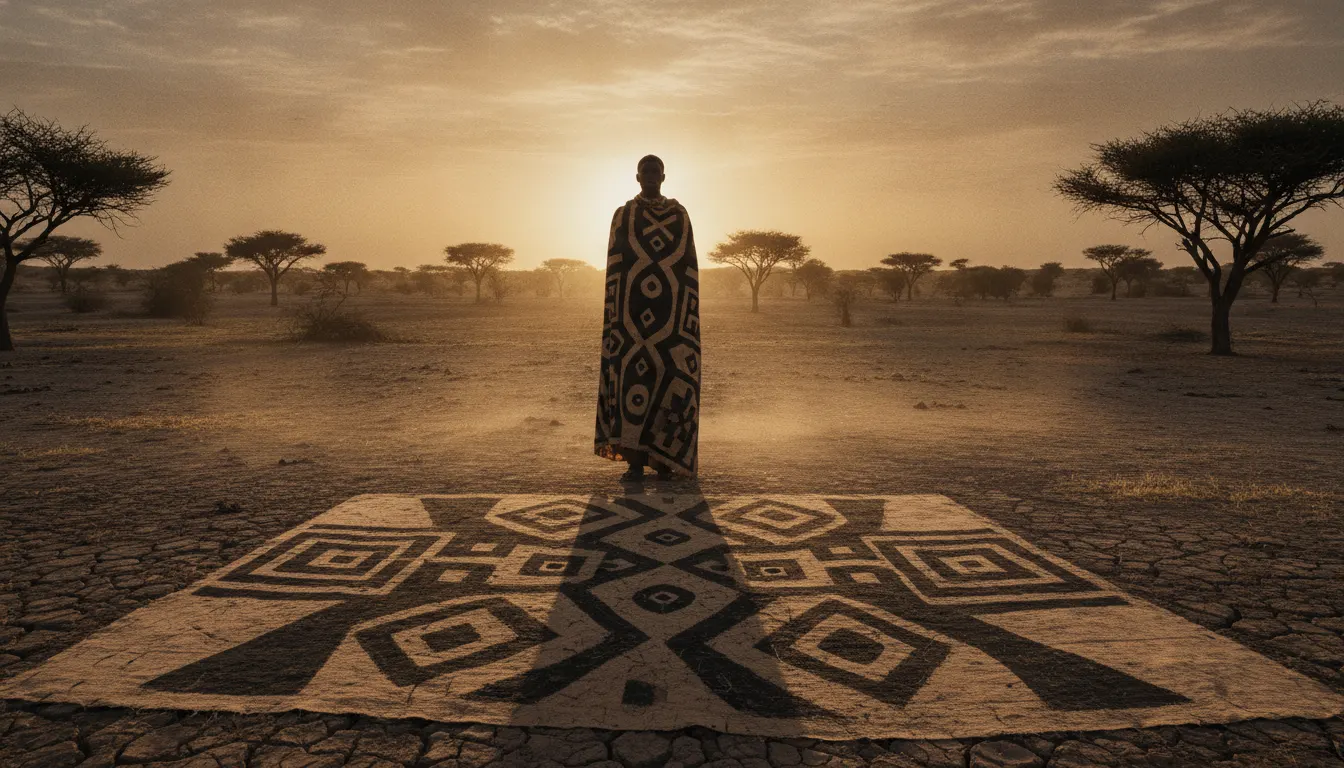
Honoring the Bamana bogolanfini mudcloth tradition of Mali. Hand-woven cotton dyed with fermented mud, geometric symbolic pattern in earth black on tan.
The moves a human crew would use to get here. Cue applies them for you, and knowing their names is how you ask for a change.
black ground with cream-white geometric pattern forms created by resist method
zigzags, lozenges, crosses, stepped lines, and interlocking T-shapes
width seam lines visible where cloth strips are joined horizontally
reflective surface quality evoking dried earth
In the tradition of the Bamana people of Mali, bogolanfini – literally 'earth cloth' (bogo: earth/mud; lan: with; fini: cloth) – is a hand-dyed cotton fabric distinguished by its paradoxical process: the white patterns are not painted on but are revealed by removing dye from areas that were protected during successive applications of fermented river mud.
Bamana mudcloth has been produced for at least several centuries in the inland Niger Delta region of Mali. The cloth is woven by men on narrow horizontal treadle looms; the dyeing and painting is traditionally the domain of women. Young women received mudcloth garments at initiation ceremonies, and hunters wore specific mudcloth patterns believed to provide spiritual protection. Each regional atelier – from Segou to San to Djenne – developed its own pattern vocabulary.
The process is demanding: hand-spun cotton cloth is soaked in a bath of n'gallama leaves (producing a yellow tannin base), then painted with fermented mud (collected from riverbeds and aged for a year or more) in multiple coats that oxidize to deep brown and black. The tannin areas beneath the mud are then washed away with caustic soda or soap, revealing the white cotton pattern. The final cloth is typically cream-white geometric forms on a dark brown-to-black ground.
Mudcloth entered the Western fashion world in the 1970s and 1980s through designers like Ralph Lauren and later Chris Seydou, the Malian couturier who elevated bogolanfini into high fashion in the 1980s and 1990s. The Bogolan Kasobane collective in Bamako, founded in 1978 by six artists including Kandioura Coulibaly and Boubacar Doumbia, transformed the tradition into a contemporary fine-art practice exhibited internationally.
The classic palette is binary: near-black or dark chocolate brown ground with cream-white geometric forms. Some contemporary pieces introduce additional earthy tones (russet, terracotta, olive). Patterns range from strict geometric lattices and zigzags to more pictographic symbols representing animals, tools, and cosmological concepts. Individual motifs carry names and meanings specific to regional traditions.
Centre Culturel Francais, Bamako (1980s-1990s)
Paris and Dakar runway shows (1985-1994)
traditional bogolanfini collection
Bamana mudcloth acquisitions
fine-art bogolanfini paintings, international exhibitions
contemporary Malian textile collection
A Look is not a filter. It is a set of stored decisions the pipeline reads before it makes a single frame, so two videos in the same Look actually match.