Esther Mahlangu
1991
BMW Art Car , BMW Museum Munich
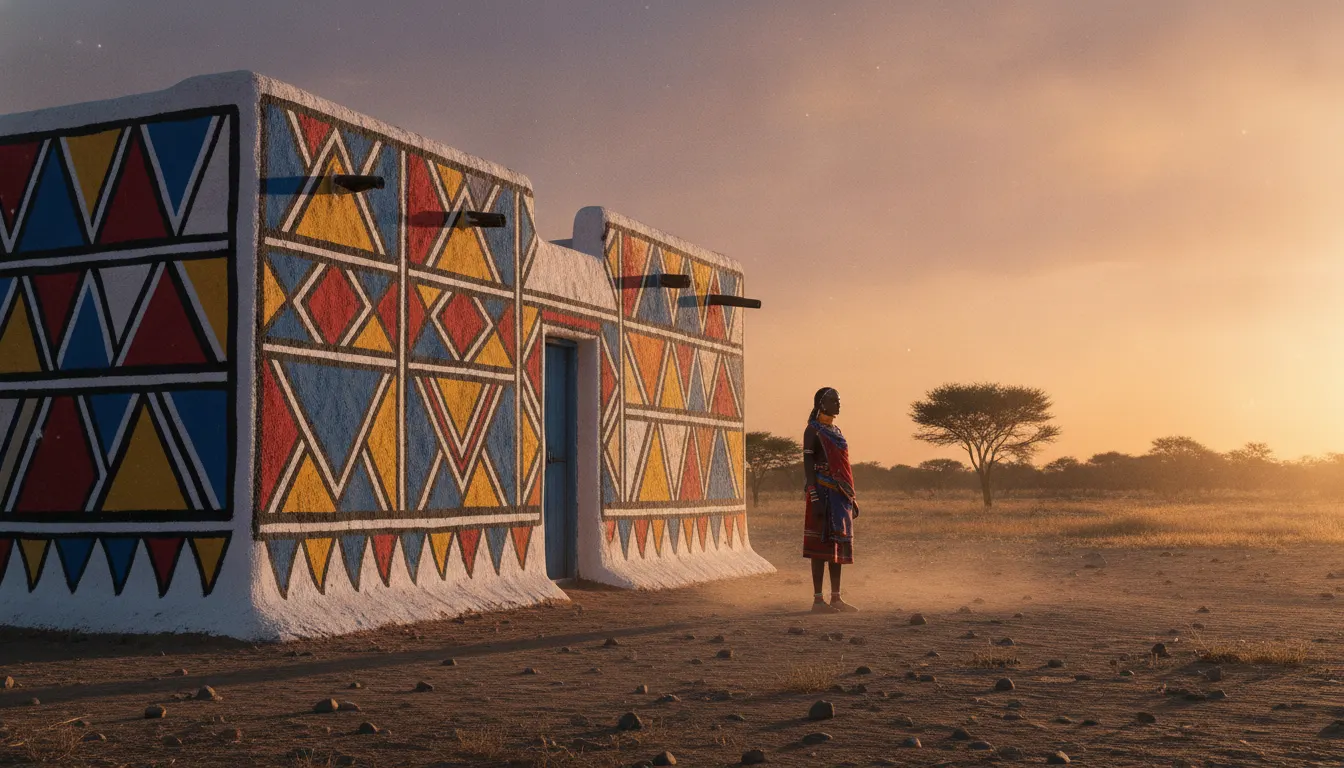
Inspired by the Ndebele painted-house tradition of southern Africa, popularized by artist Esther Mahlangu. Bold geometric mural blocks in primary colors outlined in black.
The moves a human crew would use to get here. Cue applies them for you, and knowing their names is how you ask for a change.
edged bilateral symmetry on a white ground, anchored by a central vertical axis
cobalt blue, cadmium red, chrome yellow, emerald green – with crisp black outlines
doorframes and windows become deliberate compositional elements
typically 10-20% of the form width
In the tradition of the Ndebele women of South Africa's Mpumalanga and Limpopo provinces, house painting (izindlu) is a centuries-old practice by which women transform the exterior walls of homesteads into bold, symmetrical geometric canvases – a living art form that simultaneously marks cultural identity, communicates social status, and asserts visibility against historical marginalization.
Ndebele mural painting intensified as a form of cultural resistance following the dispossession of Ndebele lands in the late 19th century – particularly after the Mapoch Wars (1882-1883), when the Ndzundza Ndebele were defeated and indentured as laborers across the Transvaal. Denied political and economic power, Ndebele women channeled their identity into their homesteads, creating murals that proclaimed 'we are still here.'
Traditionally painted with fingers and homemade brushes using mud, clay, and plant-based pigments in a palette of black, white, and earth tones, the murals shifted dramatically after the 1940s with access to commercial house paints. The introduction of vivid primary colors – cobalt blue, cadmium red, chrome yellow, brilliant green – transformed the aesthetic into the globally recognized style we know today.
The most celebrated Ndebele painter is Esther Mahlangu (b. 1935, KwaMhlanga), who has brought the tradition to international audiences. In 1991, BMW commissioned her to paint a 5 Series as part of their Art Car series – making her the first woman and first African artist in the program. She has painted murals at the Louvre, collaborated with British Airways and Dior, and continues to teach at her cultural village. Her compositions balance strict symmetry with spontaneous freehand confidence.
Ndebele murals use bilateral symmetry anchored at a central vertical axis. Geometric forms – rectangles, triangles, stepped battlements, zigzag borders, concentric frames – are rendered in flat, unmodulated color with crisp black outlines. The scale is architectural: designs are calibrated to wall planes, doorframes, and window reveals, integrating the opening as a compositional element. The color palette is high-chroma primary and secondary colors on a white ground.
1991
BMW Art Car , BMW Museum Munich
1992
mural, Musee du Louvre, Paris
1986
documented by Margaret Courtney-Clarke in *Ndebele*
1997
British Airways 747 tail livery
2018
Dior collaboration , haute couture collection
ongoing community practice
A Look is not a filter. It is a set of stored decisions the pipeline reads before it makes a single frame, so two videos in the same Look actually match.