J. Borges
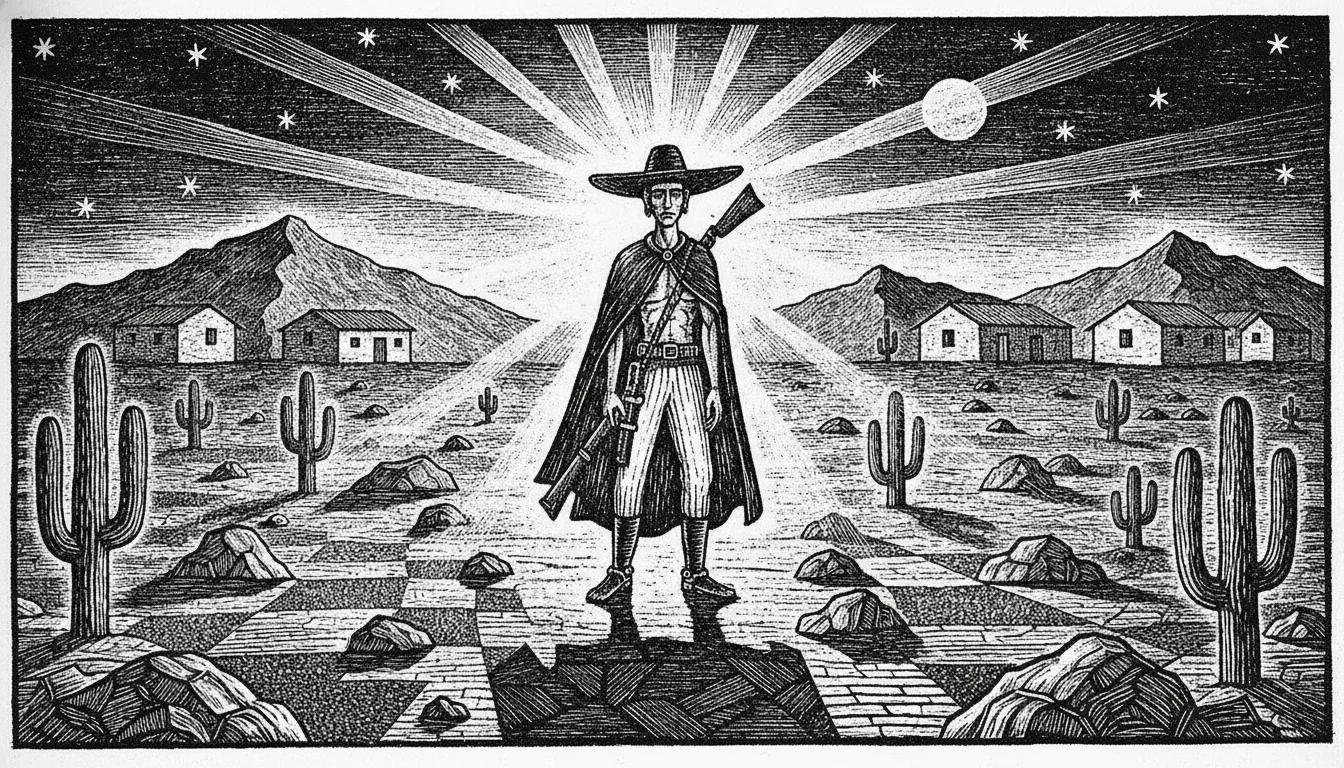
*O Homem que Vendeu a Alma ao Diabo* (1960s) – woodcut, MoMA collection
In the tradition of Brazilian Literatura de Cordel chapbook woodcut illustration. High-contrast black-and-white prints of cangaceiro outlaws, saints, and folk tales.
The moves a human crew would use to get here. Cue applies them for you, and knowing their names is how you ask for a change.
carved woodblock marks: slightly uneven lines, ink-fill irregularities, and visible grain texture
contrast black on rough cream or buff-toned paper stock
large heads, dramatic gestures, simplified anatomy
hatching for shadow areas using energetic diagonal hatch marks
facing 'portrait of the subject' cover convention: hero, monster, or miraculous figure centered on the booklet cover
In the tradition of literatura de cordel – 'string literature' – from the sertao (backlands) of northeastern Brazil, cordel woodcut illustration represents one of Latin America's most vital popular art forms: cheap pamphlet booklets of verse, hung on strings at market stalls and printed with hand-carved woodblock covers that combine crude vigor, expressive line, and genuine graphic power.
Literatura de cordel arrived in Brazil via Portuguese popular literature traditions (the folha volante and cordel of Portugal and the Iberian Peninsula) but developed its distinctive northeastern Brazilian character in the states of Pernambuco, Ceara, Paraiba, and Bahia from the late 19th century onward. The verse form – typically septilhas (seven-line stanzas) or sextilhas (six-line) in ABCBDB or ABCBDB rhyme schemes – was declaimed by traveling poets (repentistas) at weekly fairs (feiras) in cities including Recife, Fortaleza, and Juazeiro do Norte.
The woodcut covers – printed on rough-surface paper from hand-carved wooden blocks, inked with a roller and pressed by hand or with a simple press – developed as a sales tool and an art form simultaneously. The images needed to be legible at a distance in bright sun, bold enough to attract a buyer's eye across a crowded market, and sufficiently narrative to convey the booklet's subject (a famous bandit, a miracle of Padre Cicero, a supernatural creature, a satirical politician).
The master of cordel woodcut is J. Borges (Jose Francisco Borges, b. 1935, Bezerros, Pernambuco), who began carving blocks in 1964 and has since produced more than 1,000 unique woodcut images that hang in the Museum of Modern Art in New York, the Smithsonian, and collections worldwide. His compositions combine dense cross-hatching, bold silhouette, and expressive facial caricature in a style that influenced generations of Brazilian printmakers.
Cordel woodcuts are high-contrast black-on-cream or black-on-beige. The ground paper is rough, showing texture through the ink. Figures are bold and frontal, with expressive rather than anatomically precise proportions. Cross-hatching builds shadow with crude, energetic marks. Subjects include the mythological and supernatural (O Homem que Vendeu a Alma ao Diabo), the historical (Lampiao e Maria Bonita), the miraculous (Padre Cicero), and the satirical.
*O Homem que Vendeu a Alma ao Diabo* (1960s) – woodcut, MoMA collection
*Lampiao e Maria Bonita* series – widely reproduced, Smithsonian collection
prolific Bahia-based cordel poet and woodcut patron (20th century)
archive of over 10,000 cordel publications
J. Borges retrospective collections
2018
A Look is not a filter. It is a set of stored decisions the pipeline reads before it makes a single frame, so two videos in the same Look actually match.