Elena Serrano
1967
*Day of the Heroic Guerrilla* , OSPAAAL – geometric Che Guevara face
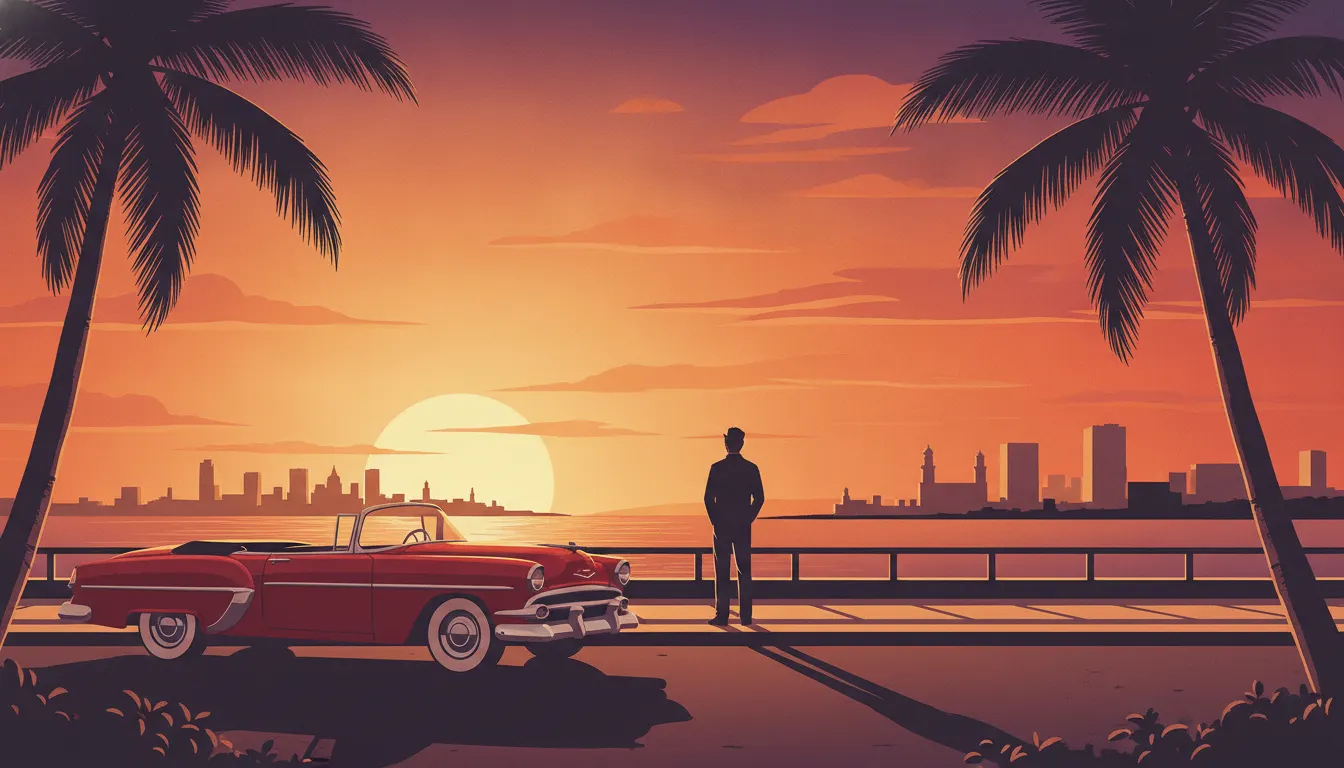
Inspired by mid-century Cuban travel-poster and rum-label tradition. Bold flat color illustration of Havana skyline, vintage car, palm, and tropical sunset.
The moves a human crew would use to get here. Cue applies them for you, and knowing their names is how you ask for a change.
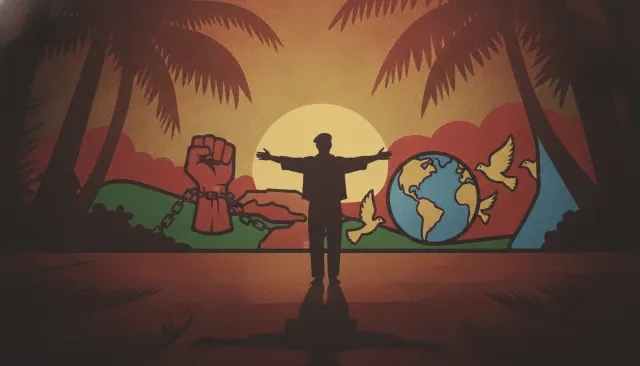
4 color silk-screen palette: bold primary or high-contrast secondary colors on black or cream grounds
contrast silhouette figure construction – human forms reduced to essential geometric shape language
Elena Serrano's Che poster as the archetype
serif or slab-serif headline typography integrated into the image field rather than added separately
clenched fists, AK-47 silhouettes, maps, flag colors – as legible international shorthand
In the tradition of the Cuban revolutionary graphic arts movement that flourished from 1959 onward – reaching its international peak through the work of OSPAAAL (Organization of Solidarity with the Peoples of Africa, Asia and Latin America, founded 1966) and the ICAIC (Instituto Cubano del Arte e Industria Cinematograficos, founded 1959) – Cuban poster design represents one of the 20th century's most distinctive bodies of political graphic art.
After the Cuban Revolution of 1959, the new government invested heavily in cultural production as a form of political communication and identity formation. Two institutions became the primary engines of graphic output: ICAIC, whose film posters applied European avant-garde and Pop Art influences to cinema promotion; and OSPAAAL, whose tricontinental solidarity posters were folded into the magazine Tricontinental and distributed globally to anti-imperialist, anti-Vietnam War, and liberation movements worldwide.
The OSPAAAL posters – produced from 1966 through the 1990s – addressed every major political crisis of the era: Vietnam, Palestine, Angola, Mozambique, apartheid South Africa, Chile under Pinochet. Their visual language was international in influence but distinctly Cuban in synthesis: the flat-color silk-screen process (limited to 2-4 colors for economic and technical reasons) forced a graphic economy that became an aesthetic principle. High contrast, bold silhouette, and arresting symbolism were survival requirements, not stylistic choices.
Key designers include: Felix Beltran (b. 1938, Havana), whose rigorous geometric abstraction brought Swiss International Style sensibility to OSPAAAL; Rene Mederos (1933-1996), whose visceral, expressionistic posters about Vietnam remain among the most powerful political images of the era; Alfredo Rostgaard (1943-2004), whose psychedelic-influenced OSPAAAL work blended Art Nouveau with Pop; and Elena Serrano, whose iconic Day of the Heroic Guerrilla (1967) commemorating Che Guevara's death used a pure geometric face derived from Alberto Korda's photograph.
ICaic's film-poster tradition developed differently – less constrained by the strict political messaging of OSPAAAL, ICAIC artists brought humor, cultural reference, and formal experimentation to a cinema culture that screened both Cuban films and international art cinema. Eduardo Munoz Bachs (1937-2001), responsible for hundreds of ICAIC posters over four decades, combined childlike illustration with sophisticated design wit.
1967
*Day of the Heroic Guerrilla* , OSPAAAL – geometric Che Guevara face
OSPAAAL poster series (1967-1975), geometric abstraction
Vietnam War solidarity poster series (1967-1972), expressionistic
1968
*Hanoi Sabado* and OSPAAAL psychedelic series
ICAIC film posters (1960s-1990s), hundreds of films documented
poster folios distributed globally 1966-1990s, collections at MoMA, V&A, MOMA Cuba
A Look is not a filter. It is a set of stored decisions the pipeline reads before it makes a single frame, so two videos in the same Look actually match.