Edward Said Tingatinga
original hardboard paintings (c. 1968-1972), private collections and National Museum of Tanzania
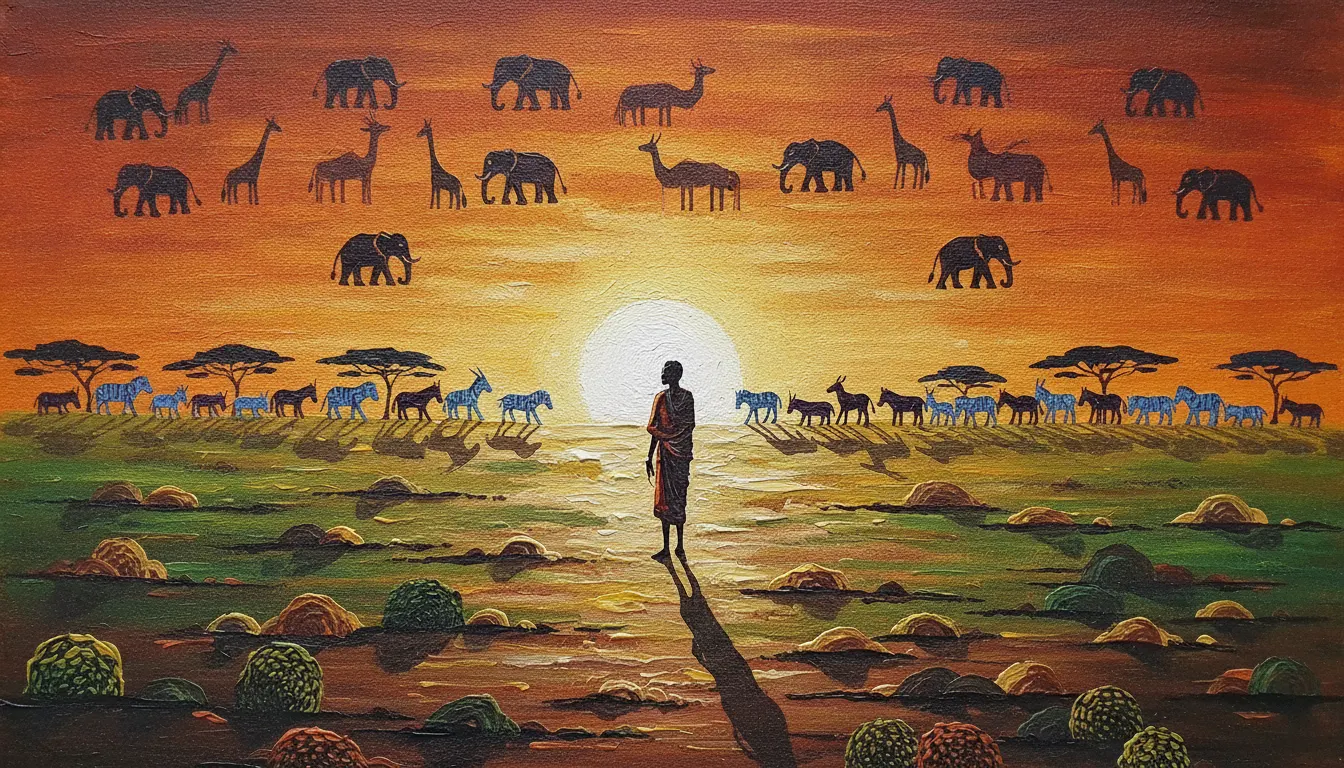
In the tradition of Edward Said Tingatinga and the Tanzanian Tingatinga school. Bright enamel paintings of safari animals, repeated in flat saturated color on board.
The moves a human crew would use to get here. Cue applies them for you, and knowing their names is how you ask for a change.
gloss surface quality – vivid, opaque, with slight sheen
dots, stripes, geometric repeat inside the outline
over composition with minimal ground plane – animals float against a pure color field
vivid greens, electric blues, hot pinks, and chrome yellows
In the tradition founded by Edward Said Tingatinga in Dar es Salaam around 1968, Tinga Tinga painting is Tanzania's most distinctive modern folk art form: brightly colored, flat-perspective depictions of wildlife and village life, painted with bicycle enamel on hardboard using a brush loaded with pure, vivid pigment.
Edward Said Tingatinga (1932-1972) came from the Makua people near the Mozambique border, migrating to Dar es Salaam where he worked as a houseboy while teaching himself to paint. He began selling small hardboard paintings in the Mwananyamala neighborhood around 1968, depicting the animals, birds, and insects of East Africa in a style that owed nothing to Western fine-art training – flat, confident outlines; saturated fills; a decorative all-over surface pattern reminiscent of batik and printed cotton.
Tingatinga was tragically shot by police during a case of mistaken identity in 1972, but by then he had taught several relatives and neighbors his technique. His pupils – the 'second generation' – including his nephew Simon Tingatinga and collaborators Omary Amonde, Daudi Tingatinga, and Rashidi Chikamoneka – expanded the style into a cooperative industry. The Tinga Tinga Arts Co-operative Society, founded in 1990 in Dar es Salaam's Oyster Bay district, now represents hundreds of painters.
Tinga Tinga paintings are typically square or round hardboard panels. Animals – elephants, lions, hippos, birds, fish, insects – are the dominant subject matter, depicted in simplified, graphic silhouette with decorative patterning filling the body. The background is typically a single flat color (vivid green, blue, or purple), with the ground plane minimal or absent. Bicycle enamel paint dries with a characteristic high gloss and punchy opacity that gives Tinga Tinga its visual signature.
Contemporary Tinga Tinga has diversified: 'spider Tinga Tinga' features intricate webs of interconnected animal forms filling the entire panel surface; narrative Tinga Tinga depicts village scenes; and export-market work has introduced more detailed, realistic approaches. The original Tingatinga style – bold, flat, psychedelic – remains the most powerful and authentic.
original hardboard paintings (c. 1968-1972), private collections and National Museum of Tanzania
Dar es Salaam, ongoing production from 1990
spider Tinga Tinga panels (1980s-1990s), widely collected
second-generation narrative Tinga Tinga works
2010
UK/Kenya animated children's series inspired by the tradition
Tinga Tinga panel acquisitions
A Look is not a filter. It is a set of stored decisions the pipeline reads before it makes a single frame, so two videos in the same Look actually match.