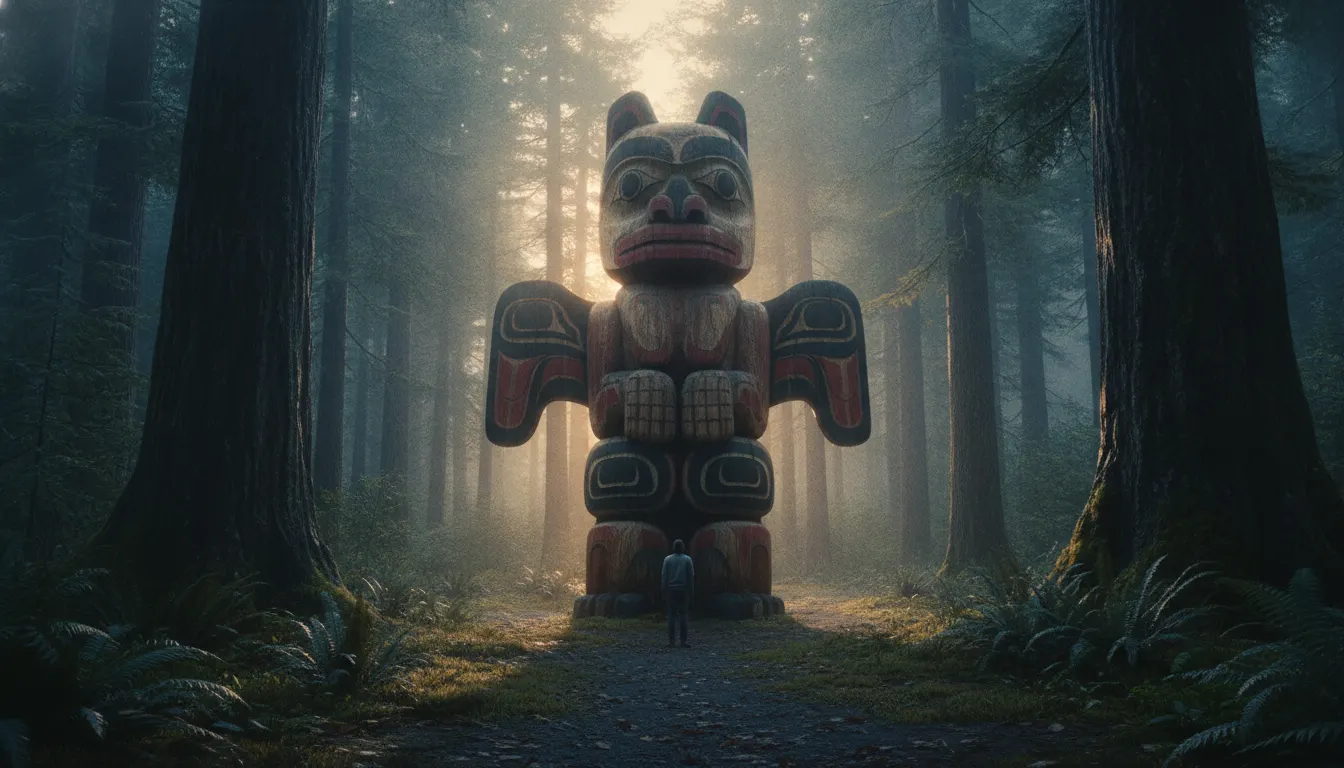
Bill Reid
1980
*Raven and the First Men* , UBC Museum of Anthropology, Vancouver
In the tradition of Pacific Northwest Coast formline design from Haida, Tlingit, and Kwakwakawakw artists. Bold ovoid eyes, U-form curves, red and black on cedar.
The moves a human crew would use to get here. Cue applies them for you, and knowing their names is how you ask for a change.
U secondary infill elements in red or blue-green within primary black outlines
color system: black primary, red secondary, blue-green tertiary on cream or white ground
to-top on totem poles
over coverage – negative space is minimized by secondary and tertiary infill
The art of the Indigenous peoples of the Northwest Coast of North America – from southern Alaska through British Columbia and into Washington State – is one of the most rigorous and sophisticated formal systems in world art history. Its visual grammar, known as formline, was systematically described by the art historian and curator Bill Holm in his 1965 study Northwest Coast Indian Art: An Analysis of Form, which gave an analytic vocabulary to principles that Northwest Coast artists had applied for millennia.
The major formline-using nations include the Haida (Haida Gwaii / Queen Charlotte Islands), Tlingit (southeastern Alaska), Tsimshian, Heiltsuk, Nuxalk, Kwakwaka'wakw (northern Vancouver Island), Nuu-chah-nulth, and Coast Salish peoples. Each nation has a distinct formal dialect: Haida work tends toward precise, refined line and clean symmetry; Kwakwaka'wakw work, associated especially with potlatch ceremony and hamatsa initiation, is bolder and more theatrically dramatic; Tlingit work often uses tighter cross-hatching and complex nested forms.
The formline system is built from three primary elements: the ovoid (a rounded rectangular shape with concave sides, used for eye sockets, joints, and primary design units), the U-form (a U-shaped secondary design element filling spaces between primaries), and the split-U (a bifurcated U-form). Primary formlines are the thick, continuous black lines that outline major design areas; secondary elements fill the interior in red (or sometimes blue-green); tertiary negative spaces are left in the ground color. The three-color system (black, red, blue-green) on a cream or white ground is the classic Northwest Coast palette.
The monumental totem pole – carved from a single western red cedar (Thuja plicata) log and raised at the front of a house or as a memorial – is the largest-scale expression of the formline tradition. A totem pole reads from bottom to top as a sequence of crest figures: the eagle, raven, killer whale (Orca), bear, frog, beaver, and thunderbird are common clan crests. The figures are not 'totems' in the religious sense; they record family histories, hereditary privileges, and narrative events that the pole's owner has the right to display.
Bill Reid (1920–1998, Haida and Scots-Canadian) is the towering figure of the 20th-century Northwest Coast art revival. His monumental bronze Raven and the First Men (1980, UBC Museum of Anthropology, Vancouver) is a masterwork of the tradition at architectural scale. His 6-meter bronze killer-whale canoe The Spirit of Haida Gwaii (1991) stands at the Canadian Embassy, Washington D.C. and at Vancouver International Airport. Reid worked in gold, argillite, bronze, and cedar, bringing formline from ethnographic display into the contemporary art market.
1980
*Raven and the First Men* , UBC Museum of Anthropology, Vancouver
1991
*The Spirit of Haida Gwaii* , Canadian Embassy Washington D.C. / Vancouver Airport
argillite platters and model totem poles, multiple museum collections
monumental totem poles, Royal BC Museum, Victoria
contemporary formline prints and carvings, multiple galleries
largest public collection of Northwest Coast art
A Look is not a filter. It is a set of stored decisions the pipeline reads before it makes a single frame, so two videos in the same Look actually match.
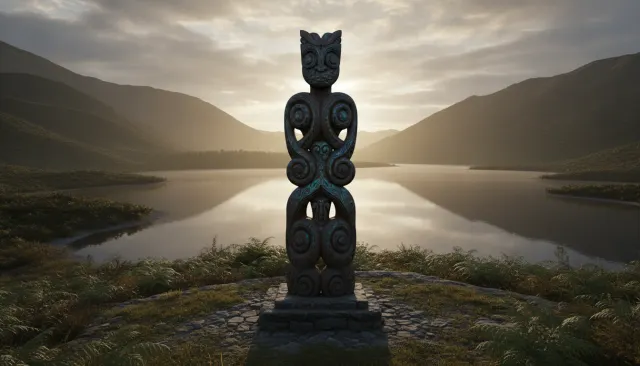 Indigenous Australia OceaniaMaori Carving and Ta Moko (New Zealand)
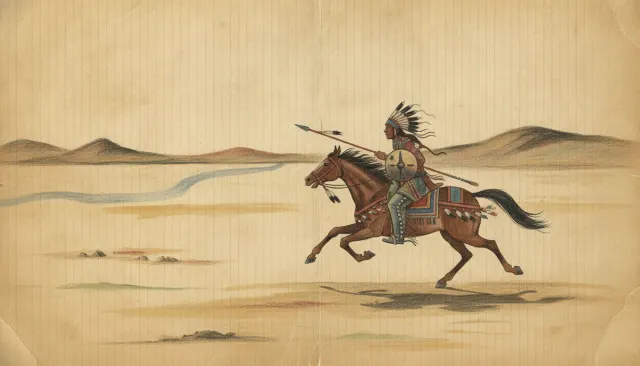 Indigenous AmericasPlains Native American Ledger Art
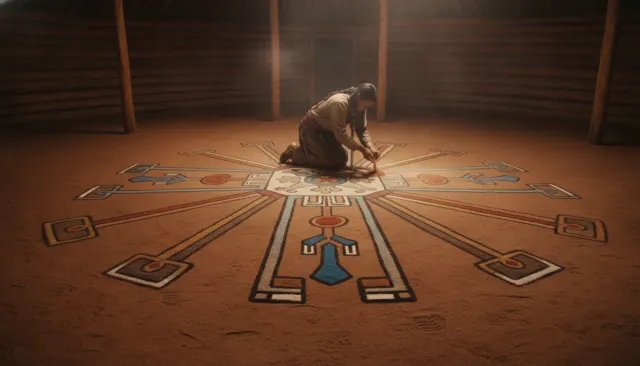 North American FolkNavajo Sand Painting Ritual (Dine)
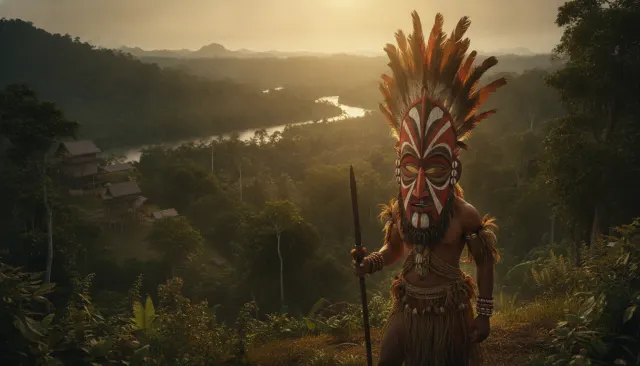 Indigenous Australia OceaniaPapua New Guinea Tribal Mask
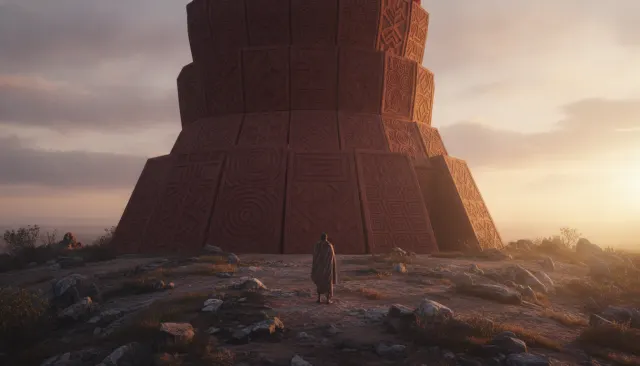 African ExtendedMalagasy Zafimaniry Carving (Madagascar)
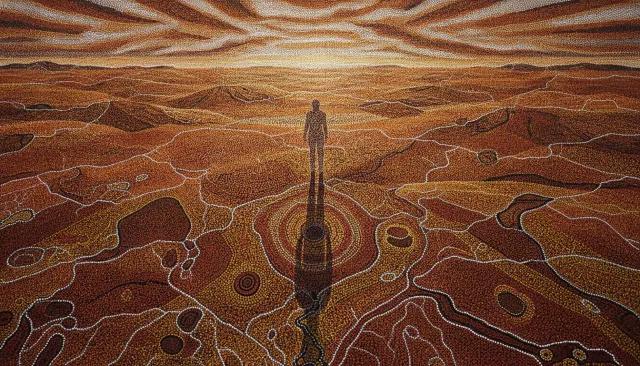 Indigenous Australia OceaniaAboriginal Dot Painting (Australia)