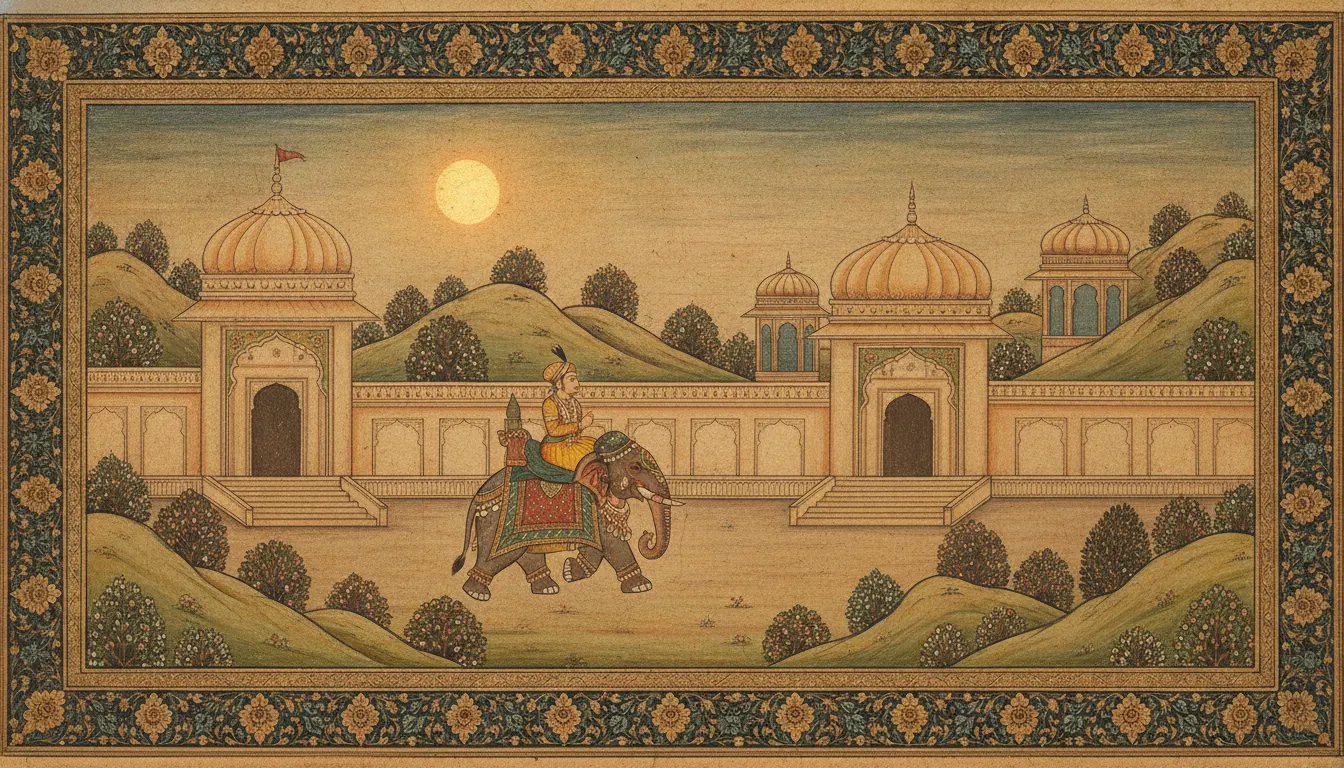
SOUTH SOUTHEAST ASIAN · TRADITIONAL · INDIA
Rajasthani Miniature Painting
In the tradition of Rajasthani miniature painting from courts like Mewar, Bundi, and Kishangarh. Royal court scenes, romantic Radha-Krishna ragamala, jewel pigments.
rajasthaniminiatureindiancourt-painting
LUT rajasthani-jewel-pigment
WHEN TO USE
- Rajasthani and broader North Indian heritage tourism and cultural brand content
- Indian classical music, dance, and Ragamala-related arts promotion where the Ragamala miniature tradition is directly referenced
- Luxury Indian heritage hotel, palace hotel, and craft brand content
- Hindu devotional content featuring Krishna-Radha narratives and Vaishnava mythology
- Fine-art auction and gallery content promoting Indian classical and Mughal-influenced painting
- Fashion editorial and jewelry brand content inspired by Rajasthani palace opulence and jewel-bright pigments
WHEN NOT TO USE
- Generic 'India' branding that collapses the specific Rajput courtly tradition into a pan-Indian visual shorthand
- Contemporary pop-culture, tech, or startup content where the courtly formality would be tonally absurd
- Content requiring photorealistic or naturalistic imagery -- the stylized flatness and unmodeled color are fundamental to the tradition
- Brands with no Indian cultural connection using the jewel palette and elaborate detail as decorative exoticism
SIGNATURE TECHNIQUES
How the look is made.
The moves a human crew would use to get here. Cue applies them for you, and knowing their names is how you ask for a change.
- 01Flat, unmodeled color fields with strong black outlines
- no Western-style chiaroscuro or volumetric shadow
- 02Mineral
pigment palette: lapis lazuli blue, malachite green, gold leaf, vermilion red, orpiment yellow, lead white
- 03Architectural elevation perspective
buildings shown as flat facades with interior visible simultaneously
- 04Large, stylized eyes (often lotus
petal shaped), arched brows, and three-quarter or profile face conventions
- 05Kishangarh elongation
impossibly long necks and refined, lyrical figure proportions
- 06Ragamala compositional program
figures in architectural or landscape settings evoking specific musical modes
- 07Fine squirrel
hair brushwork with one-to-three hair brushes for detailed facial features and calligraphic inscriptions
HISTORY & CONTEXT
Where it comes from.
Indian Rajasthani Miniature
Rajasthani miniature painting encompasses the court-painting traditions of the Rajput kingdoms of Rajasthan from approximately the late 16th century through the early 19th century. Working in a tradition fertilized by the Mughal court ateliers of Akbar and Jahangir (which trained many Rajput artists), the major Rajasthani schools -- Mewar, Bundi, Kota, Marwar, Bikaner, Jaipur, and Kishangarh -- each developed a distinct aesthetic vocabulary while sharing a common formal grammar.
Historical Context
The Mughal Emperor Akbar (r. 1556-1605) established the imperial atelier (karkhana) at his court, synthesizing Persian Safavid manuscript painting with Indian figural tradition. When Rajput chiefs entered into tributary relationships with the Mughal court, artists trained in Mughal technique moved to Rajput courts, where they adapted the style to local narrative and devotional needs -- primarily Vaishnava (Krishna) mythology, Ragamala (musical mode) series, and royal portraiture and hunting scenes.
The Major Schools
Mewar School (Udaipur, 1600s-1800s): The oldest and most prolific Rajasthani school. Colors are bold and unmodeled -- flat red, yellow, and green fields with strong black outlines. Architecture is shown in elevation. Figures are stocky with large eyes. Key works: Ragamala series of 1628 (Udaipur) and the Rasikapriya series.
Bundi-Kota School (17th-18th century): Known for rich, lush verdant landscapes, spirited animal studies (especially elephants and tigers in hunt scenes), and a greener, more atmospheric palette than Mewar. The Bundi palace paintings are among the most ambitious murals in Rajasthani tradition.
Kishangarh School (18th century): The most distinctive Rajasthani sub-tradition, defined by artist Nihal Chand (active c. 1735-1765) and the patronage of Raja Savant Singh. Figures have an elongated, lyrical quality -- impossibly long necks, arched brows, lotus eyes -- idealizing the form of Krishna and his consort Radha. The celebrated painting Bani Thani (c. 1750, National Museum, Delhi) is often called the Indian Mona Lisa.
Technique
Miniatures were painted on paper (sometimes cloth) sized with starch and polished with a stone burnisher. Pigments were mineral -- lapis lazuli, malachite, gold, vermilion, lead white, orpiment yellow, and lamp black. Brushes were made from squirrel hair, and fine detail work used brushes of one to three hairs. Compositions were sketched in red lead, then worked up in multiple glaze layers.
NOTABLE WORKS
Where you have seen it.
Ragamala series, Mewar -- multiple museum holdings, defining early Mewar school composition
1628
Bundi Palace murals (17th-18th century) -- in situ, Taragarh Fort, Bundi, among the finest Rajasthani murals
Lady with a Hawk, Bikaner School (c. 1680) -- Victoria and Albert Museum, shows Mughal influence on Bikaner
Siege of Lanka, Mewar Ramayana (c. 1650-1652) -- Freer/Sackler, Smithsonian, multi-folio epic narrative
Gita Govinda illustrations, Mewar (17th century) -- multiple holdings, Krishna-Radha devotional cycle
THE RECIPE
The exact knobs
the renderer turns.
A Look is not a filter. It is a set of stored decisions the pipeline reads before it makes a single frame, so two videos in the same Look actually match.
SettingValue
GradeColour LUT applied to every frame
rajasthani-jewel-pigmentTransitionHow one shot becomes the next
soft cuts · 360ms · ease-in-outKen BurnsCamera move applied to stills
Slow push · 0.02 · centerTypographyDisplay / body / mono pairing
Cormorant · Lora · JetBrains MonoMusic moodWhat the bed under the voice sounds like
sitar-raga · tabla-tarangPrompt suffixAppended to every shot prompt in this Look
inspired by Rajasthani miniature painting tradition Mewar Bundi Kishangarh, royal court or Radha Krishna ragamala scene, jewel pigment on paper, decorative borderPALETTE
Primary
#7A1010
Secondary
#1A4A6E
Accent
#F5C144
Text/Light
#1A0808
Text/Dark
#FFE8A8
BG 900
#0F0505
BG 800
#1A0808
RELATED LOOKS
Next to it on the shelf.
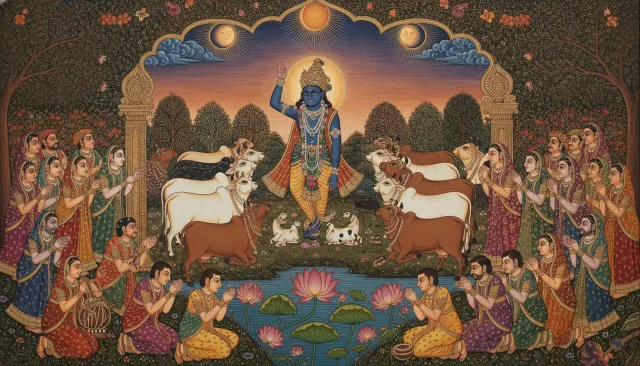 South Southeast AsianPichhwai Krishna Painting (Rajasthan)
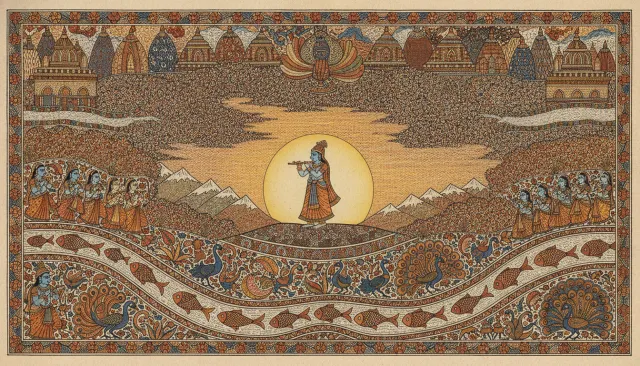 South Southeast AsianMadhubani Mithila Painting (India)
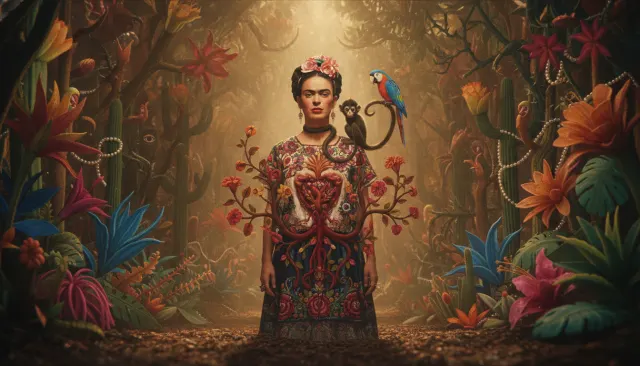 Latin AmericanFrida Kahlo Self-Portrait (Mexico)
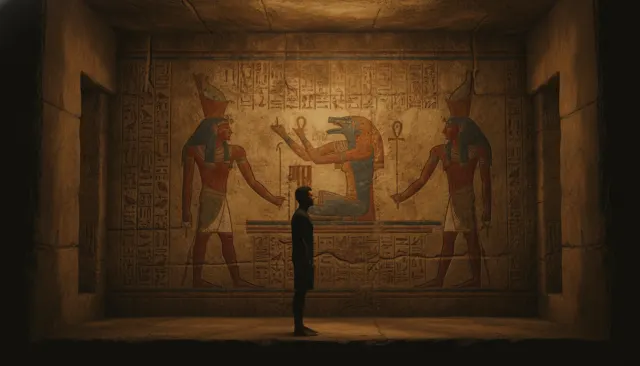 Middle Eastern ExtendedEgyptian Hieroglyphic Tomb Decoration
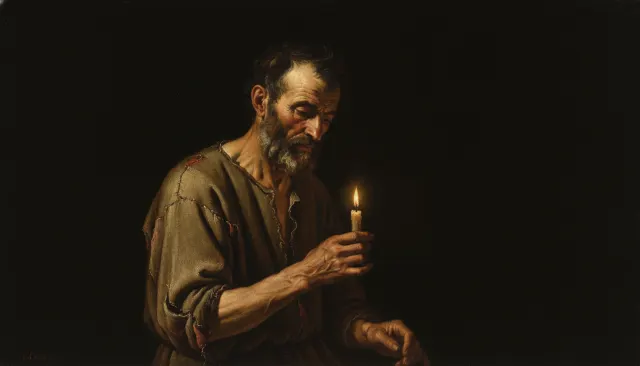 Art Movement ClassicalBaroque Painting Caravaggio
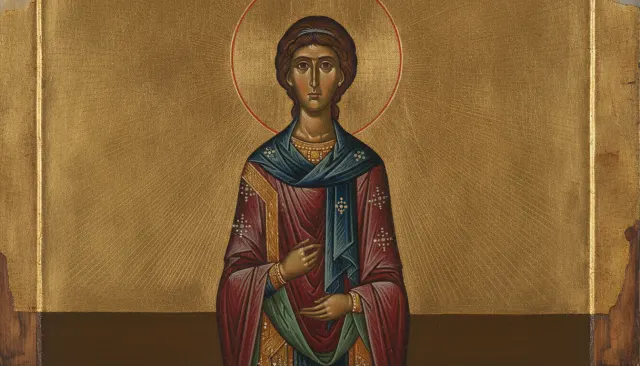 Eastern HistoricalByzantine Icon Gold Leaf
Your first cut
is on us.
+ New videoFree plan · no card · 1080p export