SOUTH SOUTHEAST ASIAN · TRADITIONAL · INDIA
Madhubani Mithila Painting (India)
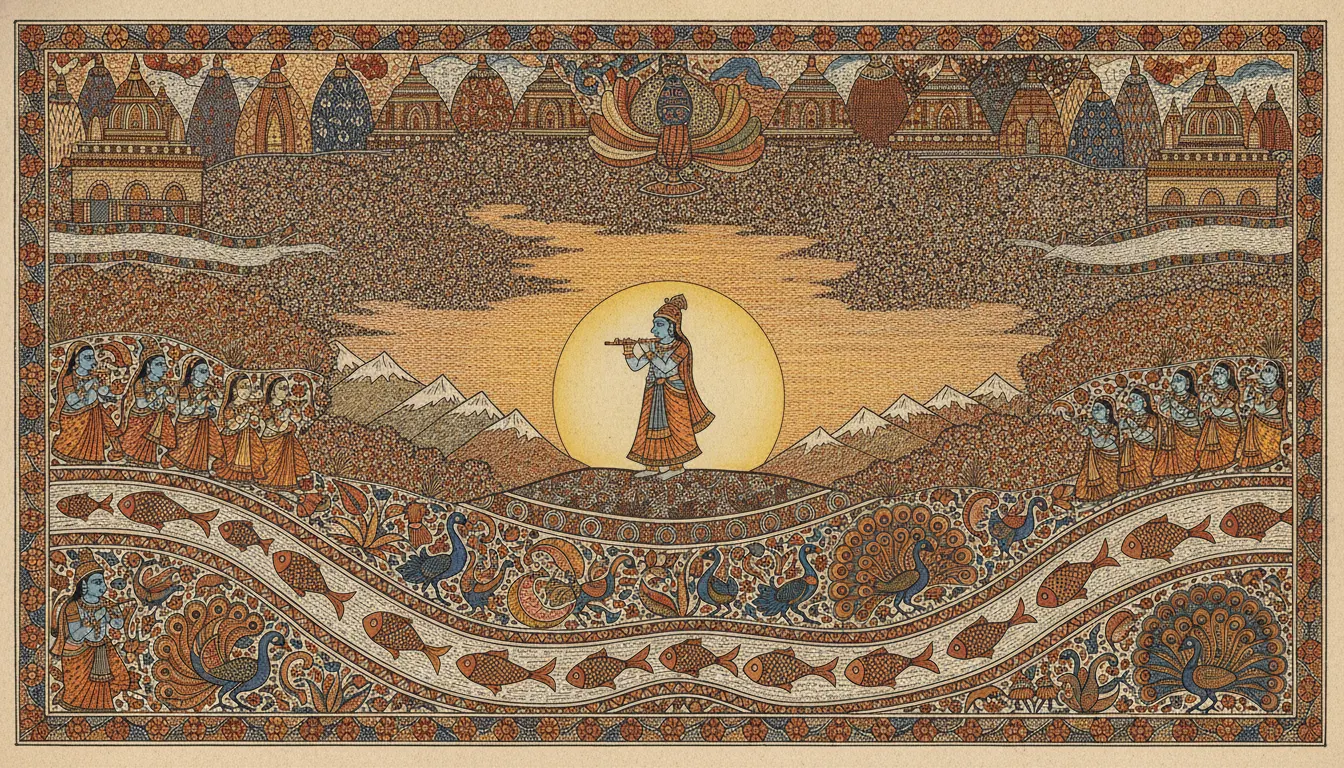
Inspired by the Madhubani Mithila folk painting tradition of Bihar, India. Tightly patterned figures of Krishna, fish, and peacock in natural dyes on handmade paper.
madhubanimithilaindianfolk-painting
LUT madhubani-natural-dye
WHEN TO USE
- Indian cultural heritage, folk-art exhibition, and craft promotion content
- Bihar, Nepal, and Mithila regional tourism and identity content
- Women's craft, artisan cooperative, and fair-trade brand content celebrating indigenous visual traditions
- Documentary and educational content about Indian folk arts, mythology, or post-drought rural development programs
- Hindu religious and festival content -- Diwali, weddings, and auspicious ceremonies -- where Madhubani motifs are traditionally appropriate
- Pattern-forward graphic design, textiles, and motion-graphics sequences that need dense, joyful line work
WHEN NOT TO USE
- Generic 'Indian art' branding that erases the specific regional, community, and women's-tradition identity of Madhubani
- Minimalist or sparse design contexts where the horror vacui fill-everything approach will be visually incompatible
- Content that divorces the mythology-specific iconography from its meaning -- fish, lotus, and sun have specific ritual significance
- High-tech, corporate, or contemporary urban content where the folk-craft register would be tonally inconsistent
SIGNATURE TECHNIQUES
How the look is made.
The moves a human crew would use to get here. Cue applies them for you, and knowing their names is how you ask for a change.
- 01Horror vacui composition
every space filled with hatching, cross-hatching, or pattern -- no empty ground visible
- 02Double or triple outline in black and red defining all figures and motifs
- 03Large almond eyes with irises touching both lids and no visible pupil -- the definitive facial signature
- 04Natural dye palette
turmeric yellow, indigo blue, kajal black, vermilion red-orange, and plant-based greens
- 05Fish (matsya) as the most iconic recurring fertility and auspicious motif
- 06Bamboo, lotus, peacock, elephant, and sun/moon as secondary symbolic fill elements
- 07Kohbar (wedding room) compositional format
central figure surrounded by concentric registers of pattern
HISTORY & CONTEXT
Where it comes from.
Madhubani Mithila Painting
Madhubani painting (also called Mithila painting, from the historical Mithila region straddling Bihar, India, and the Terai of Nepal) is a women's folk-painting tradition with roots stretching back at least 2,500 years. The Ramayana describes King Janaka of Mithila commissioning painters for his daughter Sita's wedding -- placing the tradition within Hindu epic memory. In documented historical practice, Mithila women painted on freshly plastered mud walls (kohbar) of the room where newly-wed couples spent their first nights, creating an auspicious visual environment.
Discovery and Documentation
The tradition came to international attention after the 1934 Bihar earthquake devastated the region. British civil servant William Archer photographed the exposed interior walls of damaged houses and published his images in 1949, introducing Mithila art to art historians. Following a severe drought in 1966-67, the All India Handicrafts Board commissioned the tradition to be transferred to paper and cloth as an income source for affected communities. This shifted the practice from ritual wall-painting to a commercial and gallery art form, without eliminating the ritual dimension.
Ganga Devi and the Contemporary Canon
Ganga Devi (1928-1991) is the most celebrated individual Madhubani artist. She was among the first to work on paper for sale, and her autobiographical series documenting her experiences during treatment for cancer at a New York hospital -- depicting traditional Mithila imagery alongside Manhattan skyscrapers and subway trains -- is a landmark of the tradition's adaptive range. Her work is held by major collections including the Victoria and Albert Museum and the Crafts Museum, New Delhi. Other significant artists include Sita Devi (1924-2005), who received the Padma Shri award in 1969 as the first Madhubani artist to receive a national honor.
Visual Characteristics
Madhubani painting is defined by a horror vacui approach: every space within the composition is filled with pattern, line, or color. Outlines are double or triple in black and red. Interior areas are filled with parallel hatching, cross-hatching, or solid color washes. The palette uses natural dyes derived from turmeric (yellow), indigo (blue), kajal/lampblack (black), vermilion (red/orange), and plant-based greens, though contemporary artists also use commercial poster colors.
Motifs are mythological and natural: the lotus (purity), fish (fertility and good fortune), bamboo (prosperity), peacock, elephant, the Sun and Moon, and scenes from the Ramayana and Krishna's life. The human figure is distinctive: large, almond eyes with irises touching both upper and lower lids, no pupil, prominent nose, and formal profile or frontal stance.
NOTABLE WORKS
Where you have seen it.
Sita Devi, Ramayana cycle (1970s) -- defining narrative use of the tradition on paper
Baua Devi, cosmological paintings (1970s-present) -- Padma Shri 2017, spiritual abstraction within Madhubani vocabulary
William Archer photographs of earthquake-exposed Bihar walls -- Smithsonian and private archives, first Western documentation
1934
Jagdamba Devi works (1970s) -- another early Padma Shri recipient, classical Mithila mythological subjects
National Crafts Museum, New Delhi -- largest institutional collection of historic Madhubani on paper and cloth
THE RECIPE
The exact knobs
the renderer turns.
A Look is not a filter. It is a set of stored decisions the pipeline reads before it makes a single frame, so two videos in the same Look actually match.
SettingValue
GradeColour LUT applied to every frame
madhubani-natural-dyeTransitionHow one shot becomes the next
soft cuts · 320ms · ease-in-outKen BurnsCamera move applied to stills
Slow push · 0.025 · centerTypographyDisplay / body / mono pairing
Cormorant · Lora · JetBrains MonoMusic moodWhat the bed under the voice sounds like
sitar-raga · tabla-percussionPrompt suffixAppended to every shot prompt in this Look
inspired by Madhubani Mithila folk painting tradition Bihar India, tightly patterned figures, Krishna fish peacock motif, natural dye on handmade paper, no empty spacePALETTE
Primary
#C8101A
Secondary
#0E5C9A
Accent
#F5C144
Text/Light
#1A0808
Text/Dark
#FFE8A8
BG 900
#0F0505
BG 800
#1A0808
RELATED LOOKS
Next to it on the shelf.
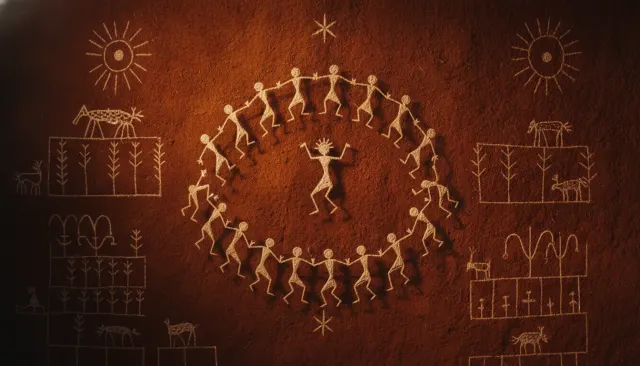 South Southeast AsianWarli Tribal Painting (Maharashtra)
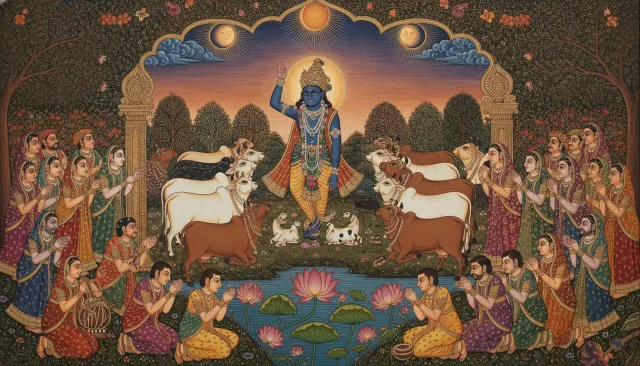 South Southeast AsianPichhwai Krishna Painting (Rajasthan)
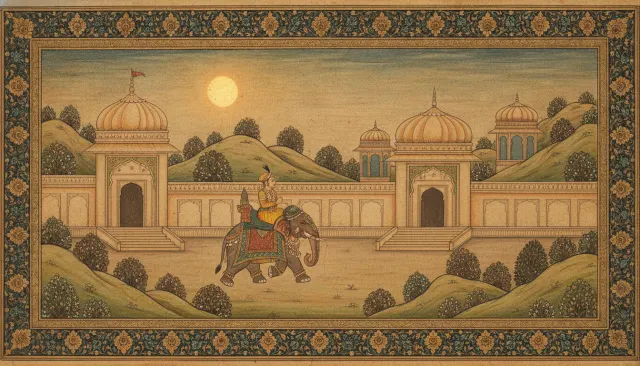 South Southeast AsianRajasthani Miniature Painting
 Latin AmericanFrida Kahlo Self-Portrait (Mexico)
 Latin AmericanDay of the Dead Sugar Skull (Mexico)
 Historical Illuminated ExtendedAztec Mesoamerican Codex Symbol
Your first cut
is on us.
+ New videoFree plan · no card · 1080p export