SOUTH SOUTHEAST ASIAN · TRADITIONAL · INDIA
Pichhwai Krishna Painting (Rajasthan)
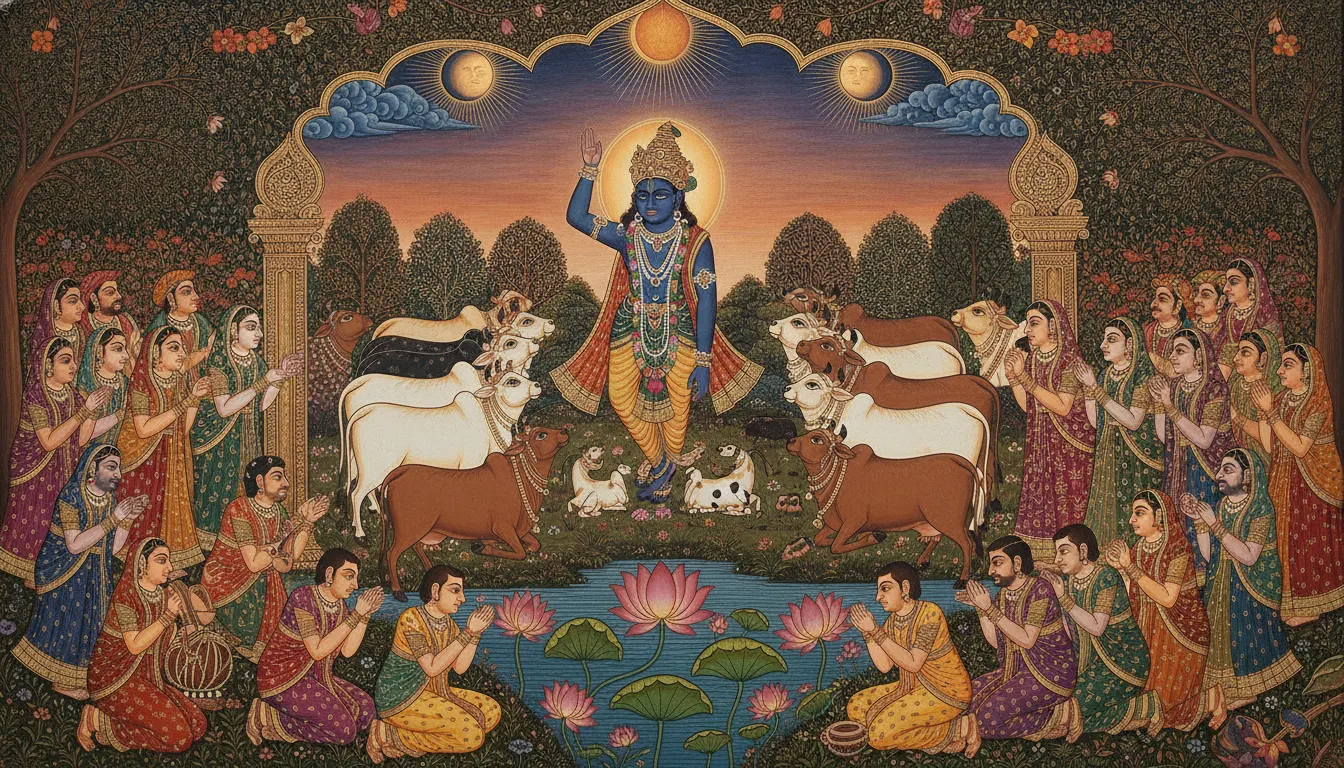
Inspired by the Pichhwai temple-hanging tradition of Nathdwara, Rajasthan. Krishna as Shrinathji surrounded by cows, lotus, and devotees in jewel-tone palette.
pichhwaikrishnarajasthanidevotional
LUT pichhwai-jewel-gold
WHEN TO USE
- Hindu Vaishnava religious content, temple events, and Krishna-bhakti devotional campaigns
- Indian luxury heritage brand content referencing royal Rajasthani patronage and courtly opulence
- Nathdwara, Udaipur, and Rajasthan tourism content where the tradition is a primary cultural draw
- Fine-art and auction-house content promoting Indian classical and devotional art
- Festival content for Janmashtami, Annakut, Holi, and other Vaishnava calendar celebrations
- Textile, jewelry, and fashion brand content referencing jewel-bright Rajasthani mineral-pigment palettes
WHEN NOT TO USE
- Secular or non-devotional contexts where using the sacred idol-hanging format without religious framing would be disrespectful
- Generic 'Indian art' campaigns that erase the specific Nathdwara Pushtimarg Vaishnava identity
- Content for brands with no Indian cultural connection using the imagery as decorative exoticism
- Minimalist or contemporary-neutral brand contexts where the dense gold-and-jewel opulence would be tonally overwhelming
SIGNATURE TECHNIQUES
How the look is made.
The moves a human crew would use to get here. Cue applies them for you, and knowing their names is how you ask for a change.
- 01Central frontal Shrinathji figure on deep lapis blue or saffron yellow ground, always with raised left arm
- 02Lapis lazuli, malachite, vermilion, gold leaf, and lamp black mineral-pigment palette of exceptional chroma
- 03Gopis, cows, lotus ponds, and seasonal motifs (peacocks for monsoon, blossoms for spring) as compositional surround
- 04Nathdwara facial convention
broad, full-cheeked, lotus-petal eyes, full lower lip
- 05Cotton or silk ground pre
sized with rice or wheat starch for smooth mineral-pigment reception
- 06Elaborate lotus and creeper border patterns in gold and colored bands
- 07Seasonal program
composition and dominant color shift with the Pushtimarg festival calendar
HISTORY & CONTEXT
Where it comes from.
Indian Pichhwai Krishna Rajasthan
Pichhwai (from the Sanskrit pichha, back, and wai, hanging) are large cloth paintings produced specifically as devotional hangings behind the idol of Shrinathji in the Nathdwara temple, Rajasthan. Nathdwara (meaning 'gateway of the Lord'), approximately 48 kilometers north of Udaipur, has been the principal site of the Pushtimarg (Path of Grace) Vaishnava sect since 1672, when the Shrinathji idol was brought there from Mathura to escape Mughal Emperor Aurangzeb's temple-destruction campaign.
The Shrinathji Idol and Pichhwai Function
Shrinathji is a form of Lord Krishna depicted as a seven-year-old child lifting Mount Govardhan above his head to shelter devotees from Indra's storm -- a key episode from the Bhagavata Purana. The iconic raised left arm is the idol's most recognizable feature. Pichhwai hang directly behind this idol, changing seasonally with the festival calendar: different paintings are displayed for Janmashtami (Krishna's birthday, July-August), Annakut (the day after Diwali), the Sharad Purnima autumn moonlit night, the Holi spring festival, and the monsoon months. Each seasonal pichhwai has a specific compositional program -- monsoon paintings show lotus pools and peacocks; winter paintings show Shrinathji wrapped in shawls with cows and milkmaids in fog.
Visual Language
Pichhwai are painted on fine cotton or silk cloth coated with starch sizing. The composition is hierarchical: Shrinathji stands at center, typically shown against a yellow or deep blue ground, surrounded by gopis (milk-maids), cows, lotus ponds, trees, and devotees. The palette uses mineral pigments of exceptional saturation: lapis lazuli blue, malachite green, gold leaf, lamp black, vermilion, and lead white. Borders are lavish, with repeated lotus or creeper patterns.
The faces of figures follow a distinct Nathdwara convention: broad, flat, with large lotus-petal eyes, a full lower lip, and a round chin. The idol of Shrinathji is always shown frontally, while attendant figures may show three-quarter views. Cows (gau) are sacred symbols and appear in nearly every composition.
Artists and Workshops
Pichhwai painting is hereditary, practiced by the Adi Gaur Brahmin community of Nathdwara known as Nathdwara painters. Major contemporary families include the Ghasi Ram and Gokul Lal lineages. Ghasi Ram Hardev (active mid-20th century) is among the most documented masters. The tradition has attracted significant collector interest in India and internationally, with auction results at Christie's and Sotheby's reaching into the hundreds of thousands of dollars for significant historical pieces.
NOTABLE WORKS
Where you have seen it.
Ghasi Ram Hardev Nathdwara paintings (mid-20th century) -- documented master of the hereditary tradition
Christie's and Sotheby's Indian art auction lots -- major historical pichhwai have achieved significant international prices
National Museum of India, New Delhi -- holds important historical Nathdwara pichhwai collection
Jagdish Mittal Museum of Indian Art, Hyderabad -- notable pichhwai holdings
Sharad Purnima pichhwai (full-moon night Shrinathji) -- among the most aesthetically refined seasonal compositions
THE RECIPE
The exact knobs
the renderer turns.
A Look is not a filter. It is a set of stored decisions the pipeline reads before it makes a single frame, so two videos in the same Look actually match.
SettingValue
GradeColour LUT applied to every frame
pichhwai-jewel-goldTransitionHow one shot becomes the next
soft cuts · 380ms · ease-in-outKen BurnsCamera move applied to stills
Slow push · 0.02 · centerTypographyDisplay / body / mono pairing
Cormorant · Lora · JetBrains MonoMusic moodWhat the bed under the voice sounds like
bhajan-vocal · harmonium-tablaPrompt suffixAppended to every shot prompt in this Look
inspired by Pichhwai temple painting tradition Nathdwara Rajasthan, Krishna Shrinathji surrounded by cows lotus and devotees, jewel tone palette, gold leaf accentPALETTE
Primary
#1A4A2A
Secondary
#7A1010
Accent
#F5C144
Text/Light
#0A1A10
Text/Dark
#FFE8A8
BG 900
#08140A
BG 800
#0F2418
RELATED LOOKS
Next to it on the shelf.
Your first cut
is on us.
+ New videoFree plan · no card · 1080p export