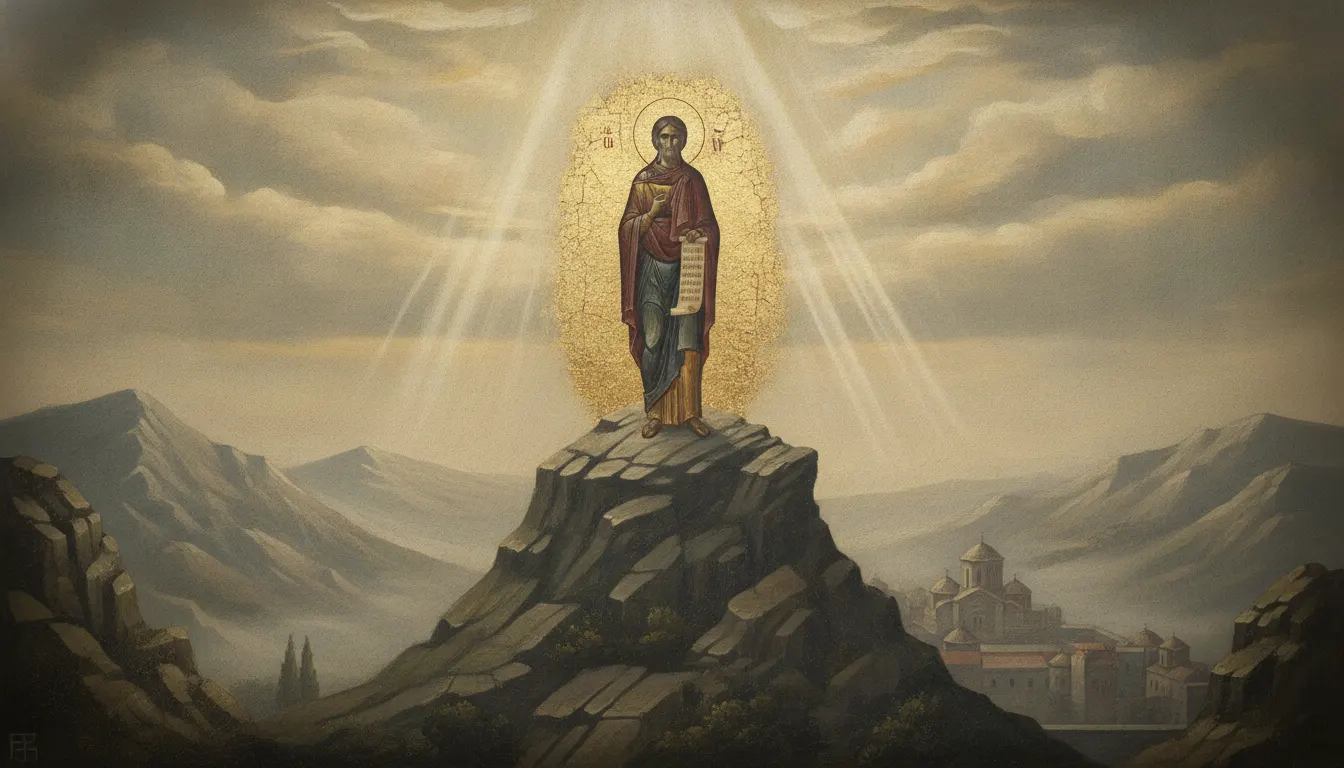
EUROPEAN EXTENDED · TRADITIONAL · GREECE
Greek Orthodox Icon (Gold Leaf)
Honoring the craft of Greek Orthodox icon-painting tradition from Byzantine to Mount Athos workshops. Egg tempera saints on gesso panel with hand-applied gold-leaf halo and lettered name scroll.
orthodoxicongold-leafbyzantine
LUT orthodox-icon-gold
WHEN TO USE
- Greek Orthodox liturgical and feast-day content where the gold-ground icon is the canonical visual form
- Byzantine art exhibition content, particularly for museum collections holding formal liturgical panels
- High-end religious art and sacred-object brand content referencing gold materiality and timeless craft
- Documentary content about icon-writing workshops, Mount Athos monastic tradition, or Cretan School painters
- Motion-graphics transitions and title cards for content on Orthodox theology, sacred music, or Byzantine history
- Luxury brand content where the burnished-gold-leaf texture signals supreme material refinement
WHEN NOT TO USE
- Casual or commercial contexts where deploying the gold-ground sacred image format would be disrespectful to Orthodox believers for whom it is a living liturgical object
- Content that treats the gold ground as generic 'vintage gold overlay' without theological acknowledgment
- Secular pop-culture content where the icon convention becomes ironic decoration
- Fast-paced social content that cannot hold the contemplative viewing rhythm the icon format demands
SIGNATURE TECHNIQUES
How the look is made.
The moves a human crew would use to get here. Cue applies them for you, and knowing their names is how you ask for a change.
- 0123
24 carat gold leaf burnished over red Armenian bole on a levkas gesso ground
- 02Compass
inscribed nimbus halos with incised cross patterns and Greek *O ON* inscription for Christ
- 03Egg
yolk tempera figures painted over and adjacent to gold ground with no illusionistic shadow
- 04Reversed perspective
architectural elements expand toward the viewer, denying spatial recession into the gold
- 05Flesh
tone build-up: sankir underpainting (green-brown) overbuilt with successively lighter highlight strokes
- 06Fine incised or raised gold relief (embossed borders, chrysography -- gold-line drapery highlights) on highest-grade pieces
- 07Greek inscriptions in red on gold ground, naming the holy figure at upper corners
HISTORY & CONTEXT
Where it comes from.
Greek Orthodox Icon Gold Leaf
The gold-ground icon is the apex form of Byzantine and Greek Orthodox panel painting -- the image most directly expressing the theology of divine, uncreated light. While ochre-ground icons serve devotional purposes throughout the Orthodox world, gold-leaf icons represent the formal liturgical standard: a portable, gleaming window into the eternal realm.
Gold as Theology
Gold in the Byzantine icon is not decorative -- it is theological. It represents the uncreated light of God (in Orthodox theology, the Tabor Light experienced by the Apostles at the Transfiguration, Mt. 17:1-9), a light that has no shadow and exists outside created time. The gold ground is therefore not a sky, not a space, not a background: it is the divine luminosity in which the holy figure is immersed. This is why Byzantine icons do not cast shadows. Andrei Rublev's Trinity (c. 1411, Tretyakov Gallery) is the most theologically analyzed gold-leaf icon in the tradition: its three identical angel figures (representing the three Persons of the Trinity) are arranged in a circular compositional rhythm around a chalice, with gold filling all spatial recession.
Technical Process
Gold-leaf application begins with the board preparation: a wooden panel (typically limewood or poplar, dried for years) is covered with linen, then built up with multiple layers of levkas (chalk-gypsum gesso, applied in 7-10 thin coats, each sanded). The gilding area is then coated with red Armenian bole (a clay bound in rabbit-skin glue), burnished to a mirror surface, dampened with dilute vinegar or alcohol, and the 23-carat or 24-carat gold leaf is laid and burnished with an agate stone. The burnished gold achieves a quality impossible with paint: actual light is reflected and refracted, making the halo and ground glow differently under every lighting condition.
Egg Tempera Over Gold
Once the gold is burnished, the figure is painted in egg tempera over and beside the gold, with the halo as the defining compositional element. Nimbus (halo) circles are inscribed with a compass and often decorated with an engraved or incised cross pattern. The halo of Christ specifically bears the Greek letters O ON (He Who Is) inscribed in the three arms of the cross.
Post-Byzantine Continuity
After the Ottoman conquest of Constantinople (1453), the Cretan School continued the gold-leaf tradition for over two centuries, exporting icons throughout the Orthodox world. Today, icon-painting schools on Mount Athos, in Athens, and in diaspora communities (from Melbourne to New York) maintain the levkas-and-gold-leaf technique with materials and methods unchanged in their essentials from the 6th century.
NOTABLE WORKS
Where you have seen it.
Andrei Rublev, Trinity (c. 1411) -- Tretyakov Gallery, Moscow, the definitive gold-ground theological icon
Duccio di Buoninsegna, Maesta (1308-11) -- Museo dell'Opera del Duomo, Siena, Italo-Byzantine gold-ground panel
Vladimir Mother of God (12th century Byzantine) -- Tretyakov Gallery, palladium of Russian Orthodoxy
Cretan School Deesis icons (15th-16th century) -- multiple collections, gold-ground tradition after 1453
Mount Athos Protaton Church frescoes by Manuel Panselinos (c. 1290) -- gold-ground monumental fresco ancestor
THE RECIPE
The exact knobs
the renderer turns.
A Look is not a filter. It is a set of stored decisions the pipeline reads before it makes a single frame, so two videos in the same Look actually match.
SettingValue
GradeColour LUT applied to every frame
orthodox-icon-goldTransitionHow one shot becomes the next
soft cuts · 380ms · ease-in-outKen BurnsCamera move applied to stills
Slow push · 0.02 · centerTypographyDisplay / body / mono pairing
Source Serif Pro · Lora · JetBrains MonoMusic moodWhat the bed under the voice sounds like
byzantine-chant · orthodox-vocal-dronePrompt suffixAppended to every shot prompt in this Look
inspired by Greek Orthodox icon painting tradition Byzantine Mount Athos, egg tempera saint on gesso panel, hand-applied gold leaf halo, lettered name scroll, devotional gravitasPALETTE
Primary
#C9A24A
Secondary
#1A1A1A
Accent
#7A1F0A
Text/Light
#1A140A
Text/Dark
#F2DCA8
BG 900
#0F0A05
BG 800
#1F1810
RELATED LOOKS
Next to it on the shelf.
Your first cut
is on us.
+ New videoFree plan · no card · 1080p export