EUROPEAN FOLK · BYZANTINE · GREECE
Greek Orthodox Icon
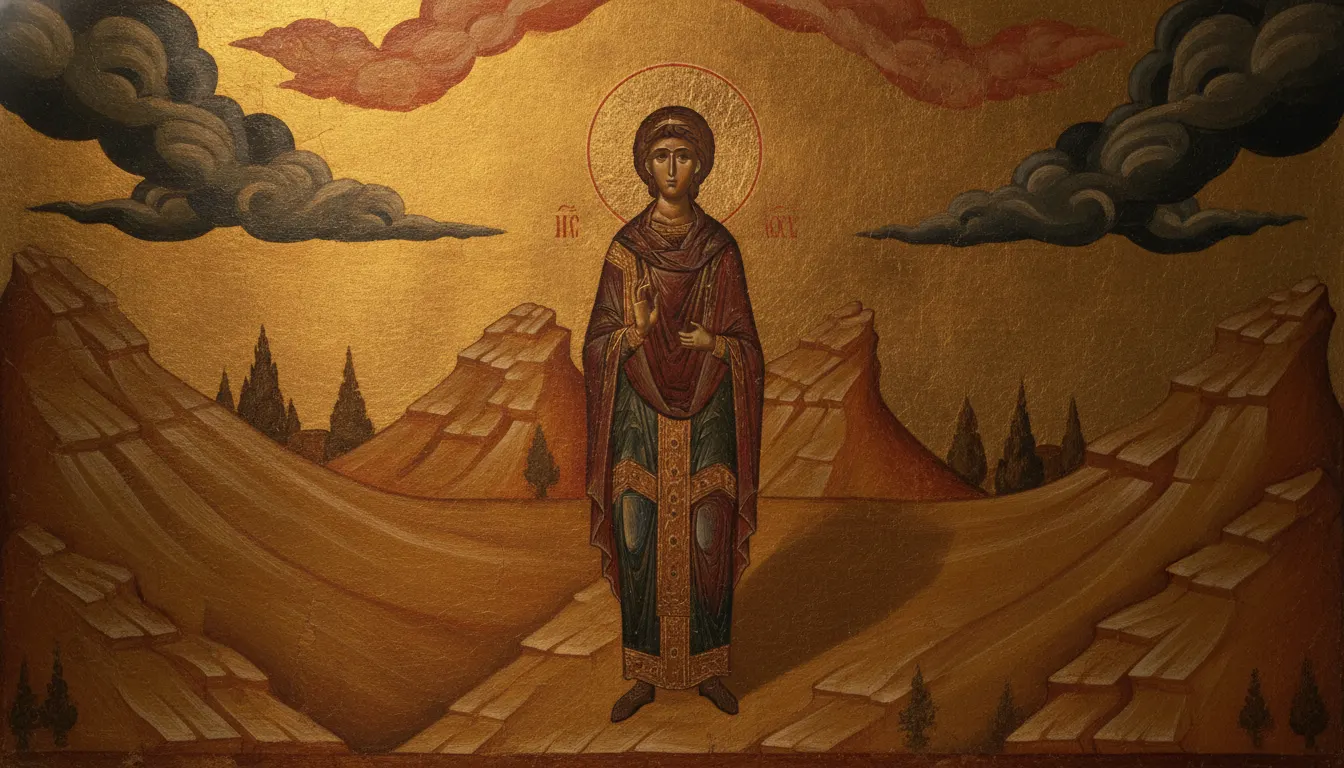
Inspired by the Greek and Byzantine Orthodox icon-painting tradition. Gold-leaf haloed saints in tempera on gessoed wood, hieratic frontal composition.
orthodoxbyzantinegreekicon
LUT orthodox-gold-tempera
WHEN TO USE
- Greek Orthodox and broader Eastern Christian community event content, church feast days, and liturgical celebrations
- Byzantine art exhibition and museum content, particularly for collections spanning 6th-15th century Mediterranean Christianity
- Documentary content about Greek cultural and religious heritage, pilgrimage, or monastic life
- Spiritual and meditative video content in the Orthodox Christian tradition
- Fine art content exploring the icon-painting revival and contemporary hagiography
- Branding for Greek cultural institutions, Orthodox theological seminaries, or Byzantine studies programs
WHEN NOT TO USE
- Secular or commercial contexts where the sacred register of the icon format would be disrespectful to Orthodox believers
- Generic 'vintage' or 'retro religious' aesthetics that strip the icon of its specific theological meaning
- Content for other Christian traditions that have distinct and different relationships to sacred imagery
- High-energy, fast-cut content formats incompatible with the contemplative visual pacing icons require
SIGNATURE TECHNIQUES
How the look is made.
The moves a human crew would use to get here. Cue applies them for you, and knowing their names is how you ask for a change.
- 01Frontal gaze
the holy figure looks directly out at the viewer as an act of spiritual encounter
- 02Reversed or inverted perspective
architectural and spatial elements expand toward the viewer
- 03Elongated facial canon
high forehead, long nose, small mouth, large almond eyes with straight brow
- 04Proplasmos underpainting (ochre/umber dark base) built up through successive lighter egg-tempera flesh layers
- 05Linear drapery highlights in pale gold or white over dark folds, non-naturalistic
- 06Greek name inscription in red ochre on the gold ground, naming the depicted holy figure
- 07Flat warm ochre or burnt
sienna ground for mid-range icons; gold leaf background for formal liturgical panels
HISTORY & CONTEXT
Where it comes from.
Greek Orthodox Icon
The Greek Orthodox icon (from Greek eikon, image) is one of the most theologically charged and visually distinctive art forms in the Christian tradition. Icon painting (hagiography, the writing of holy images) in the Greek Orthodox tradition descends directly from the Byzantine workshops of Constantinople, with a continuous practice stretching from the 5th century CE to the present day.
Theological Foundation
The Seventh Ecumenical Council at Nicaea (787 CE) settled the Iconoclasm controversy by affirming that icons are legitimate focuses of veneration (proskynesis) but not worship (latreia, reserved for God alone). This theological distinction shapes everything about how icons are made and used. The icon is not a portrait or a narrative illustration -- it is a window into the holy, a material participation in spiritual reality. This theology directly governs visual conventions: the holy figure looks out at the viewer (frontal gaze = encounter, not observation), natural illusionism is deliberately rejected (the image is of an eternal, transfigured body, not a mortal one).
Visual Conventions
Greek Orthodox icons follow a system of conventions (kanon) transmitted through iconographer's manuals (hermeneia). Faces are elongated, with high foreheads, long noses, small mouths, and large, direct eyes. Bodies are flattened. Drapery follows abstract linear patterns (highlights in thin, bright lines on dark grounds) rather than naturalistic folds. Perspective is reversed (objects farther from the viewer appear larger, drawing the eye toward the picture plane rather than into an illusionistic depth). Backgrounds are gold leaf (symbolizing divine light) or, in less expensive icons, flat ochre or warm ground. Halos are gold circles inscribed with Greek letters: O ON (He Who Is) on Christ icons.
The Egg Tempera Technique
Traditional icons are painted in egg-yolk tempera on wood panels sealed with gesso (levkas). The technique -- finely ground mineral pigments mixed with egg yolk, vinegar, and water -- produces colors of extraordinary stability and a slightly matte, luminous finish. The painting sequence moves from dark to light, building up flesh tones through multiple translucent layers (proplasmos underpainting, sankir midtone, then successive lighter highlights). Gold backgrounds are burnished gold leaf applied over a red bole ground.
Major Schools and Centers
The Cretan School (15th-17th centuries) produced the most influential post-Byzantine icon painting, centered on Crete after the fall of Constantinople in 1453. El Greco (Domenikos Theotokopoulos, born Crete 1541) was trained as a Cretan icon painter before moving to Venice and Toledo. Contemporary Greek icon painting centers include Mount Athos (the monastic peninsula in northern Greece, with an unbroken tradition since the 10th century), the Ionian Islands, and diaspora communities worldwide.
NOTABLE WORKS
Where you have seen it.
Vladimir Mother of God (early 12th century) -- Tretyakov Gallery, Moscow, Byzantine masterpiece venerated in Russia
Andrei Rublev, Trinity (c. 1411) -- Tretyakov Gallery, canonical Russian Orthodox icon descended from Byzantine convention
Cretan School, Assumption of the Virgin (15th century) -- multiple versions, defining post-Byzantine Cretan iconography
El Greco, The Dormition of the Virgin (c. 1567) -- Hermoupolis, Syros, bridge between Cretan icon tradition and Western manner
Mount Athos monastic frescoes (10th century-present) -- continuous living tradition of Byzantine mural and panel painting
THE RECIPE
The exact knobs
the renderer turns.
A Look is not a filter. It is a set of stored decisions the pipeline reads before it makes a single frame, so two videos in the same Look actually match.
SettingValue
GradeColour LUT applied to every frame
orthodox-gold-temperaTransitionHow one shot becomes the next
soft cuts · 380ms · ease-in-outKen BurnsCamera move applied to stills
Slow push · 0.02 · centerTypographyDisplay / body / mono pairing
Cormorant · Lora · JetBrains MonoMusic moodWhat the bed under the voice sounds like
byzantine-chant · orthodox-choirPrompt suffixAppended to every shot prompt in this Look
inspired by Greek Byzantine Orthodox icon painting tradition, gold leaf halo, tempera on gessoed wood panel, hieratic frontal saint with elongated facePALETTE
Primary
#7A1010
Secondary
#1A2A4A
Accent
#F5C144
Text/Light
#1A0808
Text/Dark
#FFE8A8
BG 900
#1A100A
BG 800
#2A1810
RELATED LOOKS
Next to it on the shelf.
Your first cut
is on us.
+ New videoFree plan · no card · 1080p export