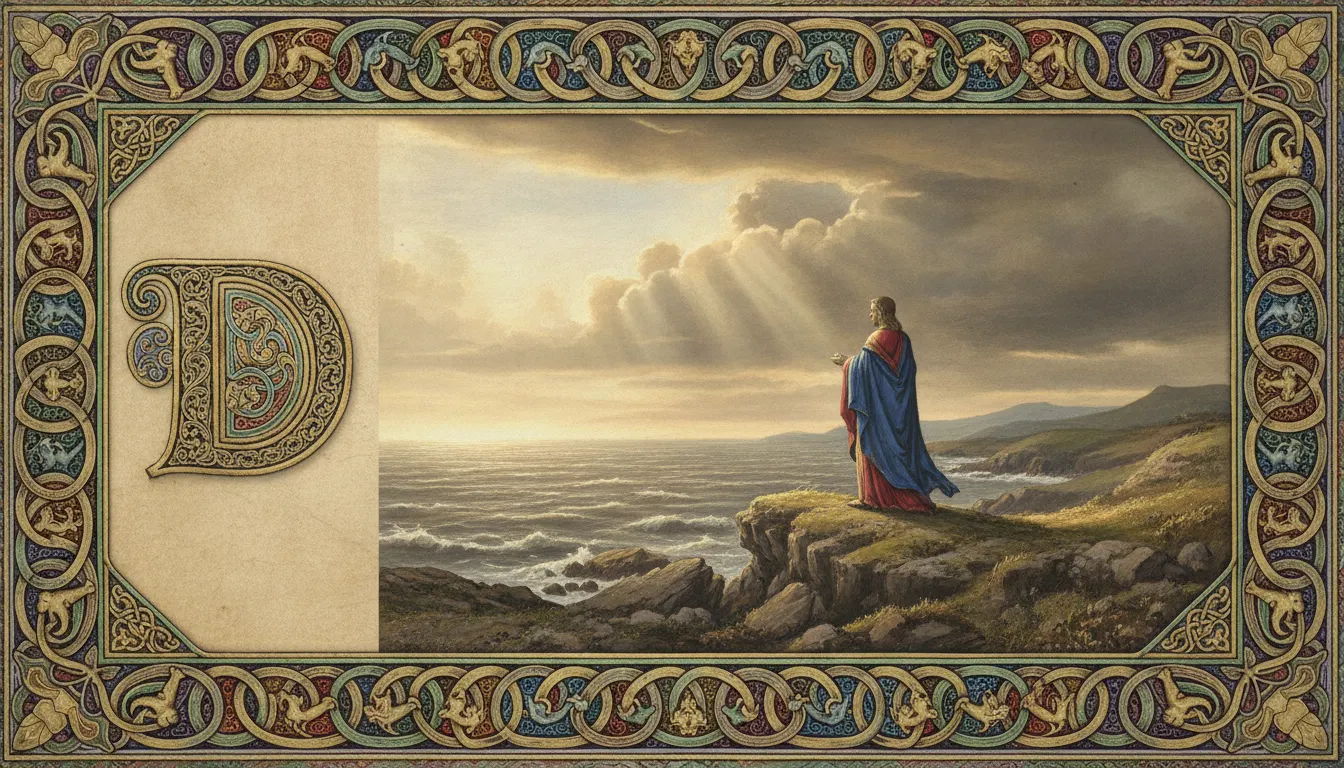
EUROPEAN EXTENDED · 800S · IRELAND
Irish Celtic Knot Illuminated Manuscript
In the tradition of Irish illuminated-manuscript design from the Book of Kells and Lindisfarne Gospels. Interlaced Celtic knot border, hand-lettered Insular majuscule, gilded initial cap.
celticilluminatedirishknotwork
LUT celtic-illuminated-vellum
WHEN TO USE
- Irish, Scottish, and broadly Celtic cultural heritage content -- festivals, St. Patrick's Day, cultural tourism
- Christian heritage and church anniversary content for denominations with Celtic or Insular monastic tradition
- Fantasy and mythology content drawing on Celtic legendary material (Arthurian, Ulster Cycle, Fenian Cycle)
- Animation and motion-design titles for content referencing medieval manuscript or monastic culture
- Heritage craft, whiskey, beer, and lifestyle brand content invoking Irish cultural depth
- Museum and exhibition content on Insular manuscripts, Celtic art, or medieval Christian book culture
WHEN NOT TO USE
- Generic 'fantasy medieval' content where the specifically Irish-Insular tradition would be collapsed into undifferentiated 'olde worlde' decoration
- Contemporary minimalist or tech brand contexts where the dense ornamental complexity would be tonally wrong
- Content that uses knotwork as generic 'tribal' pattern without Celtic cultural specificity
- Fast-paced social content formats that cannot hold the intricate visual detail -- knotwork needs time for the eye to trace
SIGNATURE TECHNIQUES
How the look is made.
The moves a human crew would use to get here. Cue applies them for you, and knowing their names is how you ask for a change.
- 01Plaitwork grid
derived endless knotwork: dots-and-diagonals construction system producing over-under interlace with no loose ends
- 02Triskele and double
spiral trumpet forms derived from La Tene Iron Age Celtic ornament
- 03Zoomorphic interlace
knotwork bands that terminate in or transform into elongated animal heads, feet, and tails
- 04Carpet Page format
full ornamental page with no text, organized as a cross within a rectangular frame
- 05Minium (red
orange), orpiment (yellow), verdigris (green), and black on vellum -- the Book of Durrow palette
- 06Lapis lazuli and ultramarine blue alongside expanded polychrome for Book of Kells-level luxury manuscripts
- 07Chi
Rho monogram as the central compositional vehicle -- the monogram erupting into dense ornamental field
HISTORY & CONTEXT
Where it comes from.
Irish Celtic Knot Illuminated
Hiberno-Saxon illuminated manuscripts -- the books produced in Irish and Northumbrian monastic scriptoria from approximately 600 CE to 900 CE -- represent one of the most sophisticated geometric art traditions in world history. Working on vellum with quill pens and mineral pigments, Irish monks created interlace knotwork of a complexity that has been compared to mathematical topology, embedding it within an intensely Christian theological program.
The Book of Durrow
The Book of Durrow (c. 680 CE, Trinity College Dublin) is the earliest surviving fully decorated Insular Gospel book. Its Carpet Pages (full pages of pure ornament, no text) introduce the visual vocabulary: spirals, step patterns, interlace, and zoomorphic (animal-body) interlace where the interlacing bands terminate in animal heads or feet. The palette is severely restricted: red-orange (from minium, red lead), yellow (orpiment), green (verdigris), and black on vellum. The restraint gives Durrow its austere clarity.
The Book of Kells
The Book of Kells (c. 800 CE, most likely produced at Iona Monastery and brought to Kells Abbey, County Meath, for safety from Viking raids) is the most complex and celebrated illuminated manuscript in existence. Its Chi-Rho page (folio 34r, the monogram of Christ) was described by Gerald of Wales in 1188 as the work of angels rather than men. The manuscript uses a palette of over 100 distinct pigments and dyes; analysis has identified lapis lazuli (from Afghanistan, via trade networks), orpiment, malachite, red lead, and ultramarine among others.
The Book of Kells is held at Trinity College Dublin and has been on continuous display since the 1950s. It draws approximately 500,000 visitors annually and is regarded as Ireland's greatest national treasure.
Celtic Knotwork Grammar
Celtic knotwork (plaitwork) is based on a grid system: a regular grid of dots, with diagonal lines drawn between them and then systematically broken and re-routed to create under-over interlacing patterns with no loose ends. The resulting endless-knot patterns symbolize eternity, interconnection, and (in the Christian context) the unity of the Trinity and the continuous thread of life. Spirals (derived from La Tene Iron Age Celtic art, pre-Christian) are incorporated as triskeles (three-armed spirals) and double-spiral trumpet forms. Zoomorphic interlace transforms the geometric bands into elongated animal bodies -- dogs, birds, serpents -- at key compositional nodes.
Cartoon Saloon and Contemporary Reach
The contemporary Irish animation studio Cartoon Saloon (Kilkenny, founded 1999) has produced a celebrated series of films -- The Secret of Kells (2009), Song of the Sea (2014), Wolfwalkers (2020) -- that directly reference the visual language of Hiberno-Saxon illumination, bringing the knotwork and spiral aesthetic to global cinema audiences.
NOTABLE WORKS
Where you have seen it.
Book of Durrow (c. 680 CE) -- Trinity College Dublin, earliest fully decorated Insular Gospel book
Lindisfarne Gospels (c. 715-720 CE) -- British Library, Northumbrian sister tradition, Carpet Pages of extraordinary precision
Book of Armagh (c. 807-808 CE) -- Trinity College Dublin, historical St. Patrick documents
Cartoon Saloon, The Secret of Kells -- Academy Award-nominated animation directly referencing Insular manuscript visual language
2009
Cartoon Saloon, Wolfwalkers -- BAFTA winner, the most visually sophisticated Cartoon Saloon/Celtic knot cinema work
2020
THE RECIPE
The exact knobs
the renderer turns.
A Look is not a filter. It is a set of stored decisions the pipeline reads before it makes a single frame, so two videos in the same Look actually match.
SettingValue
GradeColour LUT applied to every frame
celtic-illuminated-vellumTransitionHow one shot becomes the next
soft cuts · 360ms · ease-in-outKen BurnsCamera move applied to stills
Slow push · 0.02 · centerTypographyDisplay / body / mono pairing
Source Serif Pro · Lora · JetBrains MonoMusic moodWhat the bed under the voice sounds like
celtic-harp · uilleann-pipesPrompt suffixAppended to every shot prompt in this Look
inspired by Irish illuminated manuscript Book of Kells Lindisfarne tradition, interlaced Celtic knot border, hand-lettered Insular majuscule, gilded initial cap on vellumPALETTE
Primary
#1A4A2A
Secondary
#7A1F0A
Accent
#C9A24A
Text/Light
#1A140A
Text/Dark
#F2DCA8
BG 900
#0F0A05
BG 800
#1F1810
RELATED LOOKS
Next to it on the shelf.
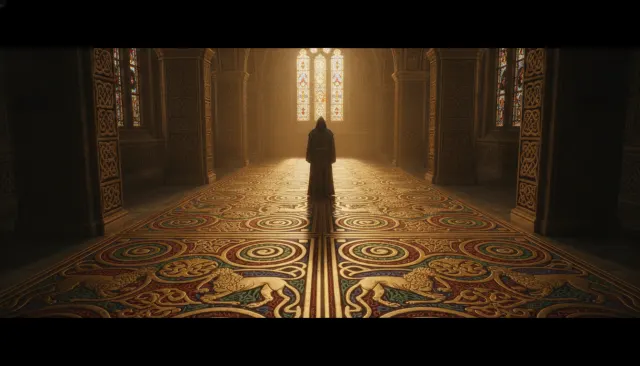 Historical Illuminated ExtendedBook of Kells Celtic Illuminated
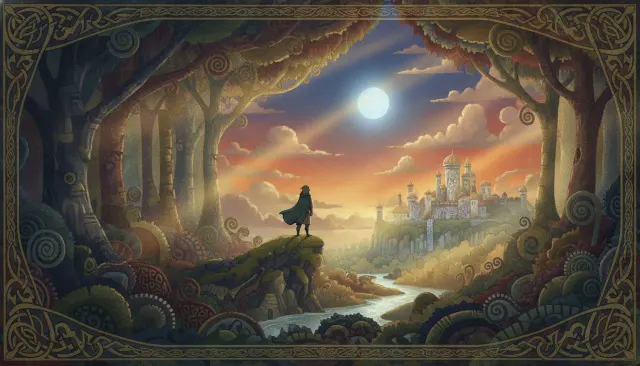 Indie Art AnimationCartoon Saloon Celtic Illuminated
 African ExtendedEthiopian Orthodox Cross Tradition
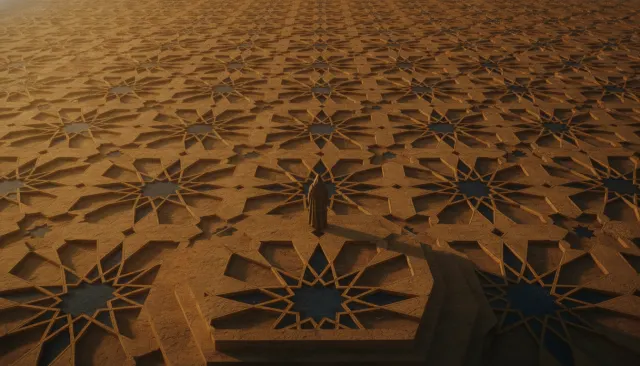 Middle Eastern North AfricanIslamic Geometric Girih Pattern
 European ExtendedGreek Orthodox Icon (Gold Leaf)
 Eastern HistoricalByzantine Icon Gold Leaf
Your first cut
is on us.
+ New videoFree plan · no card · 1080p export