MIDDLE EASTERN NORTH AFRICAN · TRADITIONAL · MIDDLE-EAST
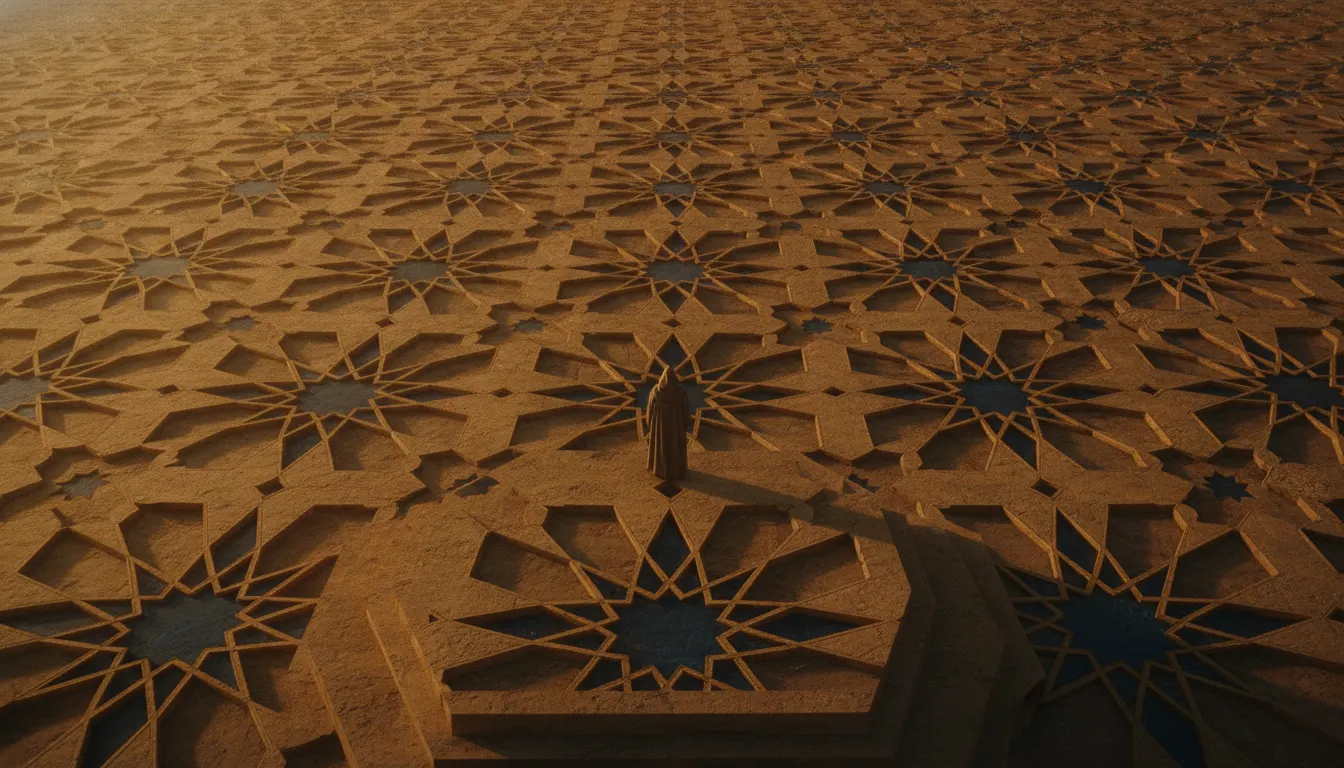
Islamic Geometric Girih Pattern
In the tradition of Islamic geometric girih design used across mosque architecture and manuscript illumination. Complex interlocking star and polygon tessellations.
girihislamicgeometrictessellation
LUT girih-tile-jewel
WHEN TO USE
- Islamic cultural heritage, mosque, and Ramadan event content
- Middle Eastern, North African, and South Asian architectural and interior design content
- Mathematical and scientific visualization content referencing the historical depth of Islamic geometry
- Luxury interior design, tile, and textile brand content referencing Arabesque and Alhambra-style ornament
- Animation and motion-graphic sequences where the infinitely tileable nature of girih patterns creates natural looping
- Cultural heritage tourism content for Iran, Morocco, Andalusia, Turkey, and other regions with major Islamic architectural heritage
WHEN NOT TO USE
- Secular tech or startup content where Islamic geometric ornament would be used as generic 'Middle Eastern' visual shorthand
- Content using only the surface pattern without acknowledging the mathematical and theological depth -- the patterns carry meaning
- Contexts that conflate Islamic geometric art with other geometric traditions (Celtic knotwork, Hindu yantra) without cultural specificity
- High-speed kinetic content where the intricate tiling logic cannot be visually registered by viewers
SIGNATURE TECHNIQUES
How the look is made.
The moves a human crew would use to get here. Cue applies them for you, and knowing their names is how you ask for a change.
- 01Five girih tiles generating infinite
plane star-polygon patterns: decagon, elongated hexagon, bow-tie, pentagon, rhombus
- 02Star
polygon vocabulary: 6-8-10-12-pointed stars as primary structural nodes connected by kite-and-rhombus field tiles
- 03Two
level self-similar structure: large-scale scaffold tiles generating small-scale surface pattern (quasiperiodic logic)
- 04Muqarnas integration
two-dimensional geometry translated into three-dimensional stalactite vault geometry
- 05Zellige mosaic execution
hand-cut terracotta tiles in earthy red, cobalt, white, black, and turquoise
- 06Thuluth/Kufic calligraphy integrated with geometric pattern in borders and medallions
- 07Arabesque (rumi/islimi) vegetal scrollwork as tertiary ornament filling non-geometric residual spaces
HISTORY & CONTEXT
Where it comes from.
Islamic Geometric Girih Pattern
Islamic geometric ornament is one of the most intellectually and visually sophisticated decorative traditions in world art. The girih (Persian for 'knot' or 'grid') system -- a specific method of generating geometric tile patterns using a set of five interlocking polygon tiles -- represents the apex of this tradition, and its complexity was not fully understood by Western mathematics until Peter Lu and Paul Steinhardt published their analysis in Science in 2007, demonstrating that some 13th-century Islamic architectural surfaces contain aperiodic (quasiperiodic) patterns structurally identical to the Penrose tilings independently discovered by Roger Penrose in 1974.
Why Figural Art Was Replaced
Islamic decorative arts developed an unprecedented emphasis on geometric ornament partly due to the Hadith traditions cautioning against depiction of living forms in sacred contexts (though this interpretation varied greatly across time, region, and denomination). The prohibition directed artistic energy toward geometric pattern, calligraphy, and arabesque (vegetal scrollwork). The result was not a limitation but an explosion of geometric invention, as craftsmen and mathematician-designers pushed the logic of symmetry and infinite-plane tiling further than any other tradition.
The Five Girih Tiles
The girih system uses five shapes: a regular decagon (ten-sided polygon), an elongated hexagon, a bow-tie/chevron, a regular pentagon, and a rhombus. Each tile has lines inscribed on its face that, when tiles are assembled, produce the continuous star-polygon pattern visible on the surface. This two-level system -- a hidden scaffolding of large tiles, a visible pattern of star-polygons -- is the key insight. Major examples are found at:
- Darb-i Imam shrine, Isfahan, Iran (1453 CE) -- analyzed by Lu and Steinhardt as containing perfect quasiperiodic tiling
- Gunbad-i Qabud (Blue Tower), Maragheh, Iran (1197 CE) -- 13th-century precursor documented in the 2007 Science paper
- Alhambra Palace, Granada, Spain (1238-1358 CE) -- the most visited Islamic geometric ornament site, with the full range of 17 crystallographic symmetry groups represented across its tile and plaster work
Geometric Elements
The visual vocabulary of Islamic geometric art is built on star polygons: six-pointed stars (hexagram), eight-pointed stars, ten-pointed stars, twelve-pointed stars, and sixteen-pointed stars, generated by rotating and overlapping regular polygons. Muqarnas (stalactite vaulting) translate the two-dimensional geometry into three-dimensional carved plaster or stone. Zellige (mosaic tile work) in Morocco and Andalusia uses hand-cut terracotta tiles in the same geometric vocabulary.
NOTABLE WORKS
Where you have seen it.
Darb-i Imam shrine, Isfahan, Iran (1453 CE) -- analyzed as containing perfect quasiperiodic girih tiling
Gunbad-i Qabud (Blue Tower), Maragheh, Iran (1197 CE) -- earliest documented girih pattern in Peter Lu / Paul Steinhardt analysis
Dome of the Rock interior mosaics, Jerusalem (c. 692 CE) -- earliest major Islamic geometric surface program
Shah Mosque (Masjid-i Shah), Isfahan (1611-1629 CE) -- UNESCO site, supreme example of Safavid tile geometry
Peter Lu and Paul Steinhardt, 'Decagonal and Quasi-Crystalline Tilings in Medieval Islamic Architecture', Science
2007
THE RECIPE
The exact knobs
the renderer turns.
A Look is not a filter. It is a set of stored decisions the pipeline reads before it makes a single frame, so two videos in the same Look actually match.
SettingValue
GradeColour LUT applied to every frame
girih-tile-jewelTransitionHow one shot becomes the next
soft cuts · 300ms · ease-in-outKen BurnsCamera move applied to stills
Slow push · 0.02 · centerTypographyDisplay / body / mono pairing
Cormorant · Inter · JetBrains MonoMusic moodWhat the bed under the voice sounds like
oud-classical · ney-flutePrompt suffixAppended to every shot prompt in this Look
inspired by Islamic geometric girih pattern tradition, complex interlocking star and polygon tessellation, infinite tile pattern, mosque architecture or manuscript illuminationPALETTE
Primary
#0E5C9A
Secondary
#1A4A2A
Accent
#F5C144
Text/Light
#0A1A24
Text/Dark
#FFE8A8
BG 900
#08141A
BG 800
#0F1F26
RELATED LOOKS
Next to it on the shelf.
Your first cut
is on us.
+ New videoFree plan · no card · 1080p export