SOUTH SOUTHEAST ASIAN · TRADITIONAL · INDIA
Warli Tribal Painting (Maharashtra)
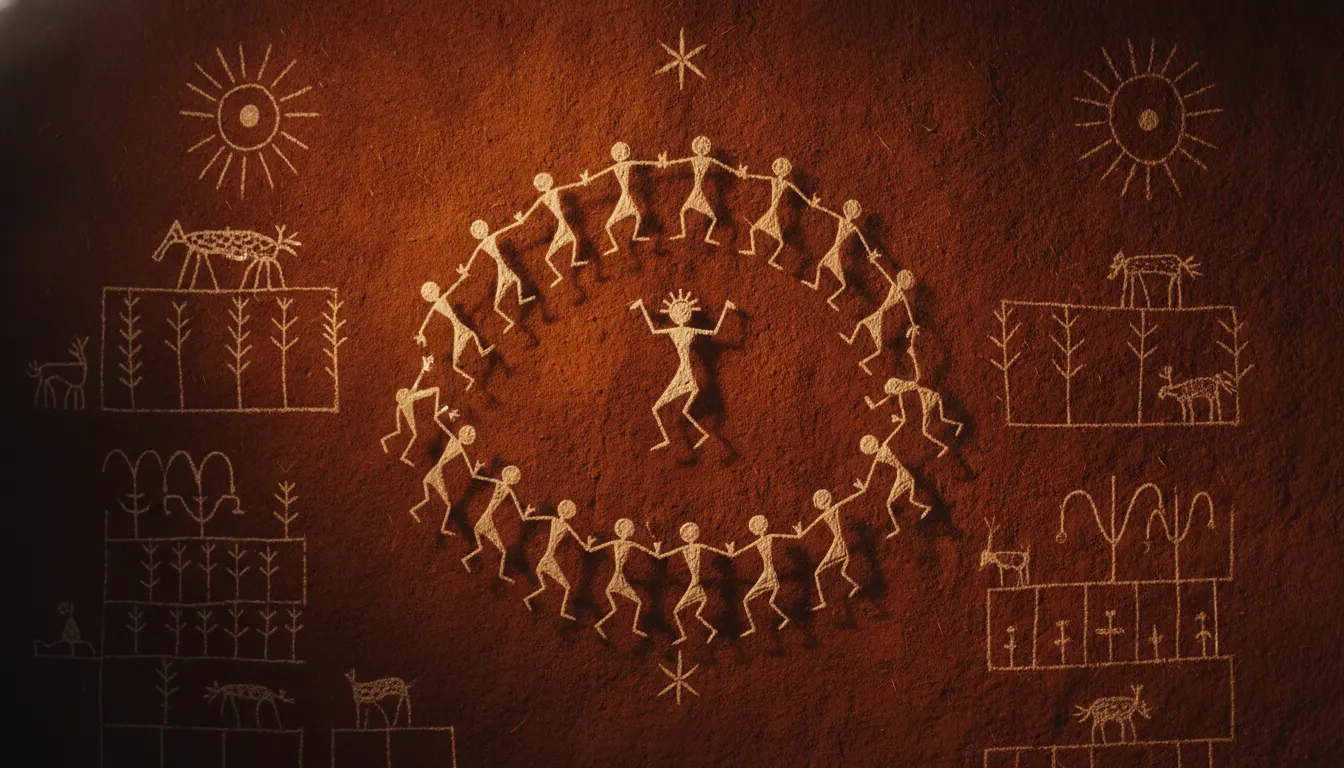
In the tradition of Warli tribal mural painting from Maharashtra, India. White rice-paste stick figures in dance and harvest scene on red ochre mud wall.
warlitribalindianstick-figure
LUT warli-ochre-rice
WHEN TO USE
- Indian Adivasi, tribal, and indigenous cultural heritage content -- especially Maharashtra-focused
- Ritual, ceremony, and festival content referencing Warli wedding and harvest traditions
- Environmental and nature-connection content where the Warli earth-material palette signals organic belonging
- Corporate and community events in India where Warli motifs are used to signal cultural roots and craft heritage
- Documentary content about Indian tribal art, indigenous knowledge, or the 1970s folk-art revival
- Minimalist geometric pattern design that wants cultural depth behind the reduced visual vocabulary
WHEN NOT TO USE
- Content that uses Warli patterns as generic 'tribal decoration' without acknowledging the Adivasi community origin
- Luxury brand content where the earth-and-rice-paste simplicity would be tonally inconsistent with premium positioning
- Complex narrative content requiring detailed figural representation -- the geometric minimalism limits expressive range
- Contexts where widespread commercial adoption of Warli imagery has already depleted its distinctiveness (generic Indian corporate event signage)
SIGNATURE TECHNIQUES
How the look is made.
The moves a human crew would use to get here. Cue applies them for you, and knowing their names is how you ask for a change.
- 01White rice
paste figures on ochre-red mud ground -- two-material palette dictated by available ritual materials
- 02Geometric body construction
two triangles meeting at apex forming torso and legs, circle for head
- 03Chauk (central ritual square or circle) framing the sacred center of ceremonial compositions
- 04Tarpa dance rings
circular compositions of figures linked hand-to-hand around a central musician
- 05Concentric
register composition expanding outward from the chauk through agricultural and natural scenes
- 06Same geometric vocabulary for humans, animals, trees, and architecture -- radical visual unification
- 07Bamboo
twig brush applied rice paste: slightly irregular edges and texture distinguishing hand-made from printed reproduction
HISTORY & CONTEXT
Where it comes from.
Warli Tribal Painting Maharashtra
Warli painting is the visual tradition of the Warli (also spelled Varli) Adivasi people of the Sahyadri range of the Western Ghats, primarily in the Palghar district of northern Maharashtra, with communities extending into Gujarat and Dadra and Nagar Haveli. The Warli are one of the largest tribal groups in the Maharashtra-Gujarat border region, with a population of approximately 300,000.
Ritual Origins
Traditional Warli painting was created by women on the interior mud walls of houses for specific ritual occasions -- most importantly on the walls of the wedding chamber (nuptial chamber painting is called lagna chowk). Paintings were made using a paste of rice flour and water applied with a chewed-bamboo or twig brush on a ground of red earth (geru) and cow-dung plastered walls. The limited palette was entirely dictated by available materials: white rice paste on ochre-red-brown ground, with occasional black from charred wood.
Jivya Soma Mashe and Male Practice
In the Warli tradition, religious painting was primarily a female domain. Men painted only ritual objects and festival items. This changed significantly through Jivya Soma Mashe (born c. 1934, Ganjad village, Maharashtra), who began painting Warli imagery on paper in the early 1970s and is credited with establishing the tradition as a recognized fine-art and commercial-craft form. He received the Padma Shri in 2011 and the National Award for Tribal Art. His son, Balu Mashe, continues the practice. The 1975 exhibition curated by Dr. Haku Shah at the Bharat Bhavan foundation was instrumental in bringing Warli to national and international attention.
Visual Grammar
Warli painting uses a severely restricted geometric vocabulary: triangles (representing both human bodies and mountains -- body triangles are joined at their apexes for a stick-figure human), circles, and squares. Figures are constructed from two triangles meeting at the waist: one pointing up (torso) and one pointing down (legs). The chauk (central ceremonial square) is the organizing composition for ritual pieces, with Palghat (the Warli fertility goddess) at center, surrounded by concentric registers of figures, animals, and patterns.
Scenes depicted include tarpa dances (circular dances around a musician playing a wind instrument), agricultural work, hunting, wedding ceremonies, and the figures of Hirva (deity of the green world), Palghat, and Pandit Bapudev. Animals -- horses, deer, peacocks, fish, birds -- are depicted with the same geometric reductivism as human figures.
Contemporary Reach
Warli imagery has been adopted extensively in Indian commercial design, advertising, textiles, and urban muralism, to the point where 'tribal' Warli patterns appear on everything from restaurant walls to corporate event programs. This widespread adoption has raised questions about attribution and fair compensation for Adivasi artists.
NOTABLE WORKS
Where you have seen it.
Haku Shah's 1975 documentation and exhibition -- Bharat Bhavan foundation, institutional legitimization of Warli fine art
Balu Mashe contemporary works -- continuing his father Jivya's lineage
Tribal Research Institute, Pune -- largest Maharashtra government archive of documented Warli ritual wall paintings
NGMA Mumbai and National Crafts Museum Delhi -- significant Warli holdings in national collections
THE RECIPE
The exact knobs
the renderer turns.
A Look is not a filter. It is a set of stored decisions the pipeline reads before it makes a single frame, so two videos in the same Look actually match.
SettingValue
GradeColour LUT applied to every frame
warli-ochre-riceTransitionHow one shot becomes the next
soft cuts · 320ms · ease-in-outKen BurnsCamera move applied to stills
Slow push · 0.025 · centerTypographyDisplay / body / mono pairing
Lora · Inter · JetBrains MonoMusic moodWhat the bed under the voice sounds like
tarpa-pipe · tribal-drumPrompt suffixAppended to every shot prompt in this Look
inspired by Warli tribal painting tradition Maharashtra India, white rice paste stick figures, circle dance and harvest scene, red ochre mud wall backgroundPALETTE
Primary
#A0522D
Secondary
#5C3A1E
Accent
#F5F1E8
Text/Light
#1F1208
Text/Dark
#F5F1E8
BG 900
#1A100A
BG 800
#2A1810
RELATED LOOKS
Next to it on the shelf.
Your first cut
is on us.
+ New videoFree plan · no card · 1080p export