Kenojuak Ashevak, The Enchanted Owl -- National Gallery of Canada; appeared on 1970 Canada Post stamp
1960
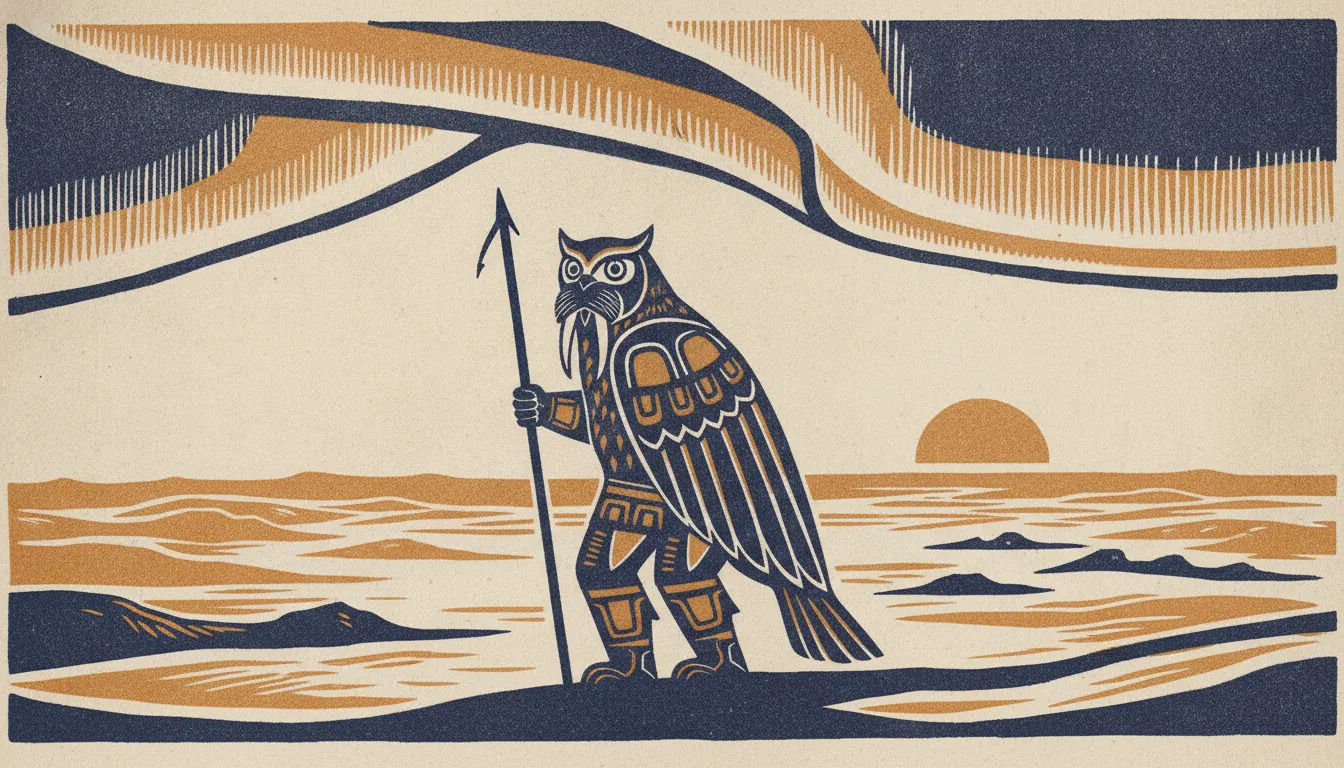
Inspired by the Cape Dorset Kinngait Inuit stone-cut and stencil printmaking tradition. Flat silhouette of owl, walrus, hunter, and shaman in bold ochre and indigo on cream.
The moves a human crew would use to get here. Cue applies them for you, and knowing their names is how you ask for a change.
cut silhouette with high-contrast black or color on cream washi (Japanese mulberry paper) ground
carved soapstone or limestone block creating slight variations in edge quality and ink density
symmetrical wing/body compositions -- Kenojuak Ashevak's defining organizational grammar
over surface patterning of feathers, scales, and fur using repeated incised line clusters
owls, caribou, bears, seals, narwhals, geese as primary figurative vocabulary
stone color registration for polychrome editions: colors printed sequentially from separate carved stones
- no shading, no cast shadow, no volumetric modeling
Inuit printmaking -- particularly the stone-cut (stonecut) technique developed on Baffin Island -- is one of the most internationally recognized indigenous art movements of the 20th century. The tradition began in 1959 at Cape Dorset (Kinngait), Nunavut, Canada, under the facilitation of James Houston, a Canadian artist and government administrator who recognized the exceptional graphic sensibility of the Inuit carvers and drawers he encountered there.
Houston organized the West Baffin Eskimo Co-operative (now Kinngait Co-operative, founded 1959) to provide a sustainable economic structure for the art production. Artists would draw or carve designs; studio workers would cut the image into a flat stone (initially local Arctic soapstone and later imported printing stones) and print it by hand on Japanese mulberry paper (washi) using water-based inks. Each print in an edition is slightly different from hand-pulling. The first Cape Dorset Annual Print Collection was released in 1959 and sold internationally within months, establishing a model of Indigenous art-market success that has been studied as a template.
Kenojuak Ashevak (1927-2013) is the most internationally recognized Cape Dorset artist. Born in an outpost camp near Baffin Island, she began drawing in 1958 at Houston's suggestion. Her 1960 stone-cut print The Enchanted Owl -- a large owl with elaborately patterned, symmetrically spread wings rendered in flat silhouette -- appeared on a 1970 Canada Post stamp and became one of the most reproduced images in Canadian art history. She was appointed Companion of the Order of Canada (1982), received two honorary doctorates, and was the subject of the NFB documentary Kenojuak (1963). Her work is held by the National Gallery of Canada, the British Museum, and museums internationally.
The stonecut technique produces images defined by flat silhouette, strong value contrast, and the slight textural variation of hand-inking on hand-cut stone. Early prints were black-ink on white or cream paper. Color printing (using multiple stones, one per color, carefully registered) developed through the 1960s. The imagery is primarily Arctic wildlife -- owls, caribou, bears, seals, narwhals, fish, geese -- and human figures (hunters, shamans, women with children). The compositions are often symmetrical or near-symmetrical, with a tendency toward all-over decorative patterning of wing feathers, fish scales, and animal fur.
Stencil printing (pochoir using sealskin stencils), engraving on copper, and lithography also developed at Cape Dorset and other Arctic cooperatives (Baker Lake/Qamanituaq, Pangnirtung). Baker Lake is particularly known for graphic imagery referencing Inuit spiritual life and shamanic transformation.
1960
A Look is not a filter. It is a set of stored decisions the pipeline reads before it makes a single frame, so two videos in the same Look actually match.