Liza Lou, Kitchen (1991-1996)
five years and 30 million glass beads, Tate Modern collection
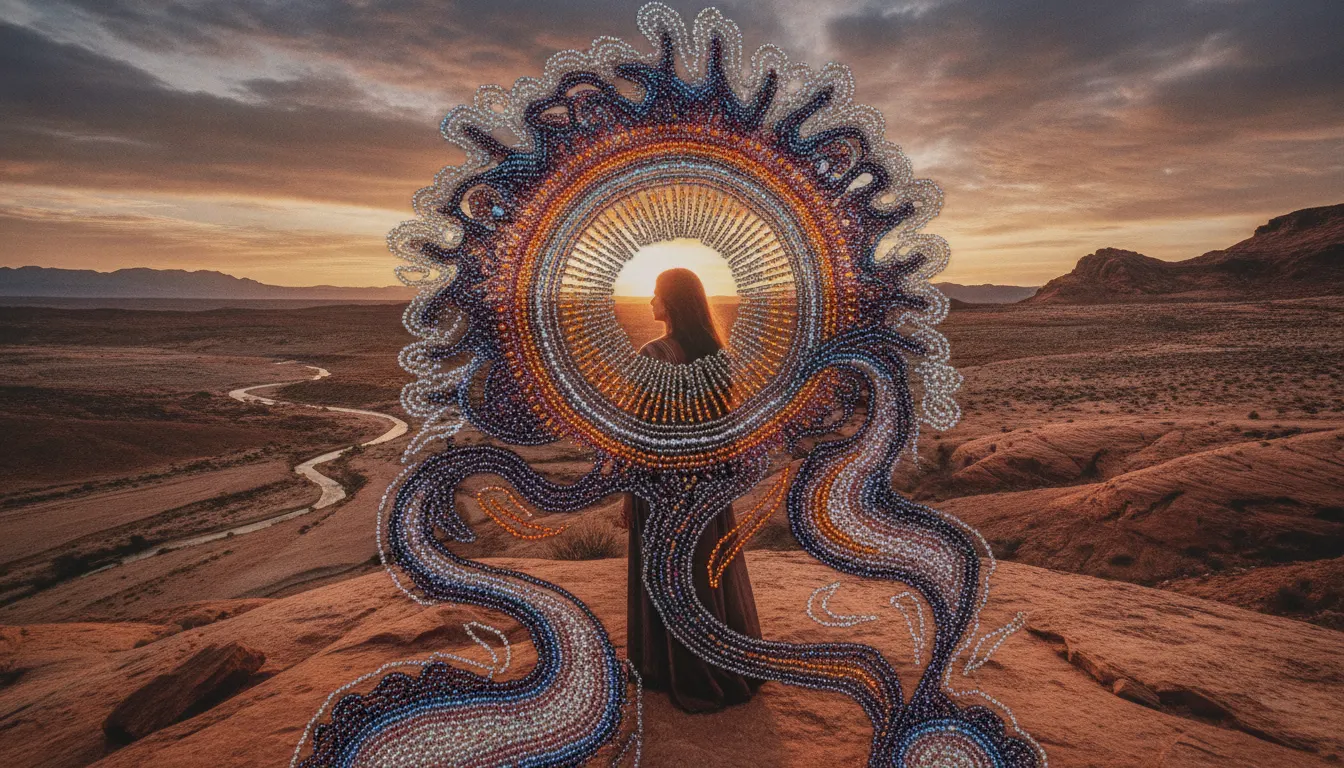
Photographic portrait with beadwork overlay. Glass seed beads sewn directly through printed photo, beaded halo or pattern field, contemporary craft-portrait fusion.
The moves a human crew would use to get here. Cue applies them for you, and knowing their names is how you ask for a change.
surface macro photography showing individual bead facets and threading patterns
rake animation slowly moving light across bead surfaces to activate shimmer and spatial depth
pixel color mapping organizing bead colors to resolve into photographic imagery at viewing distance
beads applied directly over photographic prints, partially obscuring the image below
traditional geometric beadwork patterns framing or containing photographic content
Beadwork art photo mix merges the dense, light-catching surface of beadwork - thousands or millions of individual glass, seed, or acrylic beads - with photographic imagery. The result is tactile in a way photography cannot achieve alone: pixel-like bead surfaces create a divisionist mosaic quality, each bead a discrete unit of color that together resolves into recognizable image. At distance the image reads; close-up the individual beads and their threading patterns dominate.
Liza Lou is the definitive reference: her Kitchen (1991-1996, now at Tate Modern) required five years of work to cover an entire domestic kitchen in 30 million glass beads. Every surface - dishes, sink, food, appliances - is encrusted in bead detail. Lou's practice demonstrates the extreme end of the aesthetic: not beads over photography but beads substituting for photographic realism, creating hyper-detailed surfaces that exceed photography's grain.
Hank Willis Thomas works at the intersection of photography and material culture: his Branded series (2003+) uses photographs of Black men bearing brand logos (Adidas stripes as scar tissue, for instance) and his later work incorporates reflective and bead surfaces into photographic prints. Thomas's interest in the commodification of Black culture extends naturally into beadwork's associations with global craft traditions and colonial economies of decorative labor.
Contemporary Indigenous beadwork artists including Christi Belcourt (Métis, Canada) and Jamie Okuma (Luiseño/Shoshone-Bannock) incorporate photographic reference into large-scale beadwork that addresses land, sovereignty, and cultural memory. Their work is strictly beadwork-as-primary-medium, but the photographic-realism of the resulting bead surfaces makes the photo-bead aesthetic explicit.
The aesthetic is defined by texture density and light response. Beads catch and scatter light differently from any other medium: each bead is a tiny convex lens. In video, moving light across a bead surface produces a shimmering, kinetic quality impossible to replicate digitally without specific rendering. The pixel-bead analogy is visually apt but misleading in motion: pixels are static while beads pulse and shift with ambient light changes.
five years and 30 million glass beads, Tate Modern collection
beaded domestic outdoor scene
photography addressing commodity culture and Black male bodies
pioneer combining beads, race, and the body
bead and material suits with photographic documentation
A Look is not a filter. It is a set of stored decisions the pipeline reads before it makes a single frame, so two videos in the same Look actually match.