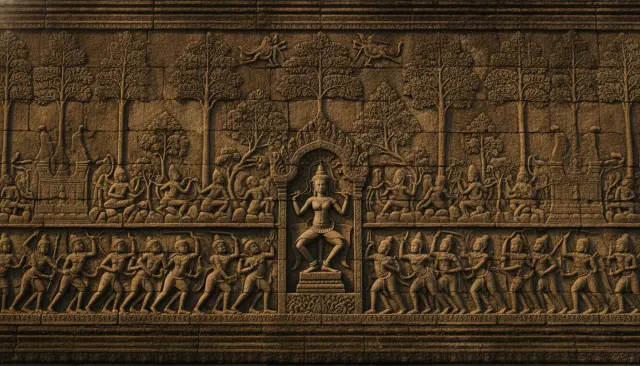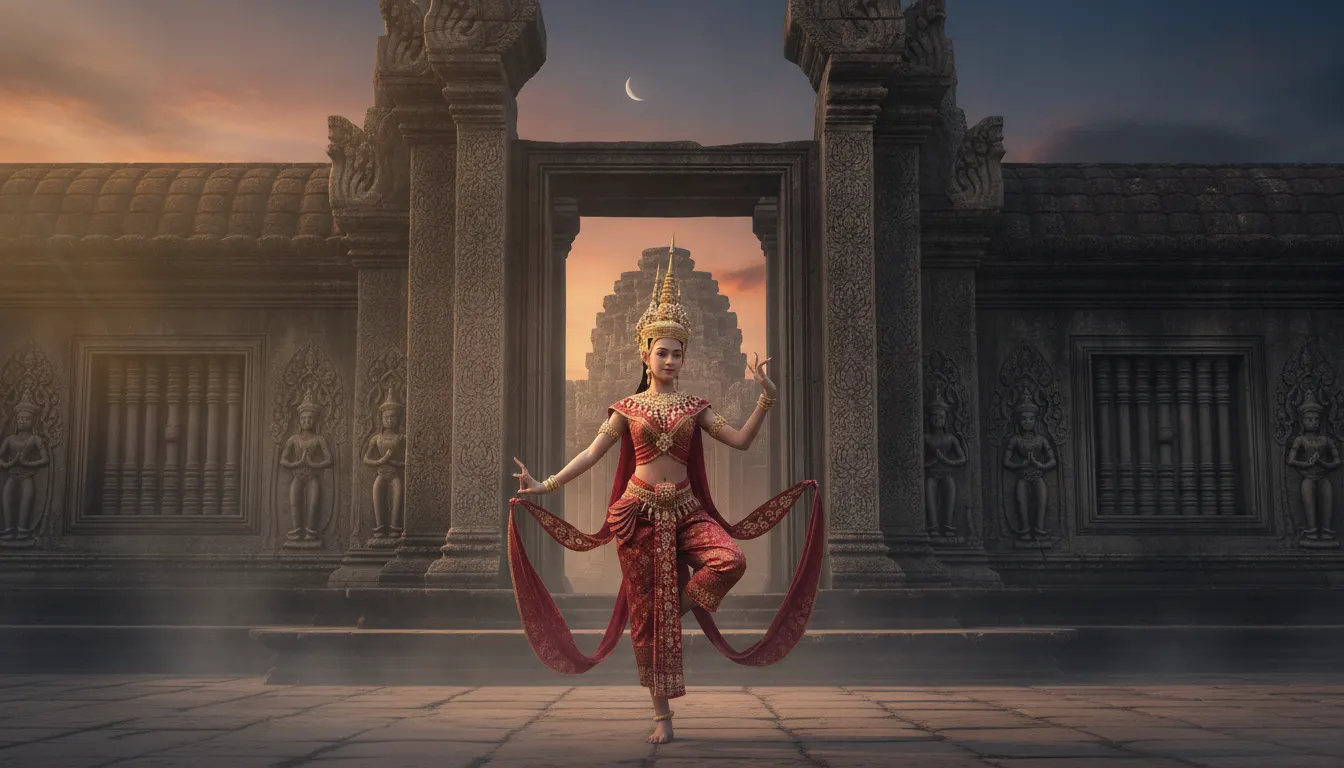
Angkor Wat bas-relief apsara gallery (1113-1150 CE)
over 1,700 individual apsara carvings in stone
Inspired by Cambodian classical Apsara dance imagery painted in royal Khmer court tradition. Stylized celestial dancer in gilded headdress and ornate silk costume, lotus-stamped backdrop.
The moves a human crew would use to get here. Cue applies them for you, and knowing their names is how you ask for a change.
knee dance stance with dramatically articulated bent-back fingers (*kbach*)
tip finial and layered decorative bands
tone silk garments: royal blue, emerald, crimson, and gold in overlapping layers
lotus-capital pillars, decorative kala faces, flame-pediment framing
layered collar, armlets, anklets, and earstuds depicted in fine line
to-gold skin tone derived from stone carving translation into pigment
quarter pose with no foreshortening – flat spatial treatment
In the tradition of Cambodian classical dance painting, this look draws on the visual representation of the apsara – the celestial nymphs of Hindu-Buddhist cosmology who dance in the heavens and whose earthly embodiment is the robam kbach boran (classical Khmer dance) tradition performed by the Royal Ballet of Cambodia.
Apsaras – divine female beings of clouds and water in Hindu mythology – were depicted in stone bas-relief at Angkor Wat from the 12th century onward (over 1,700 unique apsara carvings have been identified at Angkor Wat alone). The living dance tradition translates these stone gestures into performance: the extreme finger-and-wrist articulations (kbach), the turned-out hip stance, the conical mokot headdress, and the dense layered silk costume of the stage apsara echo the stone figures directly.
The court dance of Cambodia (lakhon luong) was maintained by the royal household and nearly destroyed by the Khmer Rouge (1975-1979), which killed an estimated 90% of the country's traditional artists. The reconstruction of the tradition by surviving masters – particularly Chea Samy, Princess Norodom Buppha Devi, and their students at the Royal University of Fine Arts in Phnom Penh – is one of the extraordinary cultural survivals of the 20th century.
Contemporary apsara painting as a commercial and fine-art tradition developed strongly in the post-1980s reconstruction period, with artists like Vann Nath (better known for his Tuol Sleng survivor paintings) and younger Phnom Penh gallery artists producing works depicting classical dance poses, temple performance settings, and individual dancer portraits.
Apsara dance painting employs a warm, jewel-toned palette: deep gold and ochre for skin tones; brilliant red, royal blue, and emerald green for silk garments; white and cream for the layered sampeg (wrapped skirt); and intricate gold phet (jewelry) details. Backgrounds typically reference Angkorian stone architecture: pillar capitals, lotus-bud towers, decorative kala faces, and flame-tipped pediments. Figures are rendered with elongated, graceful proportions, the dancer's bent-back fingers forming precise mudra gestures.
over 1,700 individual apsara carvings in stone
apsara and classical dance paintings, Phnom Penh (post-1990s)
Princess Norodom Buppha Devi's repertoire reconstruction photographs (1980s-90s)
transmission of classical dance knowledge, Royal University of Fine Arts, Phnom Penh
classical dance mask and costume collections
Khmer classical dance registered 2008, extended 2015
A Look is not a filter. It is a set of stored decisions the pipeline reads before it makes a single frame, so two videos in the same Look actually match.